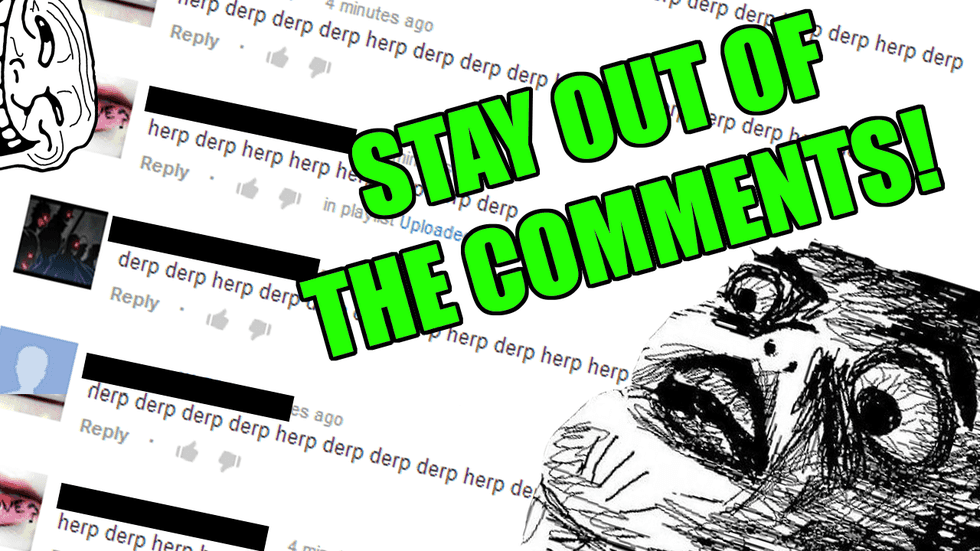
The comment section can quickly become the cesspool of any online community, destroying the confidence of not only the people who appear in the content that they’re all there to watch but those who want to talk about it as well. Unfortunately, this problem worsens if you let the local wildlife know you’re a girl; or black; or gay; or a white guy; human, really. If everyone uses their Facebook profiles to comment, the conversation can get a little hairy. However, it is tame when compared to threads where everyone’s names have just as many numbers and symbols as letters in them.
Anonymity robs online society of real-life society’s most powerful tool: shame. If someone has a dated opinion—wants to shout a racial slur in public, for instance—they don’t. If they do, they get in trouble. The punishment, if not the loss of something like a job, is the shame of knowing that people heard what you said. Everyone is afraid of becoming “that guy.” Nobody wants to be “that guy.”
That guy is the one who claims that Hitler actually did a lot of good for the world. That guy thinks that women joining the workforce is what’s wrong with today’s youth. That guy wears sunglasses in a bar at night.
I’ve seen a man with no shame, that guy, at Fresno State. He stands in the Free Speech Area with a Bible in his hand and spits fire and brimstone at us passing heathens just trying to get to class. The homosexuals are the great evil, Barack Obama is the anti-Christ and this guy just knows all of us debaucherous college students are going to Hell.
He personally doesn’t care what we think about him, but his message is null and void because he has been marginalized by the rest of us. He is that guy. He is always talked about in a negative light and has become a great conversation piece. No one agrees with him. If they did, they would have to join him on his little backward island and together they’d become those guys.
Racist, sexist and otherwise terrible ideas are slowly crushed as generations progress by what is acceptable in society.
Society’s power to punish through marginalizing is taken away when no one has a face or a real name. Even worse, a destructive comment with a slur or other horrible thing to say—usually in all caps—suddenly finds support when no one is afraid to agree. That guy doesn’t exist anymore. That guy could be any of us.
In a way the anonymity found online is bad because it lets us be ourselves. It’s why we have norms in real-life because everyone’s afraid to let everybody else know they’re a freak. We move in a herd because those that don’t die.
In some instances, this is a good thing. When you have people that don’t understand the power that they wield casually trying to inspire suicide, not so much. You don’t see the human being you just called something you would never even think in real life, all you see is a little photo of a troll face next to fl@m1ngPOTATO420.
Out here in the real world when somebody says, “I’m a Republican,” another will shake their head and ask, “Why?” The debate can get heated, but it only gets as far as somebody accused of being part of the problem.
On the internet if some poor soul is dumb enough to let their political orientation slip it’s met with things like, “I hope you die in a fiery car crash,” and “I bet you’re a [insert racial slur],” or the old tried and true staple of venomous online rhetoric: “Kill yourself.” These, of course, come in many colorful varieties, often garnished with a plethora of four-letter words.
Online anonymity creates false courage, perpetuating terms that usually end with “-ist” to soldier on in their most basic forms. The courage is false because the destructive discourse that it allows to boil from fingertips and onto web pages is so antiquated that it cannot exist in the Real World, 2016.