Each year there seems to be more and more scientific discoveries and 2015 did not fall short. I did some research and found some amazing things that science has done for us. Here is the list:
1. Pluto

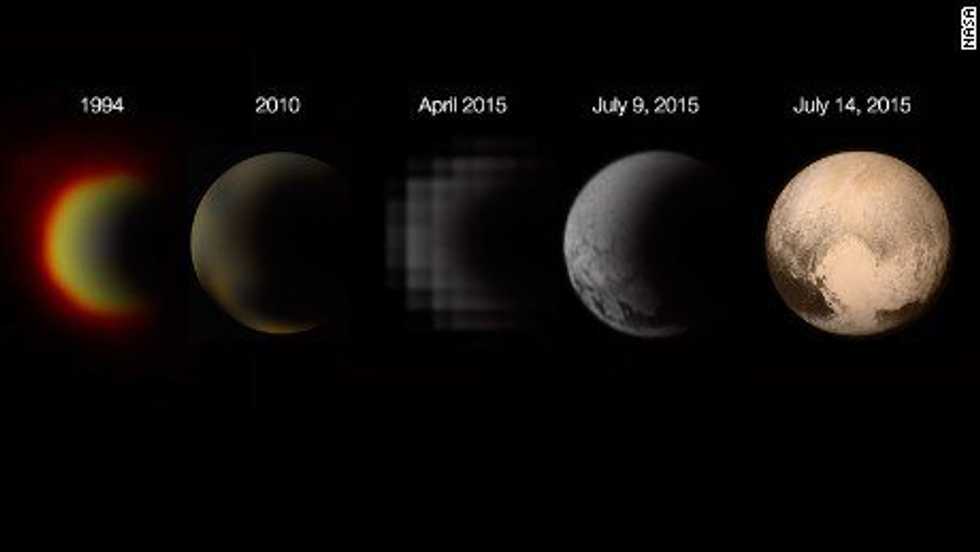
The unknown landscapes of Pluto and its moons took scientists and non-scientists alike by surprise. More than eight decades after its discovery, Pluto became much more than the dwarf planet we thought it was. It is a dynamic and complex world unlike any other in our system. Scientists were finally able to see through the telescope what they have never been able to see before. Cathy Olkin, a planetary scientists a the Southwest Research Institute in Boulder, Colo., explains here experience, "Seeing a new world for the first time, I mean that's huge. It's amazing to look at this world and realize I've been staring at it for years through a telescope and all that detail was there."
2. Gene Editing

Gene-editing technology made headlines this year. It has many ethical and societal issues that came along with it and enabled the scientific accomplishments. Researchers had transformed what was originally identified as a rudimentary immune system in bacteria to being one of the most powerful tools in molecular biology. Composed of RNA and an enzyme that slices up invading viruses, CRISPR allows scientists to edit almost any gene in any organism.
3. A New Hominid

Scientists are still trying to figure out the human evolutionary family and it's ancient secrets, and now we are one step closer to knowing more about how we got to where we are today; a series of fossils discoveries offered potentially important insights into the origins of the human genus, Homo.
4. Biological Age

There has been studies going on the past couple years to figure out people's "true age" based on how healthy they are. This has become even bigger this year. The study at Duke University, analyzed the healthy of almost one thousand 38-year-old's and found that many resemble those who are much older while others resemble those who are younger. This is using body mass index, blood pressure, and cholesterol level.
5. Climate change never stopped

There was a supposed pause in global warming that has allowed the climate change doubters to live on. This began when studies showed that decades of warming appeared to have leveled off in 1998. Since then to now, Earth's yearly average surface temperature has increased at one-third to one-half the average rate from 1951 through now. In June, National Oceanic and Atmospheric Administration announced that they were able to find the cause for global warming. It wasn't shifting of winds or pint-size volcanic eruptions, but small biases and gaps in temperature data had created an artificial plateau. The biggest culprit concerned measurements of ocean surface temperatures, scientists found.
6. Enceladus' Ocean

Cassini, which orbited Saturn, has past Enceladus more than 20 times. But just recently have measurements been confirmed. Beneath the moon's icy shell, an underground ocean spans the entire globe.
7. Treetop of Life

There were microbes found in the Arctic mud that could possibly be the closest relatives to the single-celled ancestor that swallowed a bacterium and made life what it is today.
8. Quantum Spookiness

Experiments reported this year that demonstrates that the quantum world violates locality, the principle that events sufficiently separated in space-time much be independent. This experiment executed a test put together by physicists, John Bell, to evaluate locality by performing the quantum equivalent of repeatedly flipping two coins simultaneously.
9. Epigenome Debut

This year, the book about human genetic instruction was made into a movie. Researchers cataloged how chemical modifications fold, compress and unwind the static DNA over time and how those modifications control when genes are on or off.
10. Superconductivity

Superconductors are heating up again. This is a compound of hydrogen and sulfur, when crushed at more than one million times Earth's standard atmospheric pressure, appears to whisk electrical current along without resistance at temperatures up to 203 kelvin. A room temperature superconductor would be able to robust energy devices, for example, an MRI machine that wouldn't require liquid helium coolant and levitating trains.
11. Alzheimer's

According to science news, "Scientists already had hints that the protein in question, amyloid-beta, behaves like an infectious prion, a misshapen protein that coaxes other proteins to misfold and spread from cell to cell. In a study reported in Nature, Collinge and colleagues found A-beta buildup in four of eight postmortem brains from people who had received growth hormone injections derived from cadavers." And because of this A-beta buildup and how rare it is in young people, 36 through 51, suggests that the buildup might have been seeded by growth hormone contaminated with A-beta.