


I remember with distorted clarity the first time I was invited into a home that belonged to a white family. My father drove me in his clunky blue van that he typically used on his flower deliveries. An ’89 Mazda with air conditioning that only blew burning hot air infused with the intoxicating scent of gasoline and motor oil, my dad’s van was the type of van that, if left parked on a street for too long, kids would assume that it was broken down and would then proceed to throw rocks at it.
This car ride, like many of the car rides I had shared with my father, was silent. My father kept his eyes on the road ahead, fingering a rosary and praying to Mother Mary for some miracle that we, along with the van, would survive at least one more day. Typically on rides like these, I would stare out of the window and imagine myself walking along the sidewalk, breathing in the fresh air of newly cut grass. I would pretend that whatever neighborhood we were driving through was my neighborhood and that I knew all of its corners and all of its little secrets.
As we passed through the neighborhood of perfectly manicured lawns and white picket fences, I sunk deeper and deeper into my seat, more conscious of the little gray strip across my chest and of the fact that it was belting me down in what seemed to me then as nothing more than an eyesore.
I will pick you up at exactly 8 o’clock. Do not be late. I will not wait.
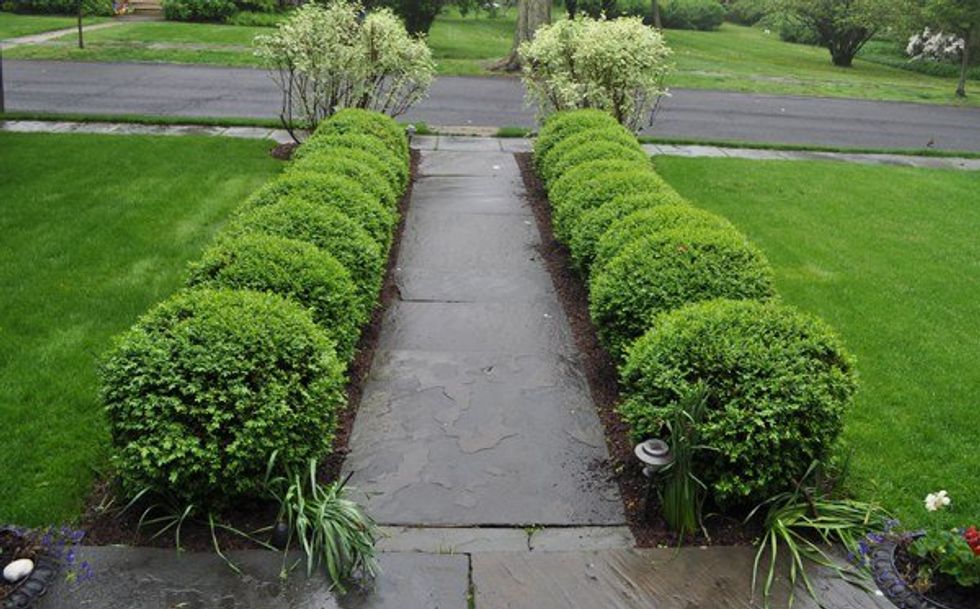
Emily’s house was composed of warm red bricks and eggshell paint. Leading up to the house was such a long driveway that the only way to leave was through a roundabout at the end. My father dropped me off in front of a line of hedges that were perfectly trimmed into little spheres. My eyes bounced from each little green ball to the next and eventually came to the conclusion that they were designed by what had to have been hired help to look like little planets. It was as if her parents had outlined a strategic plan to remind their daughter every morning that the universe was hers for the taking.
The time I spent on the front porch probably lasted only half of a minute, but it seemed to me then that I could have completed an entire rosary by myself from the moment I rung the bell to the moment the heavy wooden door opened in front of me. Trying to bury my own awkwardness before entering the house, I crossed my arms, dug my feet into their welcome mat, and prayed for the strength to survive this short visit. In times like these, where anxiety and fear shadowed my every thought, this was all I knew to do, all I was taught to do.
In the middle of my sixth or seventh or eighth Hail Mary, Emily’s mother opened the door and greeted me. Out of reflex, I bowed my head as my parents had conditioned me to do in front of every person of authority. As I moved to straighten the concave curves of my spin, I tried to think of the appropriate English equivalent for addressing a woman of her age but fell short. I decided that the literal translation – old aunt – would probably not have been appropriate.
My mind raced to reach for something that resembled a normal, American greeting. I thought of all of the American television programming that I had watched and realized that the characters all knew each other already and so they never had to worry about the formality of an initial greeting. I crossed my arms even tighter around my body as I imagined how strange I must have appeared to Ms. Jordan. I panicked as I thought of the possibility that my bow might have offended her. I can’t recall how I arrive at that conclusion, but I imagined that something as abnormal as an eleven-year-old girl bowing at the waist would be received poorly. Respect your elders. Impoliteness reflects badly on both you and us.
Ms. Jordan smiled. The corners of her mouth stretched across her face and lit a rosiness within her that shaded her lips, her cheeks, and the undertones of her strawberry blond hair that barely grazed her shoulders and curled around her ears. Her eyes looked at me with a gentleness that almost whispered for my approval. They spoke to me about her concerned with the prospect of upsetting me and reflected both within her and myself a small little girl trying to please the unspoken demands of unacquainted guests. With a soft, tender voice, she invited me in.
What seemed to me then as nothing more than the mixed feelings of misplacement and inadequacy was actually my introduction into understanding the complexities of self-identity. My self-identity was not dictated by the culture that I grew up in, but rather by the person that I would decide to be, in any moment in time, in any place or environment. I was not bound to the person that my parents had so lovingly prepared to enter into the world, nor was I bound to the person that I had seen on the television that governed what it meant to be a stereotypical American. I had the power to place myself into any situation, any environment, any neighborhood, and I could find comfort in the fact that there would always be enough love to ease my feelings of misplacement and inadequacy.
I am incredibly thankful for my parents, my culture, and the culture of my parents. Every time I hear the voice of my mother in the back of my head, I am reminded of the importance of humility, respect, faith, and, most importantly, understanding my place in the world. It is because of these voices and teachings that I have heard all of my life that I can be equally thankful for Emily and her mother.
Every time I look into my mind for the untarnished memories of Emily’s perfect room and home, I am reminded of an equally beautiful culture that was appreciative and patient with my words, laughter, and individuality. The concept of individual culture is not one that is strictly defined. Rather, the beauty of personal identity lies in the fact that one can choose and change at will. We are not constricted by the limitations of race but rather are free to indulge in the whims of situation and environment. A small eleven-year-old girl can put on a dress to feel like a princess just as I can take off my shoes to be respectful and mindful of my upbringing. My parents taught me to be cooperative and respectful of everyone’s personal identity; Emily taught me that my personal identity is deserving of respect. Respect your neighbor. Respect yourself.
At eight o’clock, I walked through the front door and past the line of perfectly trimmed planets. I climbed into my father’s clunky blue van and greeted him properly as I had done my entire life. As the van turned itself around at the roundabout, I sat in silence as I breathed in the scent of gasoline and motor oil. I closed my eyes and prayed for the van to survive at least one more day.
















