

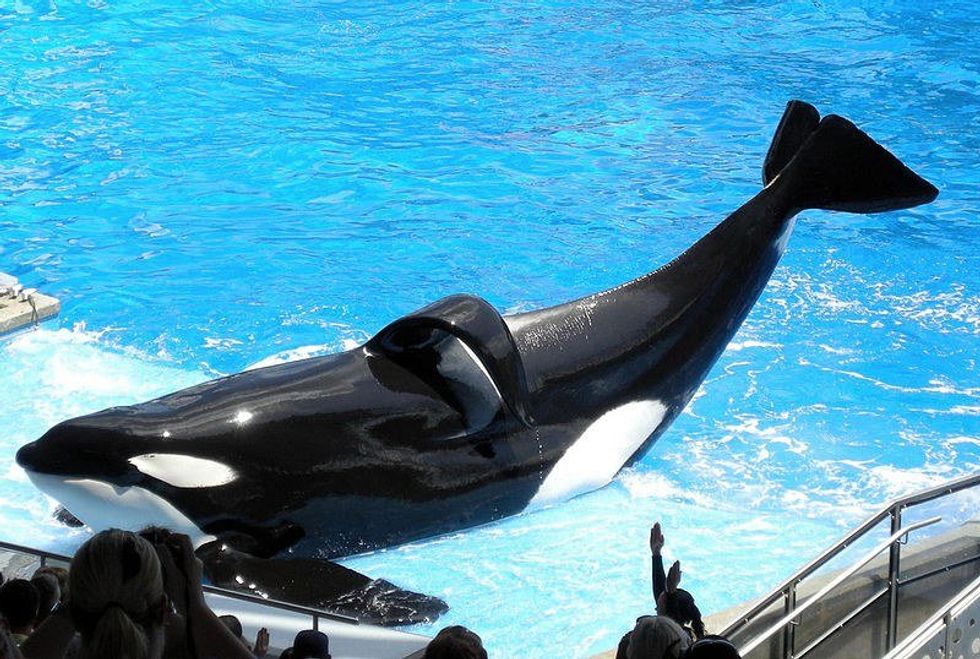
In 2013, a documentary was released exposing the alleged injustices behind SeaWorld. The film focused primarily on one killer whale that was captured in the early stages of his life. His name is Tilikum.
Tilikum first came to SeaWorld Orlando 23 years ago from a prior residency in Canada, according to SeaWorld. Tilikum has had quite a life experience, but the company says that his health is declining.
“We are saddened to report that over the past few weeks, Tilikum's behavior has become increasingly lethargic, and the SeaWorld veterinary and animal care teams are concerned that his health is beginning to deteriorate,” SeaWorld said.
Notoriously known from “Blackfish” as the orca associated with the death of three people, Tilikum may be nearing the end of his life. SeaWorld said that he has what the veterinary team suspects to be a treatment-resistant, bacterial infection in the lungs.
“Tilikum is beloved by the trainers and vets who care for him each day, as well as the thousands of fans who have connected with him during shows and underwater viewing. We truly appreciate your continued support,” SeaWorld said.
Perhaps the most famous orca in the world, it is deeply frustrating and horrible to hear that he may be leaving this planet so soon. SeaWorld claims that at his current age, 35, he is at the higher end of the average life expectancy for his species. But, according to the National Oceanic and Atmospheric Administration (NOAA), male killer whales can actually live up to 60 years, while females can live to 100.
As “Blackfish” shows, Tilikum was captured in the early ‘80s and was ripped away from his mother. While he wasn’t captured by SeaWorld, he has spent the majority of his life at the Orlando theme park, where he was involved in the killing of his trainer and a man that found himself in the wrong tank at the wrong time.
Since the age of two, poor Tilikum has spent his entire life in what could be considered a fish bowl – due to his large size. While there's no doubt that his trainers/caretakers have nothing but love for him and want to see him live a healthy life, it can’t be ignored that him, and many other animals in captivity, have known nothing but how to be a “show pet” for humans.
The WDC (Whale and Dolphin Conservation) global charity group reports that whales can swim up to 100 miles per day in the wild. This is something that isn’t a reality for whales that are held in captivity. Tilikum and others do not have the luxury to be the free animals that they are meant to be. As long as they are in captivity, they won’t ever be able to live life to its fullest potential.
It’s a hard topic to deal with, especially because the solution to the problem would take years to reach. In a utopic world, it would be the ultimate goal to one day let animals live as they should, alongside humans--and not for the entertainment of humans.
In all honesty, though, this is probably something that will never be seen in my lifetime, and my children may not even see it in theirs. It’s just a sad realization that the killer whale that made us all question animal captivity, will one day leave us.