


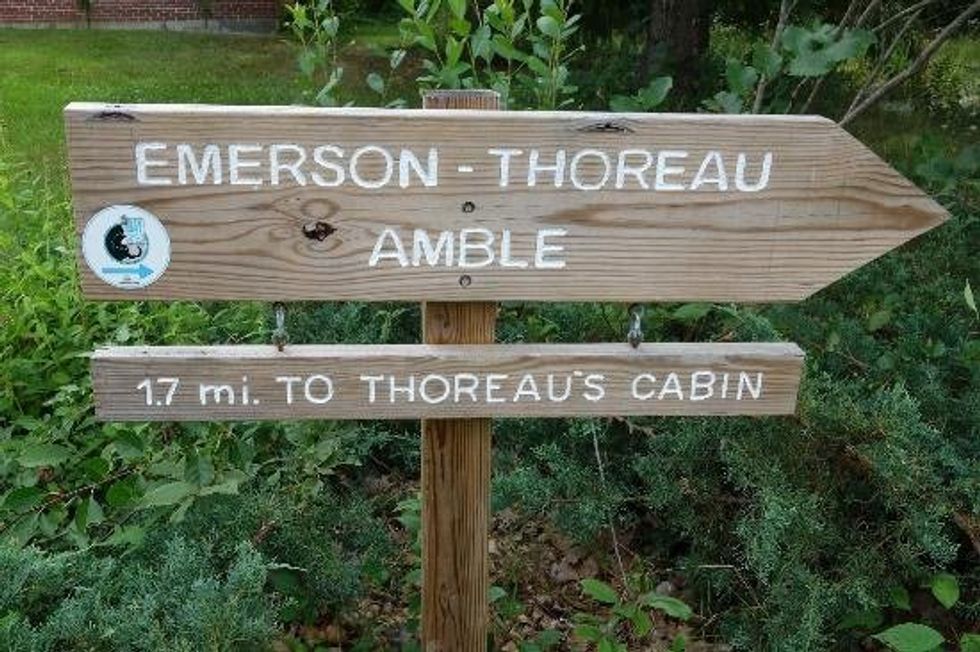
Transcendentalist writers and philosophers, Ralph Waldo Emerson and Henry David Thoreau, first met in 1837, introduced by Emerson’s sister-in-law. A few months later, Emerson delivered the graduation address, “The American Scholar” to Thoreau’s graduating class at Harvard. Thoreau didn’t bother to attend, but he did seek out Emerson’s guidance later on. The two became great friends, both sharing a spiritual appreciation for nature. Emerson even offered Thoreau a place in his home, where Thoreau spent time playing with Emerson’s children and documenting nature. Emerson saw great potential in his companion and referred to him as “My Henry”.
Emerson decided to purchase the famous Walden Pond and gathered the supplies to assist Thoreau in his 26 month experiment living alone in the woods. At the request of Emerson’s wife, Thoreau gave up his lonely lifestyle to live again with Emerson’s family, during which time Emerson was away for two years in Europe. Upon Waldo’s return, both men were remarkably changed.
Something broke up this bromance. Some think that Emerson’s wife liked having Henry around a little too much. Some historians say that the deaths of Waldo Emerson Junior and Henry’s brother, John, put a heavy strain on their relationship.
Undoubtedly, each man had influenced the other in profound ways. Both thirsted for clarity, and for inspiration. But while Thoreau lived his values outright, Emerson more-so talked about his. This is what I believe drove the ultimate wedge between these two passionate characters.
“We must learn to reawaken and keep ourselves awake, not by mechanical aids, but by an infinite expectation of the dawn, which does not forsake us even in our soundest sleep. I know of no more encouraging fact than the unquestionable ability of man to elevate his life by a conscious endeavour. It is something to be able to paint a particular picture, or to carve a statue, and so to make a few objects beautiful; but it is far more glorious to carve and paint the very atmosphere and medium through which we look, which morally we can do. To affect the quality of the day, that is the highest of arts.” -Henry David Thoreau (Walden)
Henry David Throeau, like Emerson, saw a great beauty in the human connection with nature. However, he preferred to operate outside of societal constructions such as capitalism or this ghastly perception of “progress.’ When the railroad roared near Walden and puffed it’s ugly smoke, he felt that nature had forever been ruined. Thoreau idealized pure wilderness, and found Emerson’s behavior to be hypocritical. If Emerson too worshiped the grace of the sun and the sway of the seasons, then why did he not live simply, and drink in all of nature’s gifts? Why did he not lead by example as Thoreau had?Emerson, for his part, was a professional lecturer. He taught people about nature by stepping upon his soap-box and expounding his ideals. This touched the souls of many listeners, and perhaps inspired many.
“In the woods, we return to reason and faith. There I feel that nothing can befall me in life,—no disgrace, no calamity, (leaving me my eyes,) which nature cannot repair.” -Emerson (Nature)
Unlike Thoreau, Emerson knew that society was exciting and growth was not slowing down! He was infatuated by the new international reaches of an increasingly global world. Emerson even took two years off to enjoy the fruits of society and and to lecture in Europe. He knew that he could not escape the entrapments of society, no matter how much he might have wished to do so at times.
Thoreau wanted to work outside of the system and Emerson thought he could do the most good while embracing the system and changing it from within. This is still a common theme for environmentalists today.
I often wonder…. upon graduating, should I get a job camping and mountaineering and living a 99% sustainable lifestyle? Should I be off the grid, maybe teaching others to do the same? I might “find myself” and be at peace, but would I be making a difference in the grand scheme of things?
What if I decided to work for a non-profit environmental organization. Maybe I would have to fly to a campaign site or participate in other societal norms which are unsustainable. Would I feel like my personal values and work values align? If I’m printing a zillion useless campaign flyers and killing trees, am I doing more good than bad? How does one calculate such environmental trade-offs?
How about I get a job in the corporate sector and wriggle my way up the food chain until I’m an executive and I can make environmentally sound decisions that change the entire way that capitalism works! mwahahaha. Ok- that might be a long-shot, but there are environmentalists that take this route and power through the bureaucratic headaches.
What is more effective? Who is happier? Thoreau or Emerson? Who left the biggest legacy or contributed most meaningfully to the enviornmental movement? Depending on who you are, maybe the answer is a mix of all three. One thing is for sure: No matter how environmentalists contribute to the movement, we are all aligned by our love of nature- just like Emerson and Thoreau who eventually reconciled their differences in the ultimate enviro-bromance saga.
















