Hi! My name is Lauren Bennati, and I'm a Korean Adoptee.
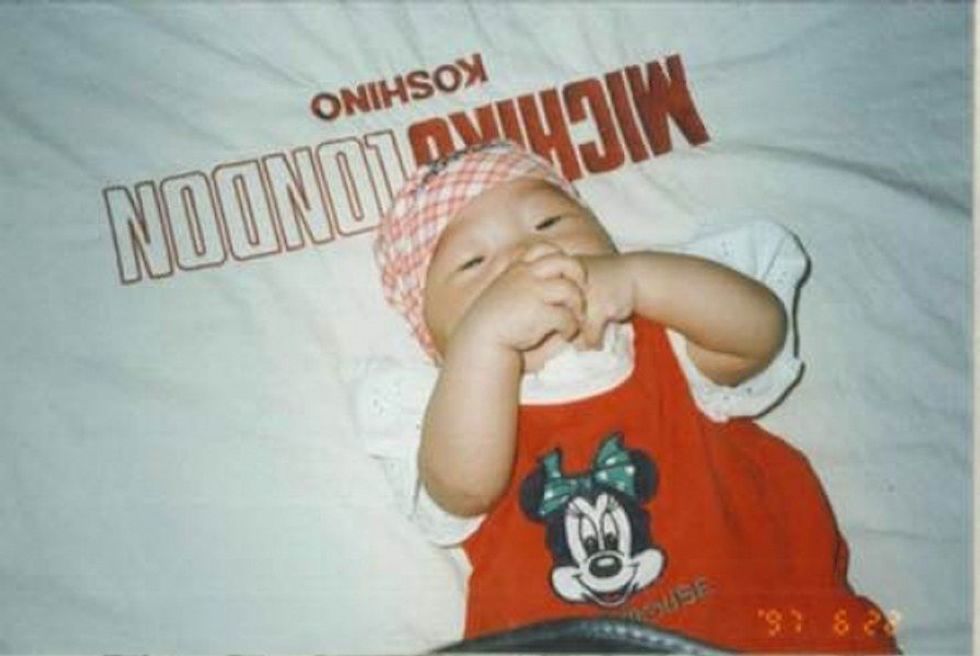
I was born on January 11th, 1997, in a little city called Taejon (now spelled "Daejon"), South Korea. I happen to not live with my birthmother, because she was 16 when she had me and gave me up for adoption.
I don't know much about my birthmother. It is not even clear to me how old she was; whether she was 16 years old based on the American way of thinking, or if she was 16 in Korean years (where you are a year old immediately after birth). It's anyone's guess who my birthfather was, under what circumstances I was conceived, and what made my birthmother give me up. All I really know is that I was born about three months early and my lungs were not fully developed, which caused me to get pneumonia not long after I was born. I want to say I was at least a month and a half old when that happened, but I digress...
After being surrendered, I was placed with an adoption agency, then with a foster family, and I was adopted by my parents in June that same year. I was six(ish) months old when I came to live with my parents (and no, I have no memory of living in Korea at all, if you were wondering). I count myself a very fortunate person that I was adopted as soon as I was and with the parents I was adopted by. (Shout out to Mom and Dad for “rescuing me from the dumpster that one time”. Y’all are the best.)
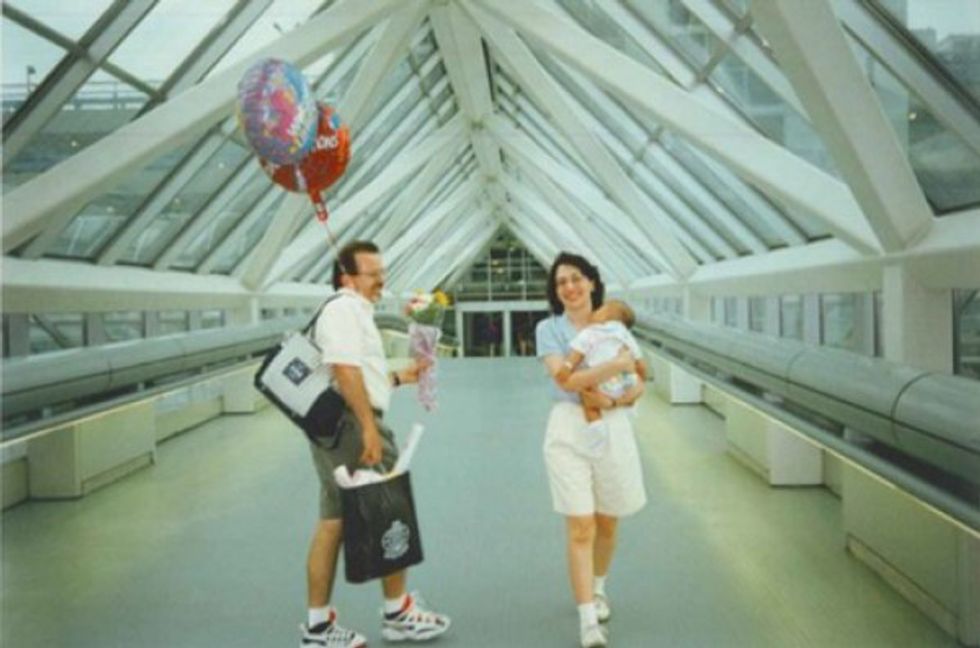
[Pictured above: My lovely parents taking me home after retrieving me from the Minneapolis-St. Paul InternationalAirport. My parents still kinda look like that, but my dad has less hair and my mom got better-looking glasses.]
Now, on to the good part...
I’m going to give some context here: If you are a parent of an internationally-adopted child, it can be a good idea to try to immerse said child with their culture, so as to give him or her some context as to why they look different. I was raised in an area where there were a lot of opportunities for Korean Adoptees (which I will refer to as KA’s for the most part from here on out) to commune with one another and to embrace the culture they were born in, so my parents did just that. The point of this article is not to disrespect the effort my parents made for me, but to give my thanks to them for letting me become my own self without the added burden of paying homage to a culture that I felt no connection to.
For the first 12 or so years of my life, I grew up as I would imagine any other little girl in the United States to grow up; I went to school, I came home, I played with my dog, I had dinner with my family, and I went to bed (begrudgingly). On weekends, I'd get up (relatively) early and go to dance class.
But this wasn't just any dance class.
It was Korean dance class.
I was grouped with other little girls my age (that supposedly were supposed to look like me) so we could learn the dance of our people. I wore white pointy shoes -- well, they were white until I got them dirty and I had to buy another pair -- and a hanbok, the traditional dress. (FYI, If you are looking to show off your girlish figure, the hanbok is NOT for you.) And, depending on the dance, I'd grab a prop. Sometimes I grabbed a pair of fans, sometimes I'd be manhandling a papier-mâché jar and I'd attempt to do what the other girls were doing. I'm not promising I did it correctly, but I can say that I tried.
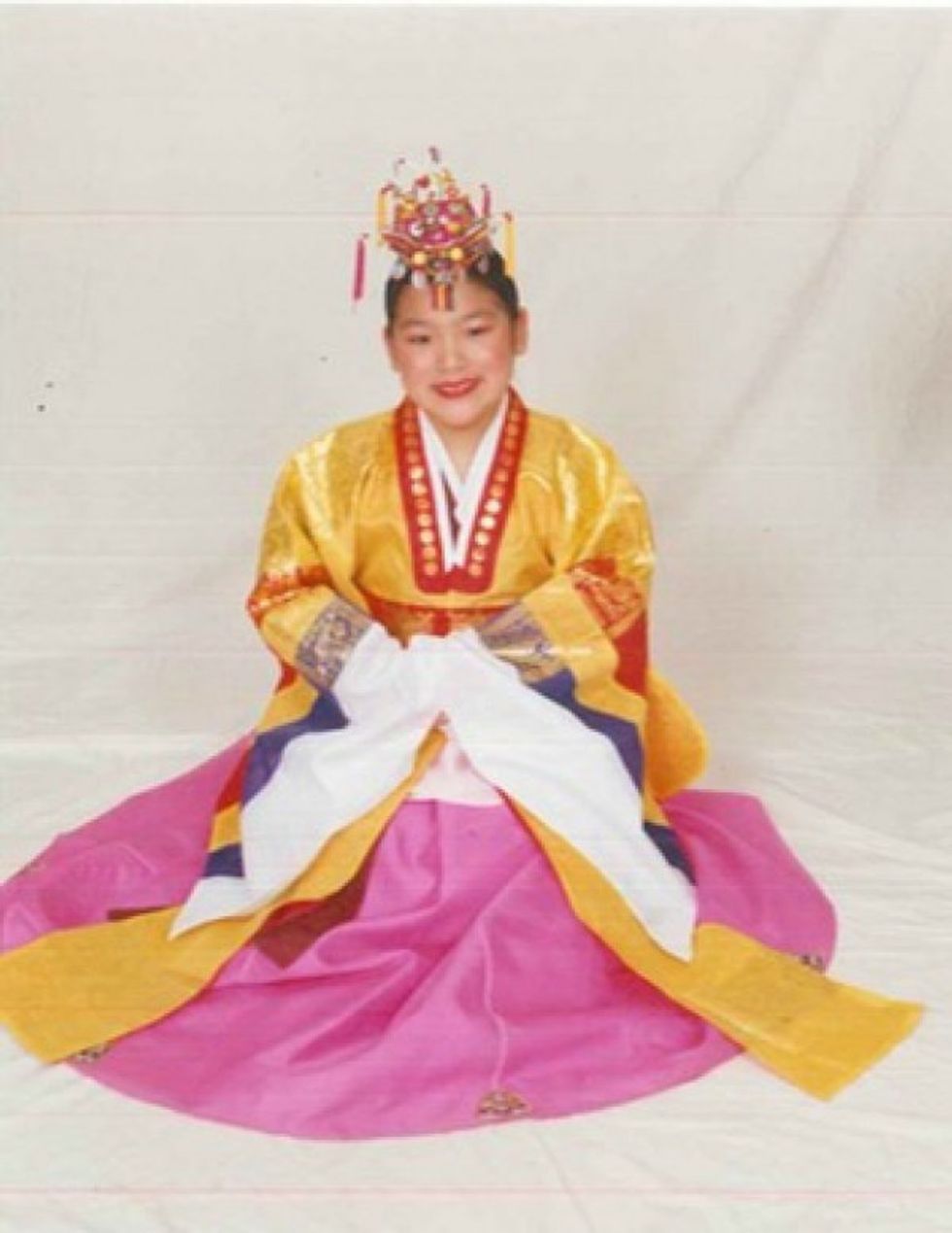
[Pictured above: Me wearing a hanbok with a gold jacket and long, colorful sleeves. Like I said, the hanbok does not complement a girlish figure. But it sure was pretty.]
During the summers, I’d go to summer camp.
But it wasn’t just any old camp.
It was CULTURE camp! For Koreans!
In the Twin Cities area, there are four or five main Korean Culture Camps. I went to one of them, but I’m not going to name it here. It’s not important, but any KA’s who read this will probably know which one I’m talking about.
I would truck over to a camp in Wisconsin and I'd do some more Korean dance, play some games, eat some food, and learn about this foreign culture that was irrelevant to me. Sure, I thought the food was weird sometimes (honestly, I still think japchae is weird because noodles are supposed to be warm, not cold. I think that's because I was raised by Italians) and I couldn't understand why I was made to learn a language that was of no use to me, but I did it. It gave me something to do for a week in the summer and I got to be around people. There was no reason to complain.
I can't really say I remember the day that I learned that I wasn't "normal". I can't specifically recall a "eureka moment" the day someone asked me why I had lines for eyes or why I didn't look like my parents. I can't say I remember looking at myself differently when someone asked me to say a word or write in Korean. (I couldn't say anything because I didn't pay attention to the language class. Again, it was irrelevant to me. Sometimes, to shut them up, I'd say something in gibberish or scribble something. And those people believed me! Suckers.) And I can't really say that it fazed me that much when my classmates back at school asked me if I ate dog (I would tell them that I would never do such a thing, and that I owned a dog, Feathers, a Brittany Spaniel mix, whom I loved very much). With all this talk about "microaggressions" and "cultural appropriation" these days (which I think is a topic for another time. Spoiler alert: Not a big fan with how popular these words are) society tells me that I, a minority, should be deeply triggered, or unsettled at the very least, by these small but "offensive" (?) mutterings of these classmates of mine as I remember these things. But I wasn't and I am not now.
I'll admit that I forgot that I wasn't white (and, to be honest, I STILL forget that I'm not white), but I always remembered I wasn't white when I heard my middle name -- which I would hear if I did something stupid, as any other child would. Even to this day, when I'm in serious doo-doo, my mother will use my middle name, Mee. (My birthname is Kim Mee Rae.) You might think that my middle name would be Marie or Maria (which my mother, whom I love very much, actually does call me when I do something stupid in the present day) but no, it's just Mee. I always thought it was a peculiar thing that I had a middle name that sounded so common but was missing one or two syllables. You would think that that wouldn't be the thing that would be a constant reminder that I wasn't white, but it was.
After this discovery that I was clearly not like everyone else, I eventually became pretty weirded out that I was not white (like literally everyone else around me, save for that dance group), and so while my classmates were soaking up everything there was to learn about the Korean culture, I became increasingly detached from this culture that I supposedly belonged to and was to be proud of. I didn't think that I needed to know all this unnecessary information that was supposed to be part of me, and although I was starting to get a taste for Korean food, I didn't find that there was anything to care about (later, I'd find out exactly why Korea was adopting out so many infants, and it gave me a really bad taste in my mouth).
Anyways, back to the story...
Remember those girls I talked about earlier that were supposed to be just like me? Yeah, a lot of them ended up bullying me. It was mostly just normal little girl stuff like talking smack behind my back and leaving me out of stuff. It was the stuff that made for typical pre-pubescent mean girls, yes, but it didn't make me feel particularly good at the time (and I'm still not very happy about it now). Now that I’m older, I wish I was wise enough back then to just let go and move on to bigger and better things, but, being the sensitive type and as much as it hurt, I held on for as long as I could, in hopes that one day a little girl with squinty eyes and black hair might come to like me and we could be friends. Where were the adults -- the teachers, the parents, the onlookers -- as these girls tore apart any shred of appreciation I had for my culture, as well as my faith in friendship for people who looked like me?
I felt betrayed. I was supposed to be one of them, but even where I was supposed to commune with people who were just like me, I was STILL DIFFERENT, and I didn't know why. Wasn't the color of my skin supposed to be enough to be part of a community?
Of all the things that could have been the straw that broke the camel’s back, going to "my motherland" should have been the least likely of them all, but all it did was validate my distaste for everything, anything, and anyone Korean (except for the food. My love for the food was the only thing that grew from the whole experience).
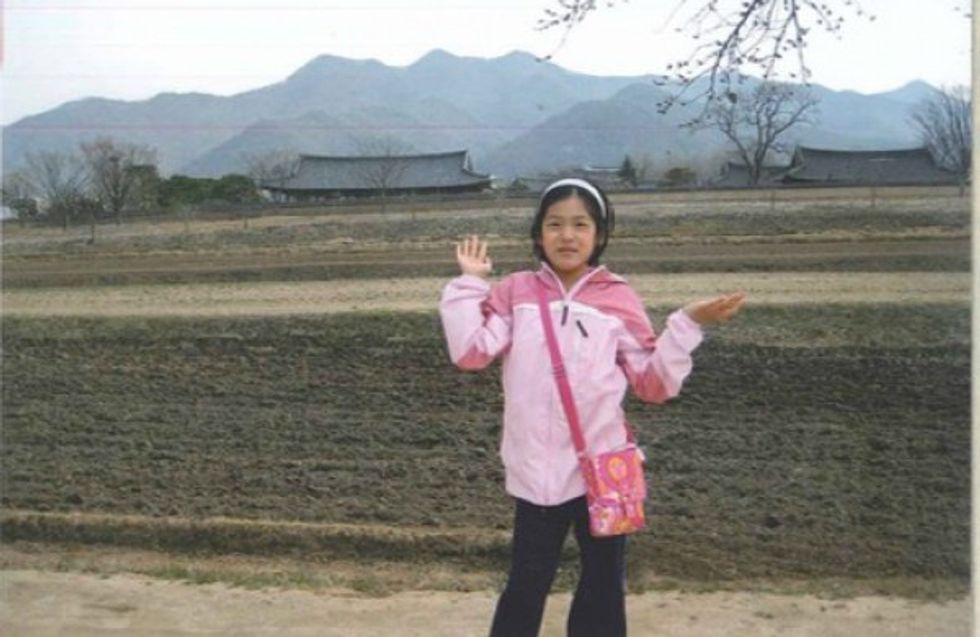
[Pictured above: Me with a rural Korean folk village behind me. I don't know what the hell I was doing with my hands. It's not like the cops were out to get me.]
When I was 11, I had the opportunity to go to Korea with my parents and my dance group as a sort of act of "going back to the roots". The flight was long (probably because I wasn't able to sleep on the plane), the beds were hard, and everyone cried because the fact of being in the place where it all began was emotionally stimulative. My mother cried. My teacher cried. Some of those girls cried (but it wouldn’t surprise me if they were crocodile tears). But me? I didn’t cry. Why didn’t I cry? I just didn’t care. I was more excited that I was getting out of the country for the first time ever to become emotionally invested.
At the beginning of that week I was in Korea, I had two friends (not too shabby for me), some money, and an open mind. You would think that I’d at least have more friends (in addition to copious amounts of souvenirs, which was a given) by the time that week ended, right? Guess how many friends I ended with? None. By day two, the two girls I was friends with sat in the back of the bus, whispering about God-knows-what. And me? I was sitting in the front of the bus, with my parents. I had no friends, my money was gone, and my dad got a wicked case of food poisoning as soon as we returned. Yeah, those were fun times...
Of course, it tore me up to know that these girls were so mean, and I look back in anger to know that the adults were only enabling the bullying, but I can’t even begin to imagine how my parents felt. I know how hard they worked to try and foster some sort of pride for my heritage and to see these young girls and their parents (and, to some extent, my teacher) ruining it for me must have crushed them. Thankfully, after the trip they didn't push the culture on me anymore, and they let me move on from that chapter with grace. The fact that they encouraged me to form my own culture and code of ethics was the best decision for them to make for me at that time, and I can't thank them enough.
I remember the day I realized that my parents saw, understood and were upset with what those girls did to me. On the last day of trip, we went to a cute little restaurant with themed booths and good food. Of course, the clique… er, I mean the little girls were all huddled together in their pink fluffy booth, and I was seated at a boring table with the adults (as expected). My dad saw this and got upset. Now, my dad is a Behavioral Health specialist. He is a pretty even tempered guy (for the most part), and he does his best to think rationally a lot of the time. But he’s not a dude you want to get mad. But when he saw that I was once again sitting with the adults when I should have been sitting with people my age, he got mad. I remember him yelling, but I don't remember what he said. I do remember them begrudgingly clearing a spot for me to sit, though. The damage was done though. I didn't want to sit with them any more than they wanted to sit with me.
You might be wondering about that open mind I had? The day I returned home from Korea, a seed -- a seed that was my broken, bitter outlook of the culture that came with the color of my skin -- was planted inside of me. From that point on, I became angry at anything, everything, and everyone Korean. I hated Korea, Korean people, Korean Culture, and I especially hated when other KA's would get all excited when they realized I was Korean.
Why do they expect me to reciprocate their excitement? I would ask myself. Why do they expect me to trust them? Why do they expect me to share my emotions, especially my raw and intimate emotions, with them? Why do they expect me to cry with the other KA's gathered around a campfire, a thing seemingly done to show unity (a vain attempt, at least by my standards) at the end of Resident Camp to sing my goddamn praises to this community (which I dare not call "inclusive" or "diverse". It's too laughable to even fathom it) who hurt me and made me ashamed to be this culture that is the least relevant thing that pertains to who I am as a person?
It took me a year or so, but I stopped taking Korean dance class. I would come home out of breath and my back hurting badly from bending over backwards playing the samgomu, and I was too upset to function. By this point in time, I had so much resentment towards all things and all people Korean that it didn't make much sense to even try to connect to my culture anymore. I was angry. Very angry. But I was hurt, too. And I think the hurt that came from it affected me more than the anger.
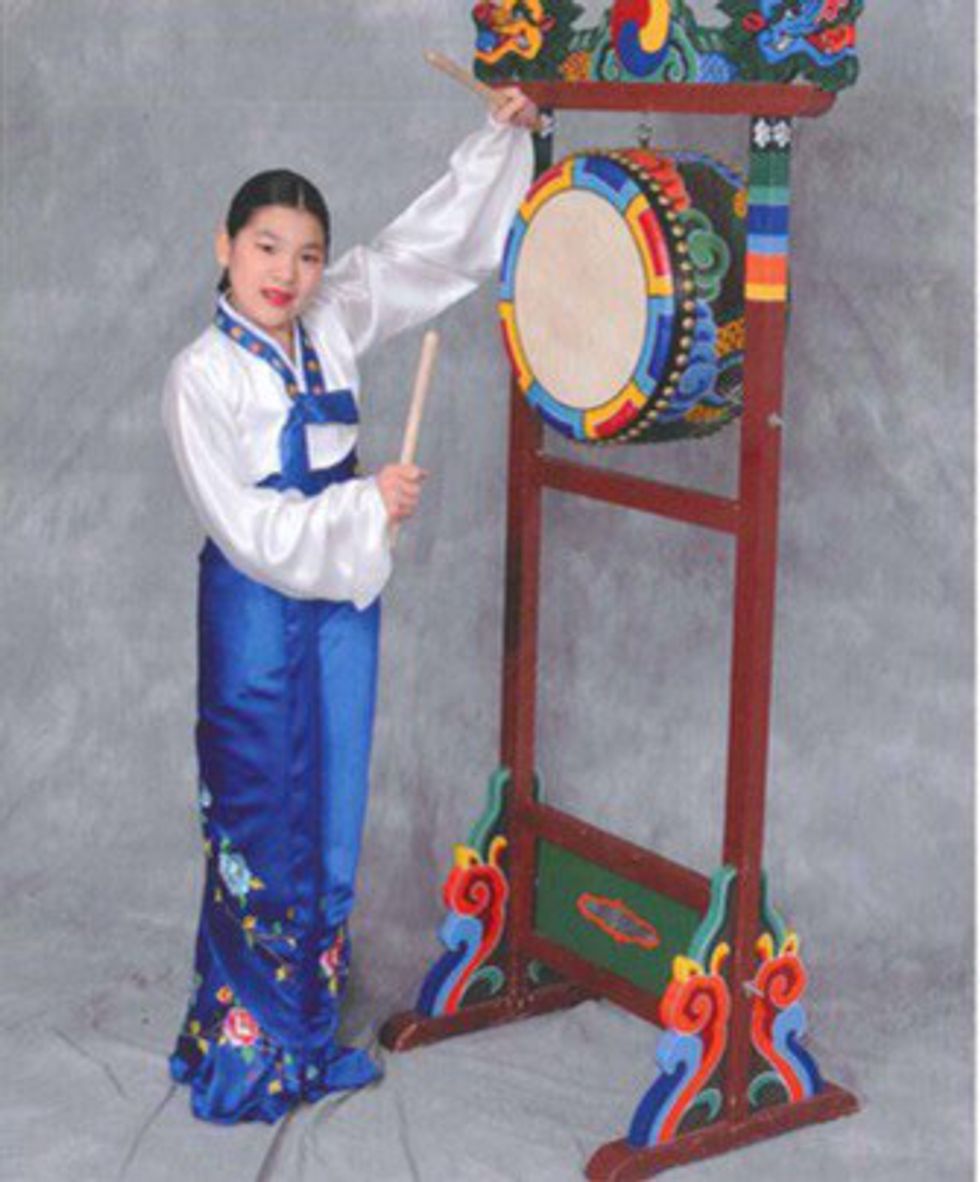
[Pictured above: Me with a samgomu drum. Normally there are three. I will say, this hanbok does a better job in showing off my figure.]
With my Saturdays now free, I didn't know what to do with myself. I connected with my white friends more. There was drama, of course, but I grew, and their acceptance of me was crucial to my growth. My skin color didn't matter with them. I made them laugh. They made me laugh. Life was good.
I started taking flute lessons in middle school, and during high school, I joined a youth orchestra. I had the time of my life (but that's a story for another time). I found my passion. I decided to pursue music. I made friends. I fell deeply in love with the music I was studying, and I found a great interest in finding where my part belonged in relation with everything else. Music, not my race, became my culture.
I graduated high school, and I moved three hours south of my home, away from my friends, to a school where I can pursue music and explore my culture -- my musical culture. I made new friends, I kept contact with the friends back home nearest and dearest to my heart. Life is great, but there was still an issue inside myself that I knew I needed to resolve.
I had many opportunities to do some thinking about the Korean part of me during my first year here at Luther. I knew that I couldn't ignore it. (For Christ's sake, there are probably, like, only three other Asians in this school; everyone else is white. That was one hell of a shell shock. That was how I figured out that I couldn't really hide my Asian-ness anymore.) Eventually, I became less angry, and I felt more disgust than anything else. Disgust that these adults in this scene in my life would perpetuate bullying, but especially in a setting where a "safe space" was supposed to be warranted (in today's terms, I guess) and they either were ignorant of the bullying that was taking place or condoned it. I will never know why these adults never noticed or tried to fix it, but that part of my life is over now. I only gained a new perspective from the whole situation, one that a lot of KA's don't seem to have. That's why I'm writing this article today.
Let me be clear: This is my own story, so things like this don't normally happen (to my knowledge; if there are I hope that my story will encourage any other KA who feels this way to share theirs), but I am speaking up because I want other KA's (and any other adoptee who feels like this) to know that they are more than a culture. You are who you are; the color of your skin does not equate to an instant group of friends, people to cry with, and most definitely not a "safe space". Being an Adoptee means to forge your own way and to play out your part in this Symphony of Life. Be bold, and never be afraid to add to the tapestry of your community, whatever that is.
My name is Lauren Mee Bennati, and I am just your (respectably) average, mostly friendly (but very sassy) flutist who clearly has an identity problem. I'm a Twinkie (yellow on the outside, white on the inside) who grew up with Pennsylvanians in Maplewood, Minnesota, but sometimes for some reason I speak with a Southern Accent (only the Good Lord knows why). I have a weird middle name. I happen to really like Asian food, especially Korean food (BTW, Bulgogi and Galbi are really good. Try it sometime.). I forget that I'm Asian and I think I'm white a lot of the time. But I know that I'm neither proud nor ashamed of my Korean Heritage, and I'm okay with that.
Besides, labels* don't matter because at the end of the day, I'm just plain ol'... Me(e).
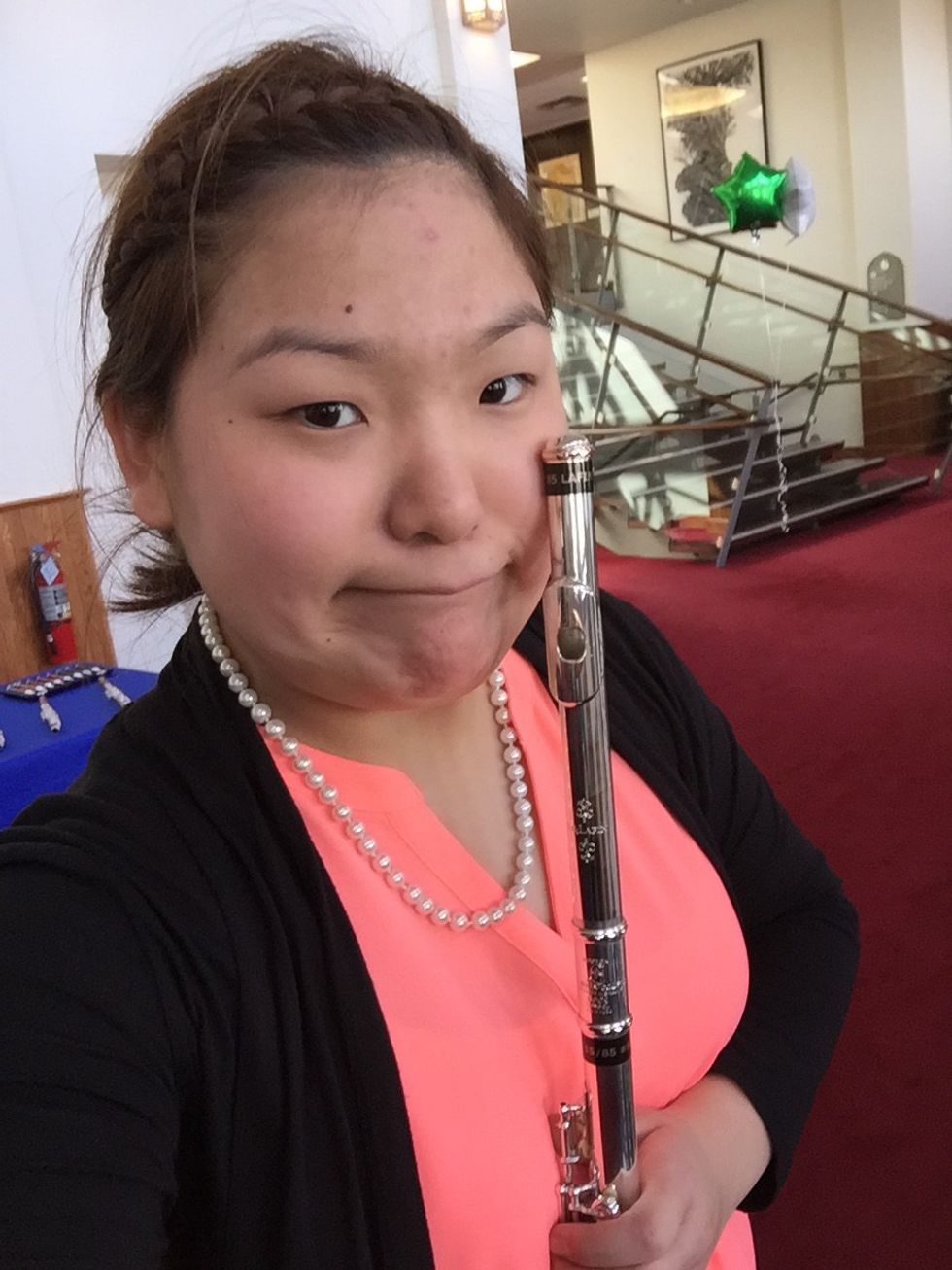
[Pictured above: Me in my natural habitat -- a flute fair. I am holding the mother of all flutes and I'm obviously deeply upset that I cannot buy it; It was $15k (!!!!!!!)]
*(Plus we'll all end up dead anyway, so that's why labels are worth their weight in belly button lint. Seriously.)