
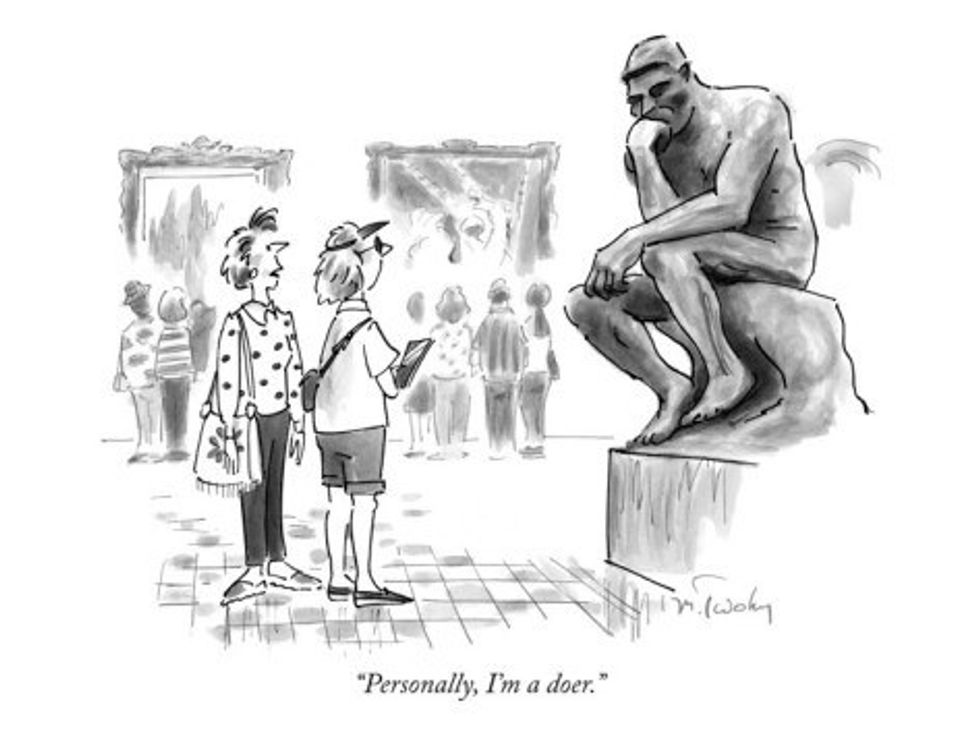
Somewhere along the historical timeline, humans decided to classify themselves into two distinct categories: thinkers and doers (and more recently, feelers – which I'll choose to ignore). As if the ubiquitous determinants of gender, race, age, and IQ weren't enough, now thrown into the mix was the ominous segregation between the thinker and the doer. Thankfully – being somewhat intelligent and all – society has come to recognize that the distinction is not as disparate as once believed. Most people are a relative blend of the two. That being said, for the sake of comparison I will treat them as separate entities.
Disclaimer: I consider myself a thinker, so I'm inherently biased. Regardless, there's no denying that the pros far outweigh the cons if I'm being strictly quantitative in determining the better archetype.
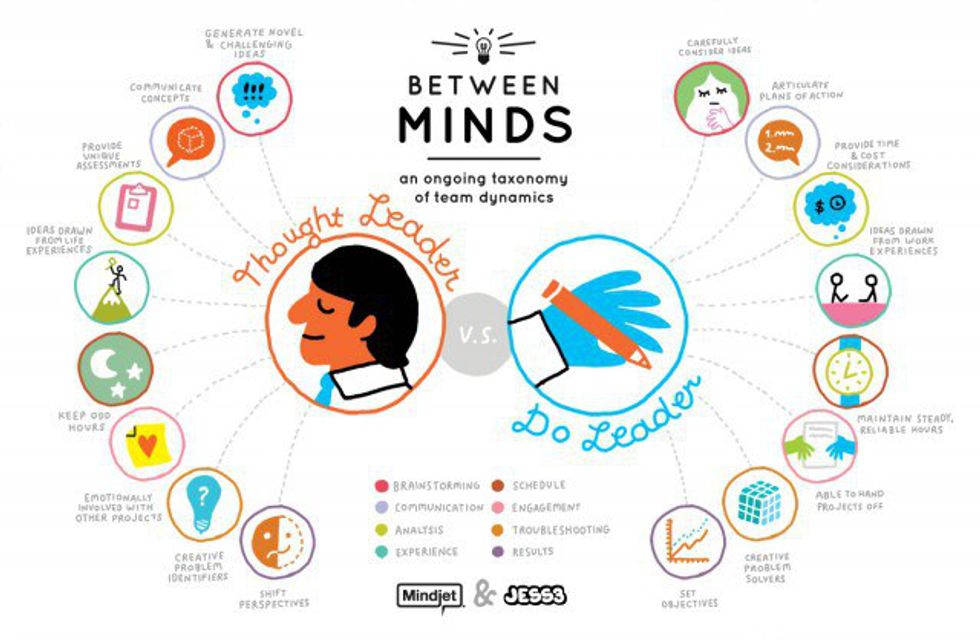
The Thinker
Pros:
- Highly insightful; introspective
- Greater ambition; thoughtfully planned out dreams
- Creativity; abounding ideas
- Emotional intelligence; rarely impulsive or reckless
- Perfectionists (also a con); great attention to detail
- Can easily become a doer when necessary
Cons:
- Fear of failure due to perfectionist mindset
- Less self-starting due to fear of failure
- Can overlook the bigger picture due to focusing on what can go wrong
- Typically more pessimistic due to overthinking
The
Doer
Pros:
- Highly productive; focused
- Conscious of time and deadlines
- Extroverted; better people skills; social
- Hard-working; motivated
- More skills marketable to employers
Cons:
- Impulsive; reckless
- Carry out actions with little thought of effects and consequences
- Less creative; less innovative
- Follows directions with little added thought or originality
- Can't fully learn to be a thinker
OK, so they're fairly even
from an objective standpoint even considering my bias towards
thinkers. However, I'd like to pinpoint a critical difference between
the two: thinkers are fully capable of becoming doers or displaying
hard work and productivity whereas doers find it much more difficult
to reverse the process.
Obviously every human being is born with the capacity to think so we are all “thinkers,” but there's no questioning the disparity in thought process between the categorized thinker and the general population. Critical thinking has been a buzz term in employer circles for the last decade because it's responsible for the new economy's success. Just ask James Altucher who repeatedly states we live in an “idea economy” – a world where creativity spurs the success of nations, of societies, of humanity. Obviously thinkers need doers to enact these ideas, yet without the minds of Zuckerberg, Jobs, and Musk there would be social and economic stagnancy. Especially in the case of Elon Musk, ideas are responsible for the future as well: self-driving cars, private spacecraft, flights to Mars.
By all means, especially in regards to the public figures I listed, thinkers are still be highly productive. Can overthinking and perfectionism be significant detractors from efficiency? At times, certainly, but ultimately with a strong cup of coffee and a desire to achieve, thinkers can still push out the same quality of work as a doer – if not better since they've put a lot of thought into their actions. It's as simple as flipping a switch in their brains telling themselves to stop thinking of alternative possibilities and just focus on the task at hand.
 Reverse the process, and a noticeable
issue springs up. How does one tell another person to “think
more,” “think from this perspective,” “think in another
person's shoes?” To follow those instructions is to acquire a new
brain – but humans have no other point of reference except the mind
they've been given. John has no ability to fathom how Jane thinks
because he's never lived a day of her life with her thoughts
and her past. For all
John knows, Jane's brain is superhuman and runs laps around his in
every way possible.
Reverse the process, and a noticeable
issue springs up. How does one tell another person to “think
more,” “think from this perspective,” “think in another
person's shoes?” To follow those instructions is to acquire a new
brain – but humans have no other point of reference except the mind
they've been given. John has no ability to fathom how Jane thinks
because he's never lived a day of her life with her thoughts
and her past. For all
John knows, Jane's brain is superhuman and runs laps around his in
every way possible.
Even if John the Doer is able to arrive at the same conclusion as Jane the Thinker, she most likely thought of the result much quicker, thought of alternatives, and thought of every effect of the conclusive action. The Thinker thinks about his/her thinking and then thinks about that.
It's an incredibly advantageous power to be a thinker – a superpower even – but what does this say about doers?
Well, I've built up the thinker to be a tad superior to the doer, but frankly, I feel as if I'm playing the devil's advocate. Critical thinking might have been huge for employment a few years ago – a huge fad. And all fads come to an end. Ultimately, employers would like to believe they want to hire thinkers to build their company, but the doer is so much easier to justify. They're extroverted; they're gung-ho about working; they're never one to miss a deadline; they're the foundational backbones of the working economy.
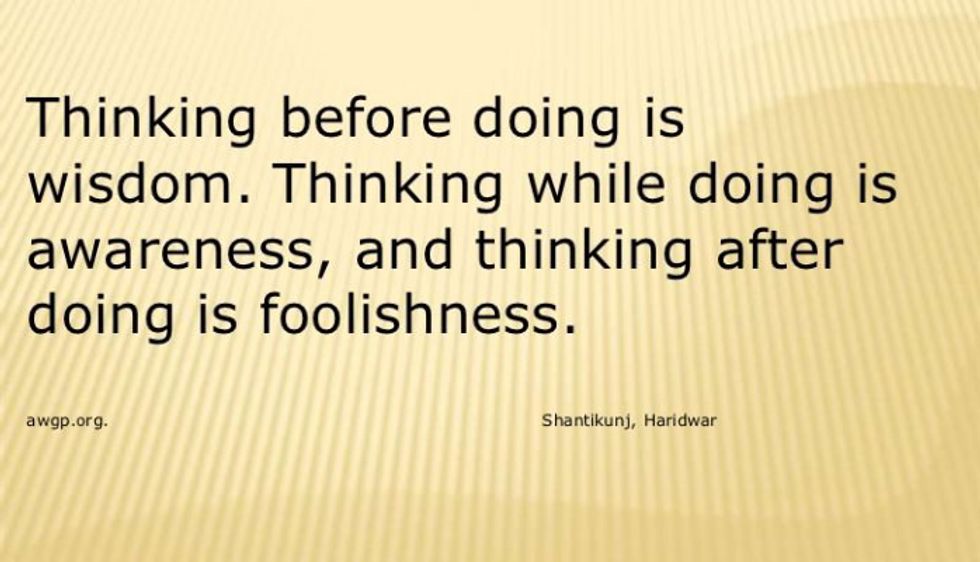
Us thinkers have a difficult time persuading people – not just employers – of our value. Even though that value is unmatchable. I do not intend to condescend doers since by no faults of our own we are mostly born one or the other; I simply wish to provide a leg up for my fellow thinkers. We may not have the mindless work ethic of our doing counterparts, but we possess abilities far more noteworthy, albeit pretentious: deep introspection into our identities; fundamental understanding of our innate calling and purpose in life; encompassing comprehension of determinants, inner workings, and results of ideas and actions; unlimited creativity to draw from for every aspect of life.
And I, for one, under no condition would I exchange these aptitudes.