They, Them, Their, There, They’re
I use they/them pronouns.
Some trans people choose to change the pronouns they use to refer to themselves. So, a trans woman may choose to use she/her pronouns and a trans man may choose to use he/him pronouns. Changing pronouns helps a trans person unite their inner identity with the outside world. Pronouns do not inherently have a gender. So, a trans woman can choose to keep using the he/him pronouns that were assigned at birth. And a trans man can choose to keep using she/her pronouns. A lot of binary trans people do change their pronouns because cultural and social implications of the words impact them psychologically. Also, if they do not change their pronouns, it can be as though they are outing themselves, or exposing their trans-ness, which is all too often a dangerous thing to do.
Please note that there are no such things as “male pronouns” and “female pronouns.” In our culture, we commonly assign she/her pronouns to a baby we perceive as having a vagina, and we call her a female. But “female” and “male” are just as socially constructed as “girl” and “boy.” Meaning, what we use to decide who is and is not a specific sex is relatively arbitrary, not really accurate, and not the only way to do it. (Writer West Anderson explains this stuff pretty well here.)
A binary trans person could choose to change their pronouns to they/them, which is commonly referred to as gender neutral pronouns. (But, as I stated, the pronouns themselves do not have a gender, so calling they/them “gender neutral” isn’t exactly accurate. However, it represents the cultural perception well.) Some people choose to go without pronouns, so everyone just says that person’s name instead of using a pronouns. Some people choose to use other pronouns like ne/nem, ve/ver, ze/hir, etc.
I chose to use they/them pronouns for lots of reasons. (Note: no person is required to explain their choice of pronouns to you. But because I’m feeling generous, I’ll continue.)
First, hearing people call me “she” or “her” generally drives me nuts. A tiny voice inside my head screams, “But that’s not me!” And it makes me feel invisible. If people use the wrong pronouns for me, it seems to me that they are not being mindful of my existence and simply choose to assume things about me and overlook my identity in order to make themselves more comfortable.
(I have a soft spot in myheart for my family, though. My family means more to me than anything else in the world. When I asked my family to change the pronouns they use for me, they weren't happy about it and quickly realized the change was hard to make. They don't use my pronouns and as far as I'm aware, they're not trying to use my pronouns. When I hear my family call me "she" or "her" the tiny voice inside head merely gives an exasperated sigh.)
Second, I’m not binary. He/him feels binary to me, personally. Plus, if I were to use he/him pronouns, I’d likely be bombarded with “Well, if you’re a man now, act like it.” And I’m not about that life. I’m not interested in having masculinity forced on me. I’m not interested in having another gender that I don’t identity with being used to measure my worth. (But, if people throw a fit about grammar, I’d rather them use “he” for me than “she,” because of the above mentioned reasons.)
Last, they/them is a set a pronouns that people are already familiar with. So I don’t have to teach people how to use a set a pronouns they’ve never heard before, like ne/nem, ve/ver, ze/hir, etc.
Honestly, I’m not sure how the above mentioned pronoun sets work really. I’ve never met a person that uses pronouns like those. If I was a good person, I’d be proactive and learn about those pronouns ahead of time, but it seems like I’m waiting to meet someone who uses one of those sets before I make myself wrap my head around it. I respect the people who choose to use pronouns like the ones listed above. I don’t have the energy to deal with people and their shitty reactions to experiencing things that are new to them. So, I stuck with they/them. I’m a different kind of person than what people typically think of when they conceive a generic human — not a boy or a girl, maybe both, but mostly neither. It just seemed to fit. More importantly, I choose to represent myself in the world with they/them pronouns.
So that’s it then? We’re just going to let people decide who they are and how they want to be treated?
Uhm, yes? Yes. Exactly that. Why does everyone act like it’s the end of the world if you can’t assume a person’s pronouns? Is it because you’re afraid of communication? Do you know how words work? It’s this easy:
“Hello, my name is Shelby. I use they/them pronouns. What’s your name and pronouns?”
“Hi. I’m Random Stranger. I use ze/hir pronouns."
"Pleased to meet you."
*continues with conversation as normal*
Changing pronouns is hard. It’s not something anyone ever does lightly. It’s full of uncertainty in how the individual will feel about the change personally and how other people will react to the change. So if someone tells you that they use different pronouns, listen to them. They’re not doing it to make your life complicated. Actually, a person changing their pronouns automatically makes their life more complicated. They have to keep track of who they’ve told, and who they haven’t. They have to find a way to start the conversation a million and one times. They have to decide if a person is assuming the wrong pronouns, using the wrong pronouns because they’re being an ass, using the wrong pronouns because they don’t know that changing pronouns is even a thing, etcetera, etcetera.
So, when you tell someone who has changed their pronouns that using those pronouns is too hard, or too confusing, or (my favorite) not grammatically correct, what you're actually saying is: "I don't understand and therefore I do not care." Uhm...
Here’s the thing. Some trans people know they're trans from a very, very young age. The rest of us went through hell and back to figure it out. So saying something negative or just generally unsupportive fans the flames of hell we've been standing in for years. At some point, trans people who have changed their pronouns generally come to a conclusion comparable to this:
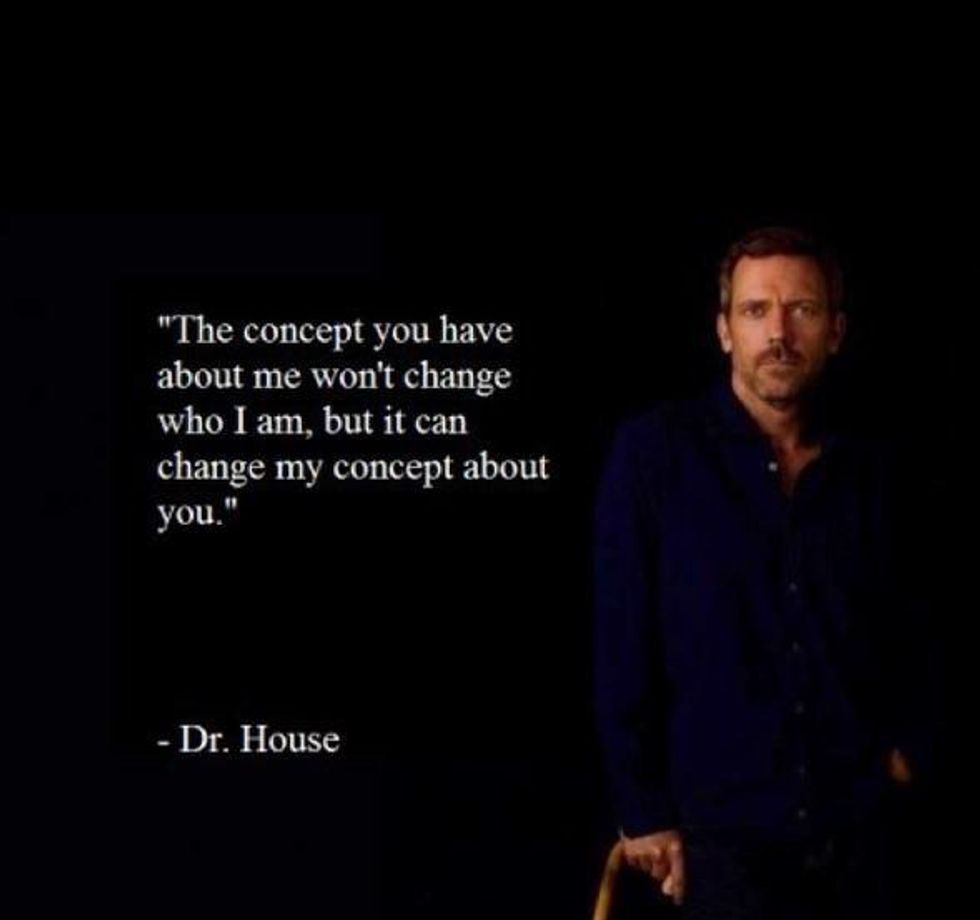
"Rock on, Dr. House. You said it," says every marginalized population ever. (Ironic coming from a rich white man, I know, I know.)