
The new 007 movie, "Spectre," is the 24th Bond film, and, now that it's taken the number one spot at the box office, reaching almost $35 million thus far, I believe it’s an opportune time to discuss how the prolific series has grown over the years, starting from Ian Fleming’s original 007 novels to the first adaptation, "Dr. No," which was based off of Fleming’s sixth novel of the same name.
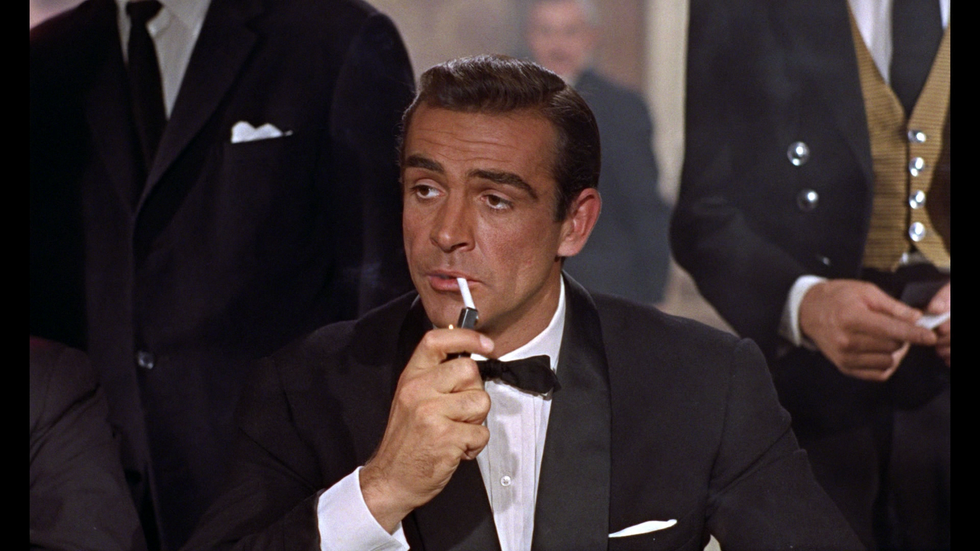
Many viewers are not aware of how James Bond actually started, with the introduction of our main character in Fleming’s first novel, "Casino Royale." This would be adapted into film only 50 years later, and where the famous Vesper martini (named after the Bond girl) had originated. In the novels, Bond is described as having a “cold and ruthless” demeanor. He has a slim build with black hair, blue-grey eyes, and a “cruel” mouth. He was also rather tall, about six feet. Such qualities are to be expected from the film adaptations, which, for some of our Bond actors, it may be accurate. Sean Connery’s Bond is one of the most notable. He maintains this sly personality, a quality sprung by his license to kill, yet remains seemingly charming and calm. His stone-like facial features coupled with his enigmatic personality give off the impression of a man you’d trust to do the right job. Connery, who started as a model, seems to me one of the most iconic of the Bonds. His shrewd stare gave an impression that he was invulnerable to pain, almost used to it, as a matter of fact. Coupled with his laconic dialogue, he exhumes a mysterious aura that captures your attention and makes his nonchalance seem more admirable.
One instance I find to be quintessential to his personality is in "Goldfinger," one of my favorites, where our villain Goldfinger has Bond tied to a table of gold, while a laser slowly makes its way to split him in half. “Do you expect me to talk?” he asks coolly. “No, Mr. Bond,” Goldfinger answers amusingly,” I expect you to die.” Even in such dire circumstances, he is able to effectively communicate his way out, claiming that only another, perhaps more professional agent will come to replace him. Such a cool attitude is expected in James Bond, regardless of the actor involved. That’s what it makes it so entertaining, that even in the face of mortality, which seems very likely in most circumstances, he keeps his cool.
Following Connery’s departure came a new actor, George Lazenby, in 1969’s "On Her Majesty's Secret Service." Many fans were surprised to see a new actor take on the series, and didn't expect for him to stay on too long. Lazenby’s Bond has the proper look to Ian Fleming’s creation, however, unlike the previous Bond, he doesn’t come off as charismatic, despite his prizing looks and well-done fighting sequences. The producers wanted to stray away from all the cool weapons and gadgets that the original Bond series tried to have, trying to bring the character back to the way Fleming made him. However, we still see the old Bond getting himself into extremely precarious situations, with, of course, a tint of romance infused into the mix, this time with Contessa Teresa. A short detour from the original films, we actually get to see Bond getting married at the end, leaving us with more of an emotional tone than we’re used to seeing.
Roger Moore holds the record for most Bond movies played, next to Connery, taking over the role from 1973 to 1985. He was also the oldest actor to portray Bond. Much of Bond’s historic portrayal comes from his versatility in his gadgets and alibis that keep him and the woman of the week away from danger. The Roger Moore era came with a series of extraordinary stunts, ones that have never been portrayed so vividly in film. It was an odd turn at the time, to see a man so fearlessly ski off a cliff, jump onto a flying plane, or hop over a pond full of crocodiles. Only in James Bond. It seems that filmmakers can’t help but return to the outlandish and incredible sequences that make 007 so exciting to watch, instead of focusing on the actual characterization aspect. Our later Bonds, including Pierce Brosnan and Timothy Dalton, bring us the same high-quality assurance of getting the job done and doing what’s necessary for his country. Dalton's character, though more cruel and realistic, was very unfamiliar to many viewers, compared to the light-hearted demeanor of Roger Moore. His hostility rang much truer to Fleming's original Bond; however, his malevolence was somewhat over-stretched. The lack of regard for his enemies' fates created a more serious tone than former Bonds.
"Goldeneye" brought us our first glimpse of Pierce Brosnan as James Bond, starting us off with a grand explosion with his partner, 006, both trying to invade a chemical weapons plant in Russia. Even within the first ten minutes of Brosnan's appearance, we see some outrageous stunts such as jumping into a falling plane (which is not unusual for previous Bonds), and taking control over the craft. Brosnan's portrayal of Bond now appears more lighter and open to bits of humor. Though his rich smile and slick hair may seem alluring, his slightly jovial attitude does not ring very true to Fleming's Bond.
And now we turn to the Bond I love, Daniel Craig. He carries this astonishing, solemn stare that seems pretty much immune to emotion. This time, along with the sensational stunts and nifty gadgets, we get a closer look at Bond’s character, his flaws, his moments of vulnerability, especially with women. "Casino Royale" brought Vesper, a woman he began to really love though he soon realized she had betrayed him. Their departure was heart-breaking for Bond, which carried over into "Quantum of Solace," where we start to find a deeper part of Bond that we truly haven’t seen before. The action sequences were undeniably noteworthy--the typical Bond routine alternating between him chasing the bad guy, then him being the guy who's chased. With his large physique and sharp movements, Bond is actually better than ever. He’s swift, he’s agile, and he has many of the qualities that Ian Fleming’s Bond denotes (except for the black hair).
"Skyfall," one of the most glorified of the series, brings us to Bond’s roots. We begin to see now that there is a history to Bond, where he returns to his parents’ grave near his old orphanage. There are plenty of reasons this movie was great. We find Bond trying to rebuild himself from his disappearance for several months after he was presumed dead. His relationship with M, his boss, takes on a tone that resonates as a mother and son type of relationship, wrought with tough love. Even though she was willing to risk his life for a mission, he still finds himself returning to her side, with his noble sense of British loyalty. No matter what happens, he'll still continue the mission. We also take note of our villain, Raoul, a former MI6 agent who was also betrayed by M and comes back with retribution. His well-crafted schemes and plots to destroy MI6 seem to hit Bond really hard. Interestingly enough, "Skyfall" also brings back some elements of the original Bond, more particularly the iconic, metallic grey Aston Martin. However, in trying to protect M from the menacing Raoul, we also have a chance to see Bond as a sentimental, broken hero, who still manages to take on the villain.
The only issue I have ever had with the Bond series was its variety of unfathomable situations, where the impossible is totally possible, yet obviously unrealistic. Depictions of the Bond girls come off as shallow and predictable, to which he can capture any woman’s attention by saving their lives or just offering to buy her a drink. It's quite humorous but absolutely irregular in the context of other action and spy films. But of course, that’s what makes James Bond 007. He is slick and cunning in his ways. The novels tend to romanticize and delve into his actual thoughts and reactions regarding things like the imminence of death or sex with a woman. Of course, this is excised from film because of Hollywood’s preference for brevity.
It's evident that the commonality amongst all the 007 films is the tendency to showcase Bond as the epitome of stereotyped masculinity. James Bond measures up to what we would call the ideal Alpha Male, with his infallible technical and combat skills, his irresistible charm, his luxurious cars, and his profuse knowledge of fancy liquor. We cannot help but want to be Bond when he's on the screen. His charismatic air grabs our attention so much so that we yearn to be able to mimic his behavior. Though none of us really can adopt such a complacent attitude, we can still find solace in observing him in his prime.
We owe our enjoyment of such quality movies to the Hollywood industry for selling sex and violence. Throughout the history of 007, we’ve seen the same Bond nearly every time, sometimes with a slight twist. Yet, that’s what we all want, for the protagonist to outsmart the villains who are a bit too gullible for his tactics, to get the girl, then drive home in a $100,000 car (which was most probably stolen).