

It was the feeling of having absolutely zero control. I was with these three girls, whom I barely knew, and these three African men, whom I knew not a bit. And I was falling down a volcano. There was nothing I could do to stop myself from tumbling. There was nothing I could do to reach the bottom faster. There was nothing I could do to make the rain stop, just for a few moments. There was nothing I could do to abort the situation. There was nothing I could do to go home. How did I get here? It was then on that volcano that I thought I really regretted my choice to come to Africa. All I wanted was the comfort and safety and familiarity of my home. But that was just a little out of reach.
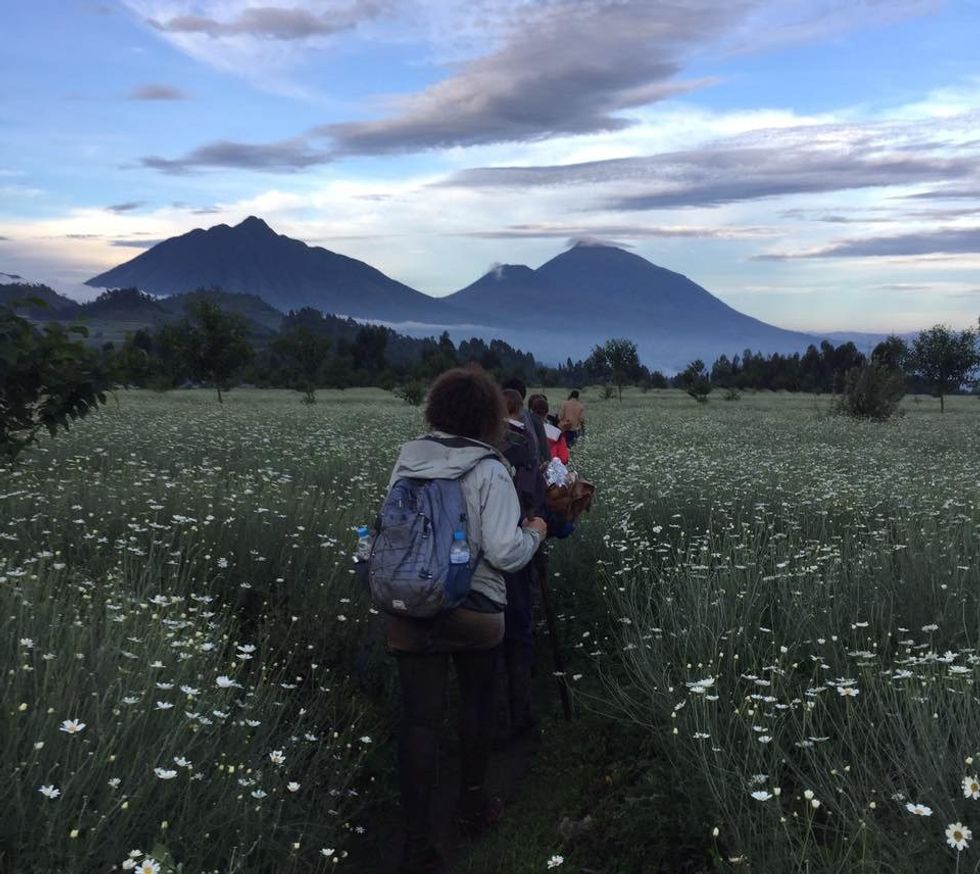
Five hours up, four hours down, we were told. We were brought here to trek to the top of Bisoke Crater Lake, an inactive volcano. Does that mean it should be climbed? Not in my book.
The terrain became increasingly muddy. When we started, we were walking on solid, rocky ground. Now, it was hard to find any footing. With every step forward, you risked getting your foot stuck and losing your shoe in the swampy mud. But you couldn’t focus solely on keeping your shoes on your feet. You also had to be attentive to the bushing lining the narrow path. You had to shimmy through the tiny opening in the leaves so not to get skimmed and burned by one. The mysterious plants, no matter how lightly they touched you, left a scorching scratch on your skin. And these scorching scratches would flame up randomly for days to come.
“It’s an adventure. It’s about the experience.” One of the many motivating phrases our guide used to get us to the top. We spent probably a total of 10 minutes on the top of that volcano before we were ushered back down in attempt to beat the rain. The rain that never stopped. It pounded against the side of the volcano, slickening the already muddy trail. It wasn’t long before the entirety of the path was a steep slip n’ slide made of mud. There was no hope of walking; you were sliding. Your clothes and backpack were layered with mud only to be washed off by the rain before being coated again and again. The unpleasant little plants were now the last of your worries, as you joined them on the edges of the trail, just to find some solid footing.
Many stifled tears, curses, complaints and pleas later, we arrived at the bottom again. I felt my eyes start to shrink, my knees beg to buckle beneath me and my ankles think about giving out. But they didn’t. I had made it. I made it through what I considered at the time the worst day of my life. The day that actually taught me how to live.
Sometimes, the “worst days of our lives” are also momentous and a pivot point for change. While standing on that mountain, in the pouring down rain, covered in what felt like pounds of mud, I told myself I regretted coming to Africa. Those next five weeks became the best five weeks of my life. I chased lions on a safari. I bonded with our translators, who I was sure I had nothing in common with. I taught hundreds of kids English and life skills and spent my days with them dancing under the sun. I listened to stories about our hosts losing their brothers and sisters to the genocide. I fed monkeys bananas on the college campus in Huye. I ate homemade ice cream and banana cake. I learned African songs and games from our students, and even a little bit of the local language, Kinyarwanda. I thrived.
It all started on that volcano. I learned to smile even through the pain. I learned that it could always be worse. I learned that sometimes we need to lean on each other to make it through. And I proceeded to learn countless lessons in the weeks that followed. Those five weeks were filled with wonderful memories, with love, with treasured experiences. I met the kindest people in the world. I went to Africa to teach, but more importantly, I learned.

















