
Religion is a power and a movement used to guide groups of people with a set of principles by which to live. Each religion has its own set of principles that reflect a distinct goal (i.e. to reach nirvana, or to become one with the Dao). A religion is unable to accomplish its objective(s) without the supremacy that exists within a higher power to guide the people. People need something to follow, some overarching authority to guide and to wield the power of the religion, otherwise the religion lacks form. They need something to which they can attribute the values and teachings of the religion, something that can be perfect and is exempt from human error, and something that need not be explained but yet can explain the meaning of everything. People need something to follow, whether it be a leader, a teacher, or a god. In the case of religion, regardless of what that being is, it eventually transforms itself into a being that is divine. This divinity comes naturally as the central being to the religion is raised above others by answering the unanswerable and by doing the impossible.
Both Buddhism and Daoism are examples of religions which have attempted to avoid the incorporation of a god, however, each of these religions has evolved to involve a form of divinity that is central to the religion through the idolization and worshipping of The Buddha and The Dao, respectively. Buddhism is a prime example of the fact that religion cannot exist without a god or an idol to guide the movement. Meanwhile, although Daoism does not exhibit a deity in the same, somewhat concrete form as other religions, the Dao, or “The Way,” can be seen as divine, and thus as an abstract form of a god. The first volume of The Norton Anthology of World Religions discusses both of these religions in great depth. Jack Miles, the general editor recruited the efforts of Donald S. Lopez, Jr. and James Robson to explore the texts, teachings, and history of Buddhism and Daoism, respectively.
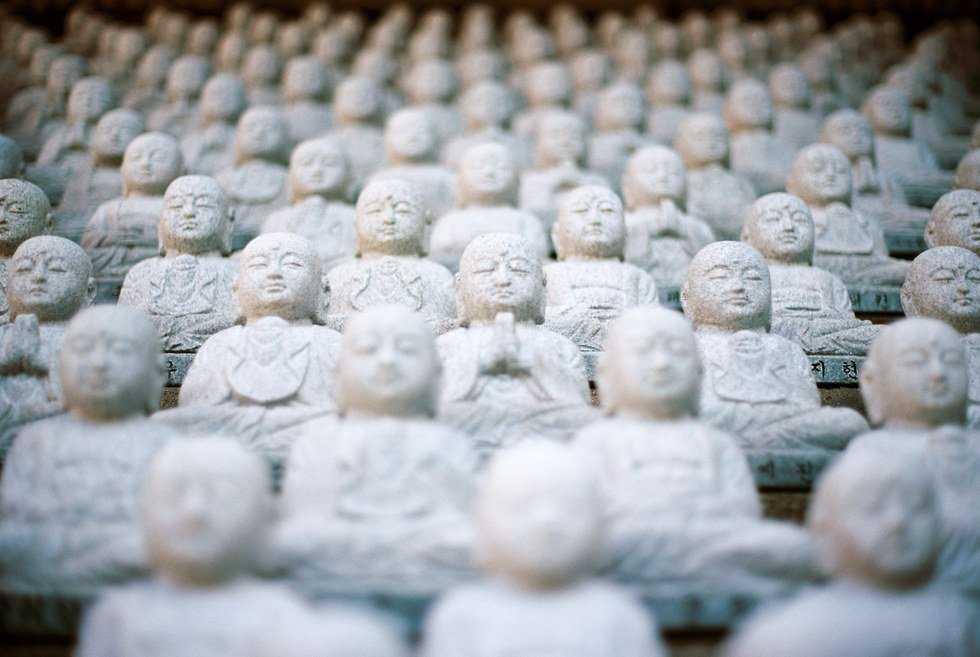
In Lopez’s introduction of "Great Discourse on the Final Nirvana" (The Mahaparinibbana Sutta), he quotes the Buddha saying, “You should live as islands unto yourselves, being your own refuge, with no one else as your refuge, with the dharma as an island, with the dharma as your refuge, with no other refuge” (841). Here, the Buddha is saying not only what Lopez interprets as that “the Buddha has taught everything necessary to traverse the path to nirvana; no other teacher is needed, nor is anyone else required to lead the order of the monks,” but also that the Buddha’s teachings are to be followed in and of themselves rather than the Buddha as a person. The Buddha is saying, as he has said before, not to make him into an idol or god, and to focus on the dharma. Regardless of his requests, the Buddha still exists today in temples as statues, and is even regarded by some as a god. Additionally, within his teachings, the Buddha says that the worship of gods and idols hinders and gets in the way of one’s path to nirvana. Despite this statement, the Buddha is referred to as “the Lord” (843), and “the Blessed One” (898), both reverent names. Thus, the Buddha’s attempts at guiding his people away from idolization has failed and he has become a divine being. Not to mention the plethora of text written about the Buddha. In these texts, the Buddha answers questions about the meaning of life and explains his path to enlightenment. By doing so, he rises to a divine level and becomes the central saintly leader of Buddhism.
Like Buddhism, Daoism is a religion that began at first without a clear god, and yet has grown around The Dao, or “The Way.” The Way is a way of life and being; it is a force that “cannot be captured in language.” It is “a unified universal principle preceding the origin of the universe, which set into motion the process of creation and was the cause of its enduring transformations. The Dao is the unchanging reality behind a chaotic and ever-shifting plurality of transformations” (1483). The Way is everything, yet it is nothing. The Way answers the questions which no one else can and is the creator. "The Scripture of The Way and Its Virtue" goes into further depth of what the Way is and isn’t, and its meaning within Daoism. It was written that “The Way is empty, yet use will not drain it…It images the forefather of God” (1516). This statement alone inflates The Way to a level of high divinity. “The myriad creatures rise from it…It gives them life” (1515). The Way is given credit for all of life, and is there to guide all who need it. The Way, although not a person or god, is the central idea of Daoism which is worshipped and gives meaning to all that lives.
In other religions, the use of divinity is clear, while in Buddhism and Daoism especially it appears to be more abstract. Throughout Buddhism, the Buddha very clearly condemns any form of worship and says that it will impede with one’s path to nirvana and enlightenment. Meanwhile, in Daoism, worshipping is not forbidden, and in some circumstances it is encouraged (when worshipping the divinities: Wushang fawang, Yuanshi tianzun, Taishang xuhuang, Yuzhen dadao, Gaoshang Laozi, and Taiyi tianzun (1813)). However, regardless of the original intentions of the religion, the statement remains clear that some form of divinity is a necessity to religion, as the people need something to follow and something that can guide them to explain the inexplicable. Both The Buddha and The Way started off as guides, and throughout time have evolved to become something much more. It is human nature to search and yearn for explanations, and this time and time again has been done through the teachings of world religions.