
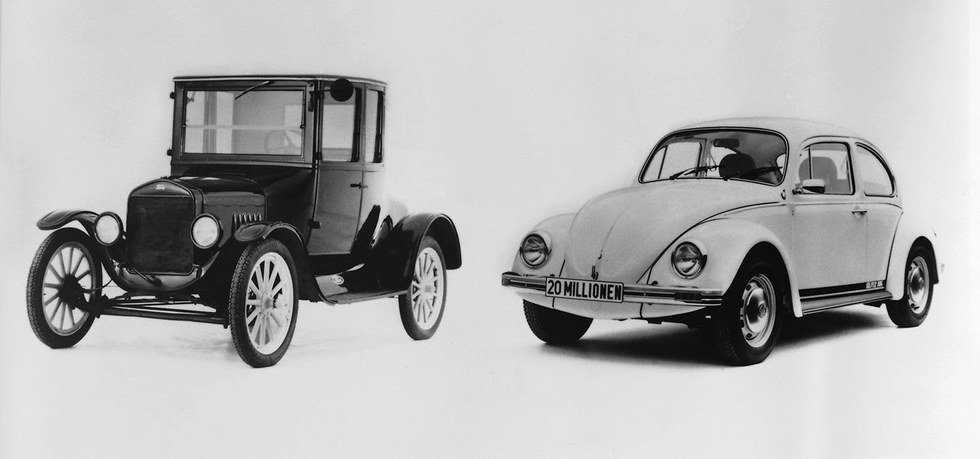
A hard comparison for an automobile historian is between two completely different cars. However, one similarity between the Volkswagen Beetle (or Bug, as it is popularly known) and Henry Ford's Model T is that both were revolutionary in their design, engineering, and in their drivers. Even so, both the Model T and the Beetle had their obvious differences. As such, one essentially borne the notion of the affordable car for the masses. The other took the same notion, and a little air-cooled simplicity, and became a cultural automotive icon.
But the eternal question concerning the legacies of Ford's creation and a machine built for simplicity is this: Which of them would be considered the true "people's car"? The obvious is that both were meant for the common masses. But did the Model T's humble beginnings outweigh the Beetle's more bureaucratic circumstances?
This question merely sets the stage. The Model T was the dream of Henry Ford, who was an engineer at heart. Ford found the wealthy market for the automobile to be appalling and sought to create easy transportation, and to give the working man his leisure. That by itself commands a great legacy for what is considered the first truly modern automobile, but that is not the end of Ford's influence not just in the market for automobiles, but for the industry itself. Ford was the essential generator of the assembly line, which could ensure the same quality of work in each car that was produced, and also that there would be more of them that were consistent with the last. Regardless of the slavery that Ford may have instituted with the monotony of the assembly line, the production of the combustion-driven Model T was predicated on this system, and it revolutionized the lives of the farmer and the businessman alike.
The Beetle had its beginnings as the dream of Adolf Hitler, who wanted a cheap and reliable car made for the German masses. This was a goal that was shared by Ferdinand Porsche (yes, him), whose career in racing and designing led him to a fated meeting with Hitler, and he set out and made what would be the prototype for the Beetle as we know it now. World War II complicated the Beetle's existence, and if it weren't for the British occupiers charged with revamping Porsche's work, Volkswagen would not even exist. The Beetle's simplicity, with a reliable air-cooled engine, unique rain-drop design, and a parts-based design that could be easily repaired, connected with conscious buyers. It would further connect with the Counterculture, where it became an automotive icon.
There is obviously more to this story that could be added. Perhaps a closer look at the design of both of them would help is trying to address the question of whether both are the same, or totally different. The Model T and the Beetle were based on the same premise, and both indeed had a similar purpose.