It’s February of your senior year. High School is winding down and you are ready to take the next step in life, a higher education. You just received in the mail that you have been accepted to your dream school. You’ve been dreaming about this institution for as long as you can even remember. The last four years you've spent working towards that GPA, running fundraisers, being the captain of your tennis team, and spending your Saturday mornings at the local soup kitchen to boost your credentials. You have never been so proud in your life. Then reality checks in when you see your bills owed for the first year totaling $56,000. You do not care though, you have worked so hard for this that there must be a way around it. As it turns out there is! You can easily loan out as much money as you want and all you need to do is have a parent or guardian co-sign it and your lifelong dream becomes reality.
This is the story of many middleclass Americans, including myself. The days of finishing high school and working on the farm or steel mill are long behind us. “Of course I am going to college, what else is there to do?” many of us repeatedly told ourselves. Parents encouraged us to seek out higher education and they even planned financially to support you. What they, and no one else, planned for was $56,000 a year, for four years, (assuming you graduate on time). This is not an issue, all you need to do is sign up and private firms like Sallie Mae will mail a check to your university. Problem solved!
The Year is 2006. You do not have a job, but you are thinking about getting one. You also do not have any assets, but interest rates are incredibly low and banks are handing out loans like free samples at Wegmans. You decide you want to buy a house that you certainly cannot afford but everyone else is getting a loan, so why not get one for yourself? Signed, sealed, delivered the house is yours. 18 months later you still don’t have a job. You get a letter in the mail demanding you pay back the loans or the bank will seize it along with any assets you have. The price of your house begins to fall, steadily at first, and then you realize you cannot even sell it to pay back the loans. Thus, the housing market officially busts. We wrongfully assumed the value of our houses would continue to rise. Then, banks are losing millions and billions of dollars. The banks fearing the absolute worst, stop giving out loans and interest rates skyrocket. We know the history onward. Simple economics states once the banks stop giving out loans, the markets collapse. The realization of how terrible of a situation we have brought ourselves into sets it. Unemployment skyrockets and the worst recession since the Great Depression begins. Luckily, Uncle Sam saved the day by bailing out the banks with 700 billion dollars of our nation’s tax money.
Ten years from now the possibility of this repeating could be almost certain. Many assume we will all be able to just easily make more money because of having a college degree, just like how people thought the value of their household would continue to rise. Some of us will be able to pay off our loans, but many will not. Once loans are not paid back, we could see an entire collapse of our nation’s Higher education system. Yes, that means no more frat parties either, unfortunately. The day we receive our degree, the countdown begins. We have 12 months to start paying back our loans until the debt is then our parent’s responsibility. This may sound terrible, but at least there is something backing all this fake money. Other reports show that having a college education truly increases the average income over a lifetime versus someone without one. The problem with this assumption is that it assumes that everyone taking out loans will finish college. Sometimes life gets in the way and a degree does not pan out. Ideally, there should be some regulations on who receives loans. President Obama has urged private givers to ask for a 3.0 GPA to continue receiving loans. As of right now, there is no federal regulation on who receives loans based on academic performance.
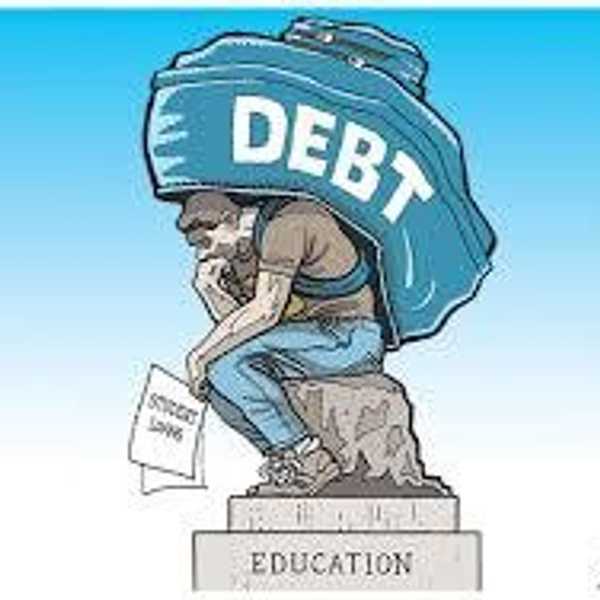
The bottom line is the issue at hand is a real one. Student debt is the second largest debt in the country right behind mortgage debt. Bailing out colleges like the banks is incredibly unpopular and only plug up the holes on a sinking ship. Before assuming that college is the only option, we need to reevaluate the relationship between costs and benefits. Parents, before cosigning that contract, you must be ready to make your child commit to finishing college. As a whole, we can work towards lowering the debt with rational and fiscal decisions we make privately and publicly.