

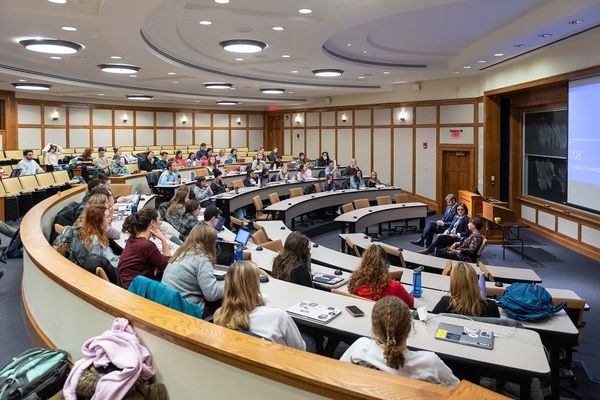

Non-traditional students are on the rise. According to the National Center for Education Statistics, roughly 72 percent of all college and university students are non-traditional. This class of student has been increasing at a considerably rapid pace in the last decade as more working adults have made the decision to continue with their education. Despite these statistics, higher education does not seem to have received the memo. Non-traditional college students face numerous challenges in their quest for a higher education that are certainly not limited to child care, availability of classes, and the almost archaic system that assumes most students of higher education are recent high school graduates.
Many working adults are parents and some of these adults are single parents. While all parents can have issues with finding child care while acquiring an education, it is with single parents that the majority of burden seems to lie. Finding child care as a single parent can be a formidable task, and many parents do not have the family connections to ensure their child is properly supervised.
There are certain schools help assist working adults with this matter; Augusta University has recently implemented a program to help parents with this issue, thanks to an on-campus student movement.
While child care is certainly an issue, the availability of classes can also be an enormous hindrance toward the non-traditional student. Before delving into the issue, it must be noted that quite a few schools do offer different class times for a particular class, and the issue is that many of these classes still take place only in the morning and afternoon. Working adults who succeed during their higher education tend to take more evening and night classes. The issue is that both evening and night classes are few and far between. For this reason, many adults have a tendency to lean towards two year programs or technical colleges for their educational requirements.
Classrooms themselves can be unfriendly toward the non-traditional student. Professors often assume that their students are recent high school graduates, and the idea that “you should already know” something is heard on a regular basis. Basic ideas, such as proper English writing, may not even be taught in the English class itself. Personally, my Philosophy class has taught me more about how to write than the four years of English and Humanities I enrolled for.
Many non-traditional students feel like they will always be behind and cause continuous stress on themselves just to try to “catch up”. Non-traditional students often have difficulty keeping up with a system that was clearly built for 18-year-olds. Copious amounts of study and homework is a huge stressor, as is the issue of out of class activities to be completed for the class.
These issues do not even begin to touch the multitude of issues that non-traditional students face while attempting to get the higher education they desire. Certainly there are no easy answers to this dilemma, and there may be concepts that just can’t be fixed in a timely manner.
However, higher education can’t continue to ignore the growing percentage of non-traditional students and must adjust to fit their needs. The system itself needs to realize that times change.















