
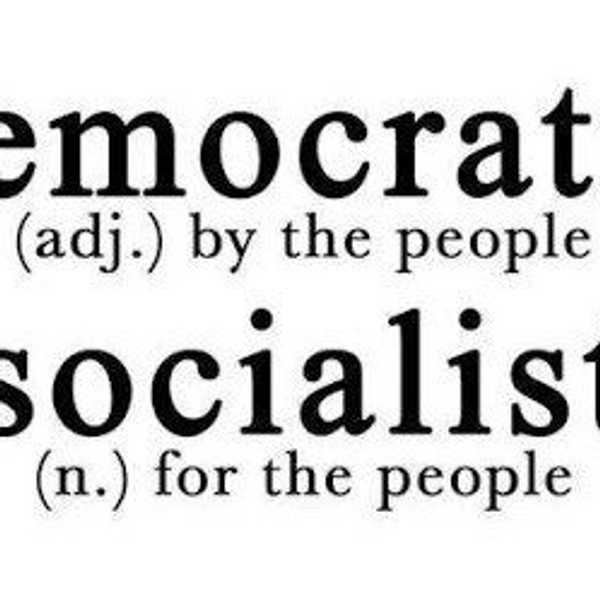

Socialism wasn’t always taboo.
During the beginning of the twentieth century, the Socialist Party of America was a thriving political organization. In 1912, the party drew nearly a million votes for its presidential candidate, Eugene V. Debs, a great labor leader. Threatened by socialist popularity, the Democratic and Republican parties began to support progressive agendas, effectively stealing the socialists’ thunder. The fatal blow, however, came about during the Cold War, when the public identified socialism with communism (when in fact the American Socialist and Communist parties were bitter rivals). Socialists then turned their support to the Democratic party, which already included unions, racial minorities, women’s rights activists, and environmentalists.
Yet even this resurgence was limited, as ignorance about the political model grew with the socialist taboo.
As conversation continues around the presidential debates, it’s important to realize that perhaps America’s current political model is flawed.
Consider the alternative socialist approach in Finland, where the incomes of individuals are recognized within the justice system. Speeding tickets, for example, are assigned on a scale relative to the individual. It’s part of the country’s “day fine” policy, which requires fines for small infractions such as speeding to be based on the income of the person receiving the fine. Finland is not unique in this policy. Other countries like Sweden, Denmark, Germany, Austria, France, and Switzerland also have systems of “day fines.”
According to The Atlantic, the system works like this: the amount of spending money the individual has for one day is estimated, then divided by two. This is considered a fair amount to deprive them of for that day. Based on the severity of the crime, the system may calculate that the offender should go a certain amount of days without that money, doubling or tripling the amount.
The premise is that a $500 ticket for a poor person is a harsh punishment, but not so for a businessman or businesswoman who makes that amount in an hour.
Economist and Professor of Economics Emeritus at the University of Massachusetts Richard Wolff says that one way to encourage equality is to make the punishments equal, not in number but in felt deprivation. Those heavy fines are then used to benefit social impacts, such as national healthcare, tuition-free college, and free childcare.
Finland, which also has a capitalist economy, considers an offender’s position in society, not just the transgression itself. In this way, Wolff explains, “You hold the economy accountable for how it treats people, you don’t treat people accountable for how well they’ve done in the economy.”
Currently, American culture is not ready to accept such socialist tactics. The American Dream of pulling yourself up by your bootstraps means that this model of equal punishment is perceived as unequal and unfair. Most Americans are ignorant about the social norms in other countries, particularly the equality provided by government institutions.
With the new generation, attitudes are shifting. Wolff points to presidential candidate Bernie Sanders, who identifies as a democratic socialist and an outspoken opponent of income inequality and corporate greed, as a beacon of potential change.
In fact, a 2010 Gallup poll showed that 36% of all Americans have a positive image of socialism.
Yet even Sanders has conceded that the odds are against him. Fortunately for the candidate, he is a democratic socialist, which might lessen the blow for more conservative voters. We can only hope that with each conversation about the presidential debates, an opportunity for awareness is raised and new political solutions explored.