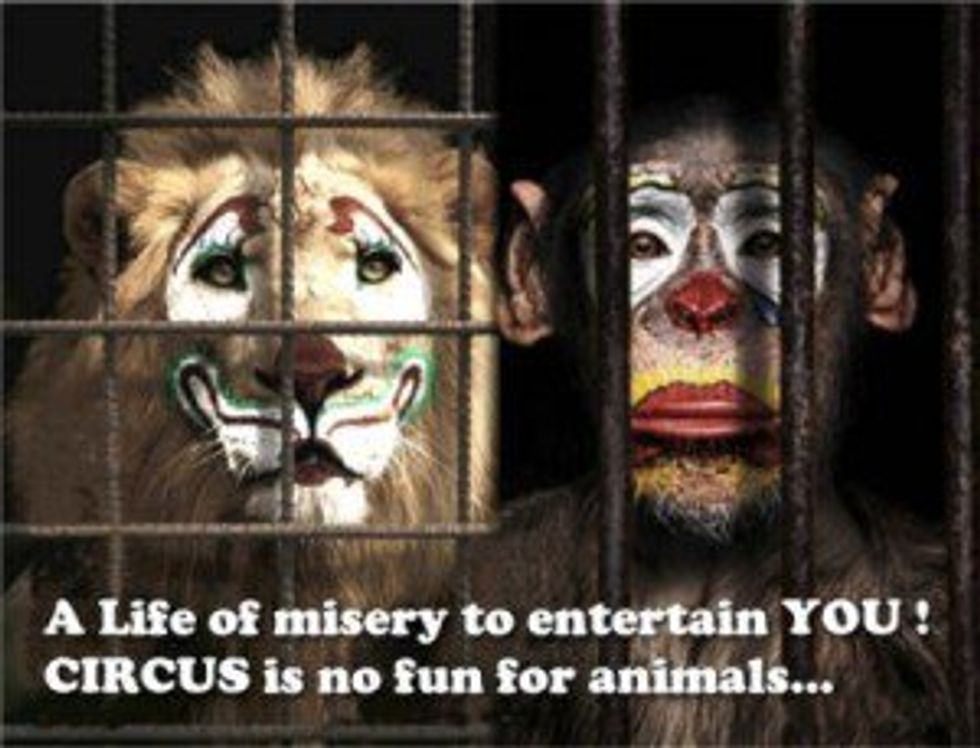
Americans love animals! We love to eat them and watch them dance and put them behind bars. We love them so much we’ve created multiple moneymaking establishments where we can go see wild animals up close. We can watch the amazing Orca, who can swim around 100 miles a day in the Ocean, linger with a flopped dorsal fin around the perimeter of a cement pool. Elephants that enjoy grazing and wandering large savannas charm us when they are chained up and whipped into wearing those fun little circus hats. People even visit gorillas to get a taste of what the exciting, stationary life of a captive animal looks like, unlike the boring play and interaction you would observe in the wild. The confusing part about all these fuzzy animals that we love to anthropomorphize is why don’t they love us back? These animals lash out because to them we aren’t their friends or their caregivers. Animals who are taken from their homes in the wild, and put under our command in a restrictive environment for the remainder of their lives, regard humans as their oppressors.
How is the animal entertainment business not a business founded on the enslavement of a sentient being? The animals don’t get anything out of it. Nobody asked the polar bears at zoos if they prefer to float in the tub of a glass enclosure in upstate New York or San Diego instead of following her instincts and fulfilling her life in the arctic. Perhaps she would have said yes, or she just as likely would have said no, but it doesn’t matter because she had no say at all. Who did have a say? The people who pay to keep her there so they have a place to take their children for a few hours and grab a snack and a few cute pictures? That seems extremely imbalanced in terms of whose life is being affected more dramatically.
Perhaps I seem presumptive in my assumption that a wild animal like a wolf doesn’t prefer running in circles around the perimeter of a cage to the strenuous challenges offered to wolves in the wild. You know, like hunters… but that’s another article. Sarcasm aside it isn’t completely unfathomable to think that animals are safer and better looked after in captivity. As a former volunteer at my local zoo, throughout my adolescent years I observed the lives of zoo animals on a daily basis and saw how some of the programs run by these establishments do offer wildlife and ecosystem education to the public. Interestingly, however, much of the material that I got to relay to visitors was not about the animal sitting in the cage behind me, but their relatives who evolved and adapted to a very different lifestyle in the wild.
It is true it can be very sad for these animals when they have to struggle to find food or lose their babies to predators in the wild. However those struggles are in their nature and easier to move past when they are in their comfortable environment with their kin or naturally intended peers surrounding them. In the hands of a human these animals are subjected to tasks and training that are not in their nature in order to be served food. They have to be or they wont behave the way that we want them to. Even when they are trained “successfully” like famous Orca Tilikum, who was featured in the eye-opening documentary Black Fish, these animals become so disturbed by their subjection to involuntary and senseless preforming that their cognitive functions are deranged.
Tilikum has killed three people since being kidnapped from a screaming pod of wild Orcas in 1981 and still preforms at Sea World in Orlando today. Even once captive these animals are selectively separated and grouped for show and mere aesthetic purposes, so the mothers and offspring more often than in the wild experience the pointless and heart wrenching loss of one another. In the wild when an animal dies it is to feed and promote the health of another, but what can we say for tearing animals away from their comforts and loved ones in captivity, prompting them to mourn so intensely that they produce screams never heard before by researchers? Simply because we like it better that way; this justification is a disgrace.
Tilly isn’t alone, many captive animals like him have acted violently in the same sort of retaliation and been far more lucky to have been killed and granted an untimely escape from their suffering. Tyke was an elephant known for her resistance to the circus training she had been condemned to,and was eventually shot in the streets of Honolulu, Hawaii after killing a trainer and escaping the ring during a show. Recent pandemonium has spread from a zoo in Cincinnati, Ohio where Haramble, a 17-year-old Gorilla attacked a 3-year-old boy after the child fell into his enclosure. He injured the boy to the point where police felt they had to shoot him and people wonder what could have prevented the tragedy. These incidents are only a few among many jaw dropping hidden instances of outrageous practices in the animal entertainment industry. Not only are these animals deprived of the maximum health and stimulation that they might access in the wild but they are often tortured, confined and drugged.
Race horses drop dead on the scene from trainers feeding them illegal drugs, or if the horses never manage to suit the physical expectations of the greedy, multi-billion dollar industry then they are brought to slaughter to be discarded. Apes used for television entertainment are routinely beaten. Horses used for carriage rides in cities like New York are kept in the dark quarters of abandoned walk up apartment buildings on their rare time off and develop injuries and illnesses from the hazardous environments in which they are forced to work. Circus animals are prodded with electric rods, kicked, hit, beaten and battered to convince them that it is in their best interest to preform. The list goes on.
The bottom line is that these animals do not belong to us any more than another person belongs to us. I speak with hostility and urgency because I am concerned not only about the otherwise peaceful animals who are being mistreated and longing for freedom in this very moment but about the children who we are teaching to appreciate these violent traditions. To tell our kids when we go to a zoo or aquarium that these animals are happy in this environment is a bold-faced lie and thereby hinders their education about the reality of the animal's nature and biology. On the other end we could tell them that it is acceptable to have these animals preforming for us because how they feel isn’t so significant since people are “benefitting.” This teaches them that as long as we are satisfied we can assume our perspective is the most important and suspend any empathy or ethics. We ought to teach our children that love is not possession but understanding. If there is one thing we can surely understand about any animal, human or not, it’s that they want to be free.