

When I recently saw the movie, it became really obvious that the production team of "Rescuers Down Under" wanted to present a left-winged political message. To start with, the poacher is someone who doesn’t care about other’s emotions (think of how he treats Joanna, his pet lizard, and Cody) and is very physically strong. In this way, the poacher represents the way that some wealthy people, in capitalism, don't care about and are capable of exploiting poorer people, the environment, or both. Whether it's the poacher here, Family Guy's C.M. "Monty" Burns, or Texas' own Koch brothers.
Really rich people are immune to pretty much anything. The poacher, by making a living off selling poached animals, also represents the environmentally and socially destructive nature of capitalism while, at the same time, acknowledging that the rich (the poacher) is dependent on the environment and the very people he/she suppresses to survive. Charles, often called Karl, might be a possible allusion to the Marx who called people like the poacher "bourgeoisies."
On the other side of the economic conflict in "The Rescuers Down Under" is the team of Cody and the mice, who all bond together to save the golden eagle in the film. They represent the working class who make the communist revolution by overthrowing the greedy capitalist poacher. The culmination of this idea happens at the point in the film right before the character Barnard “saves the day” towards the end. As the poacher was lowering Cody into the river with a crane with controls in the cockpit of the poacher’s truck (or whatever that thing is) Barnard snuck into the cockpit, stole the key of the truck, and turned the crane off, preventing Cody from being plopped into the river. Right after Bernard cut off the power of the truck, the poacher was wondering what could have caused this to happen, so he went up to the cockpit in search of his keys. Bernard had to hide with the keys under a gas pedal in the truck to prevent getting caught by the poacher.
At this point in the movie, the momentum of the opposing sides changes. Up until this point, the poacher had an advantage over Cody and the other animals, such as the eagle and mice. Bernard changed the whole tide of the movie by enabling 1) Cody to escape from the river and more importantly 2) preventing the poacher from ultimately catching the eagle. This change of momentum of the movie could represent a left-winged economic revolution given the rest of what we know about the characters. In order to make this revolution almost strikingly obvious at this period in the movie, the producers seem to have put a symbol of this kind of revolution on the back of the gas pedal that Bernard was hiding behind:
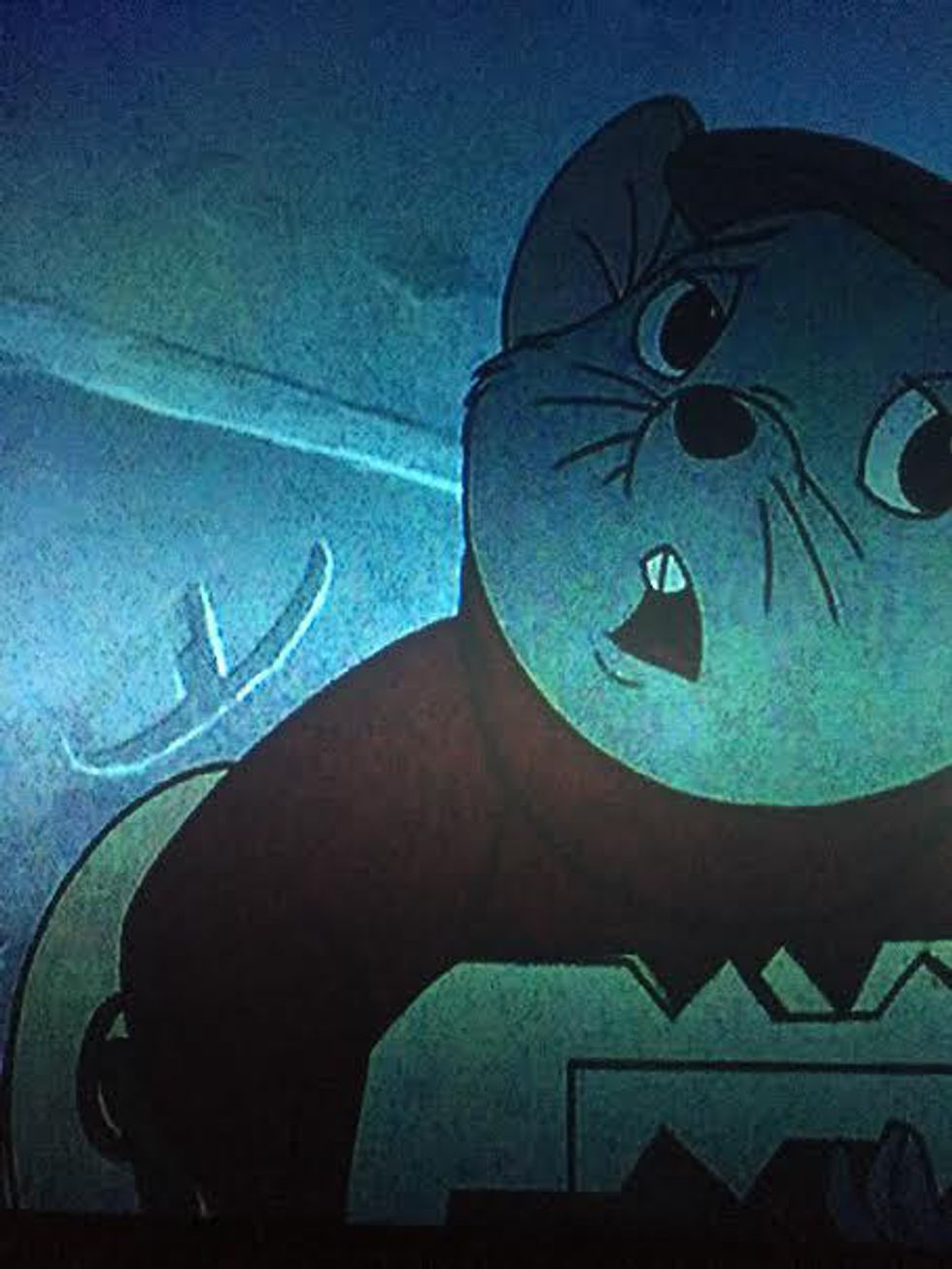
You may recognize the symbol Bernard stands in front of from the communist party:

If we can accept that, at this point in the movie, there is a kind of extreme leftish political revolution, then there are a lot of other interesting aspects of the movie that are worth taking a look at. A great example of this is the development of the Bernard character. Until he saves Cody (and ultimately the eagle), Bernard is extremely passive. For example, from the start of the film, he wants to propose to Miss Bianca, but somehow cannot find the confidence to actually do it on two occasions after showing clear signs that he wants to. Also, a couple characters flirt with Miss Bianca during the movie, which he tolerates.
If Bernard represents a member of the working class, then his lack of confidence pre-revolution could be a symbol of suppression of poor people in a capitalist society. More importantly, though, after the “revolution” mentioned previously, Bernard musters up the confidence to propose to Miss Bianca, who of course agrees to marry him. In this way, the movie may be referencing the fact that a left-winged revolution grants certain people (members of the “proletariat”) opportunities that they didn’t have in a free market.
I think that the liberal message Disney presents in "Rescuers Down Under" even makes even more sense given the time period it was made. The movie was released in 1990, around the time that the Communist Party of the Soviet Union, led by Mikhail Gorbachev, was becoming much more right-winged. Interestingly enough, 1990 was the year that the communist party lost its monopoly over the political system of the Soviet Union. For a movie with a more pragmatic economic outlook, see the Lorax.