


When you ask Google to define 'poor', it spits out three definitions:
1. lacking sufficient money to live at a standard considered comfortable or normal in a society.
2. worse than is usual, expected, or desirable; of a low or inferior standard or quality.
3. (of a person) considered to be deserving of pity or sympathy.
I don't think it is mere coincidence that this one word shares these three definitions. Sadly, often when we think of somebody as poor, we not only think of the first definition, but the second and third as well. I think the connotations surrounding this word are often not considered- the phrase "helping the poor" is tossed around, and people don't bat an eyelash, myself included. And yet I think this makes what should be an unnecessary statement a bit of a foreign concept to us:
The 'poor' are people too.
Obvious, right? This may sound ridiculous, like saying that the sky is blue. And yet I know that even though I have done lots of volunteering in my town, this fact had never really sunk in for a long time. I'm helping a good cause, I'm donating my time to something selfless- is what I told myself. And yet it was always an abstract goal, helping a large mass of faceless and nameless poor.
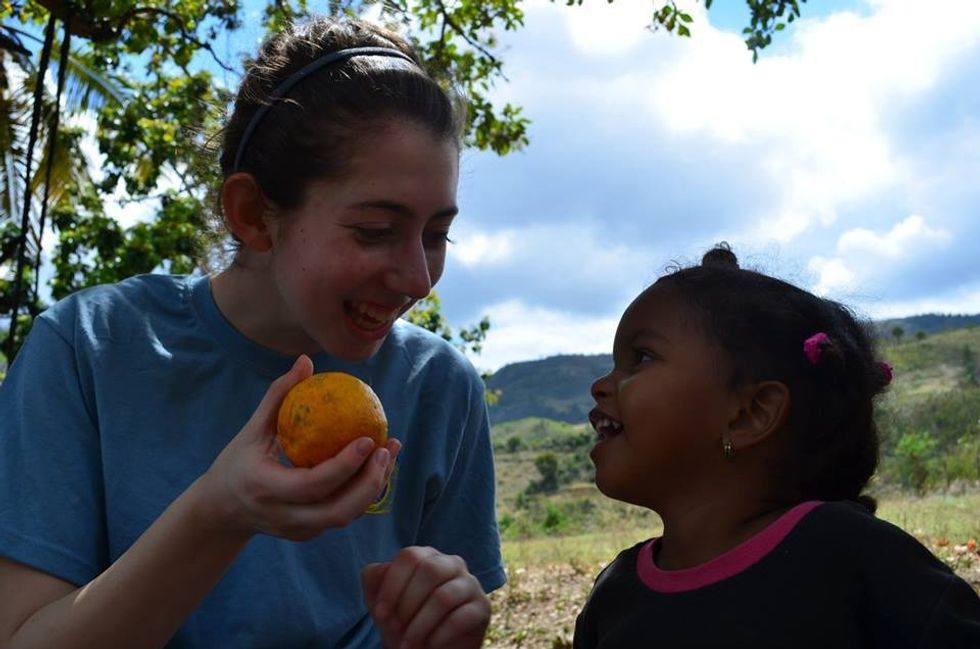
However, this changed for me last March. I went to the Dominican Republic with a group of fellow students and sponsor from my local high school, and through the course of the next two weeks I fell in love with the town of La China; I fell in love with each and every one of the children. The poor was no longer a concept I kept at arms length, it was the children that I Ioved deeply. I remember one afternoon sitting by the rocky road that ran through the village, thinking about the kids, and almost unwillingly crying because I knew that the circumstances that they had been born into would stop them from having a choice of what their future would be.
The poor are no longer an abstract figure to me. It's David, with his mischievous smile and big bear hug. It's Miguel, living on his own at 13. It's little Dilah, tottering around outside our home, just waiting for us to come out. They are individual lives, they are people, people who had accepted us into their lives for the short period of time that we were graced to enter them.
For me, this realization has changed my motive behind everything I do. My goal is not to help 'the poor', or 'the less fortunate'- it's to help people.
Instead of mentally making ourselves superior to those we are helping, we should aim to instead view them as equals, people just like us. It it is easy to fall into the mindset I've described, but that doesn't mean it has to be a permanent one. You may find you have more in common with the people you're helping than you would think.















