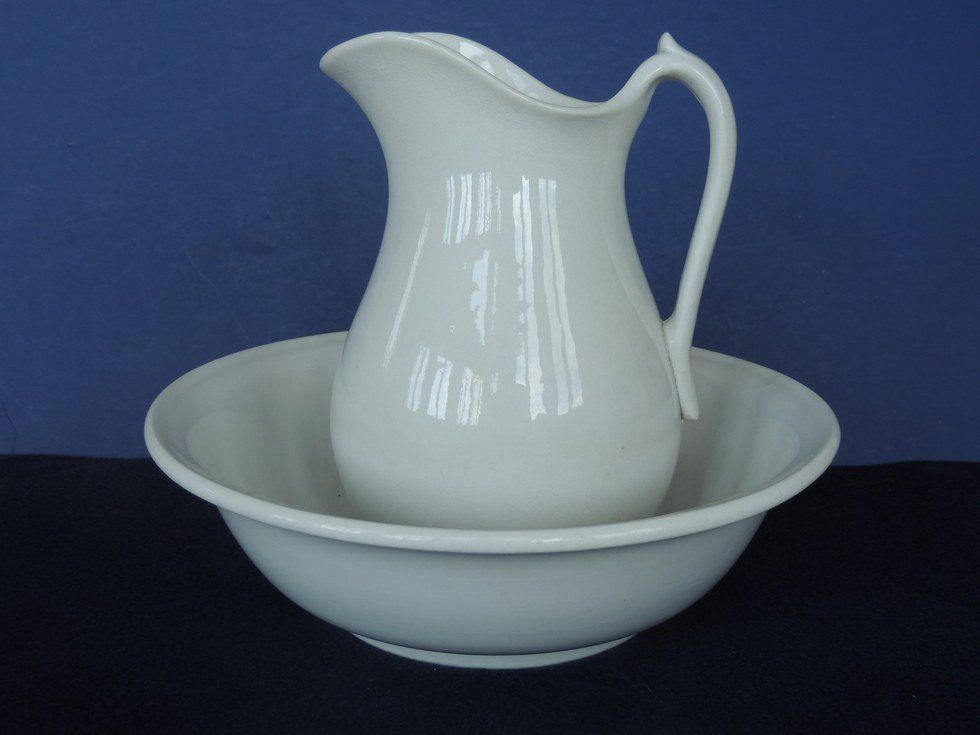
Mom has had her grandmother’s white ceramic pitcher for as long as I can remember. It lived on top of the curio cabinet, overseeing the living room, and I would often catch my mother looking at it while sitting on the couch. Not saying anything, just looking.
Kathi and her grandmother, Siti, were as close as grandmother and granddaughter could possibly be. Kathi, being rather indifferent to her own parents, especially her mother, loved going over to her grandmother’s house to watch her make Dolmades and various Mediterranean dishes. Siti offered my mother a place to feel warm before going back to a house filled with coldness.
I don’t remember my great-grandmother dying or how my mother looked the day it happened, but I can only imagine how the crumbled paper of my mother’s soul must have ached in her chest.
Out of all of the mementos my mother could have asked for from her grandmother, she wanted the ceramic pitcher. It was pure white, unstained, and completely intact except for a deep crack in the right side running from the base of the mouth to the middle of the handle, which curved over the fat torso of the pitcher like a snake.
I don’t remember when my mother placed the pitcher for display in our home, but I wondered for a time about why.
My great-grandmother was very old when she passed away. My mother always said she was the most-God fearing woman she knew, she is who taught my mother to love God.
“Each morning she would wake up and fill the pitcher with water from the well,” Mom would tell, “And then my grandfather would use the water to wash and shave with before going to work.”
Siti would always wash her face and hair with his dirty water after he had left for work each day, being a good wife and putting her husband first always.
My mother never really knew why there was a crack in the side of the pitcher, she figured that it may have been due to my grandmother’s clumsiness at one time, or maybe it was her husband’s fault.
“She probably told me at one point,” Mom said, “but I’ve forgotten by now.”
I’ve always known that the pitcher meant much more to my mother than it ever meant for my grandmother. It was something Siti had touched, used, washed, and seen every single day of her life. I suppose my mother always thought that if she had the pitcher, my great-grandmother would come back to life in some way.
On Christmas Eve, a few years ago, my dad knocked into the curio cabinet and my mother’s beautiful pitcher smashed into a million pieces on the floor.
I never saw her shed a single tear as she gathered up the pieces with her French-manicured nails and placed them in a cardboard box. She was silent for the rest of the evening as the rest of us opened presents from one another and drank hot chocolate in front of the fireplace. My mother’s entire life had shattered on the floor that very evening and no one even realized.
The box of shattered ceramic still controls the corner of the living room, unable to be repaired, right next to the curio cabinet. My mother sits next to it in a chair most nights while she watches television or drinks a glass of wine. Sometimes she still stares at it as she used to when it was on the cabinet, as if she is looking into the eyes of her grandmother.
Mom and I have always been close, as close as she and her grandmother were I’m not sure, but we’re close. I look like her, I think like her, and I act like her, but I believe a part of my mother sank the day her grandmother fell to pieces in the living room. A part of my mother also broke that day, but that part seems to still be alive within me. When the day comes for my mother to become my own pitcher, I hope that she does not come crashing down on me, to be placed in a box and forgotten by all but me.