
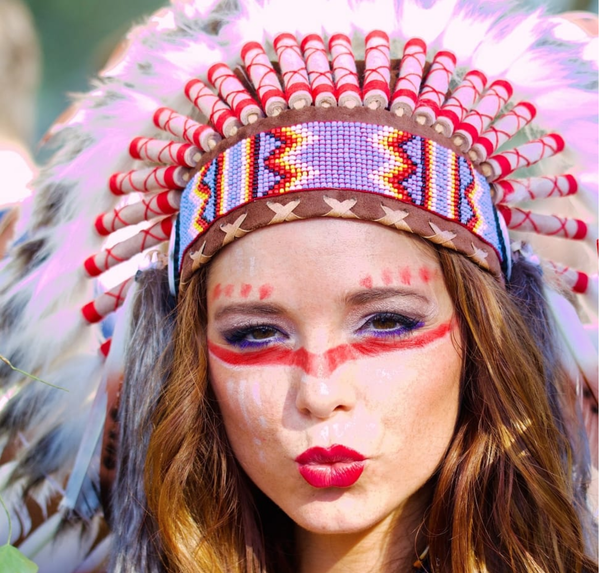

Fanfare, beautiful models, luxury lingerie and all, the 2016 Victoria’s Secret Fashion Show lived up to its history of cultural appropriation yet again, following the controversial Native American headdress worn by Karlie Kloss in 2012 with a new segment dubbed “The Road Ahead.” Drawing “inspiration” from Chinese culture, the segment featured models such as Elsa Hosk hoisting a gaudy Chinese New Year dragon on her back, Kendall Jenner with her flaming tails, and Adriana Lima touting Oriental-style embroidery on her boots.
1. Kendall Jenner flaunting the Chinese dragon aesthetic.
 According to Victoria’s Secret spokespeople, “The Road Ahead” was a celebration of multiculturalism, “blending in little bits of this and that from all cultures around the world.” But it is hard to view it as such when the designs are inherently nothing more than, as they deemed, “little bits of this and that,” taking from Peruvian, Mexican, and Chinese designs to create a mashup of exotically whitewashed luxury. If this is supposed to be a celebration, then why not preserve the inspirations as a whole, rather than throw in a dragon tail or two and steal a couple of “primitive” cultural patterns to reinvent as fashion? As Cosmopolitan executive lifestyle editor Helin Jung writes, “[Victoria’s Secret] and its creative leads shamelessly cherry-picked imagery, breaking apart aesthetic references from wherever they wanted and stitching them back together again. They’re telling us it’s worldliness. It’s not. It’s a hack job.”
2. Models strutted up and down the runway wearing cropped cheongsams, bolero jackets, and Andean pom-poms (all in the same outfit) as an expression of "multiculturalism."

VS Collection creative director Sophia Neophitou described a hand-painted piece of silk, crafted by artisans whose cultural knowledge decidedly surpasses hers, as being "meant to be naive, homespun...but this is so luxurious." Patronizing the simple craftsmen of China, Neophitou suggests that the brand has elevated primitive Asian culture to something worthy of luxury, once again reinforcing the Eurocentric concept that any non-Western art is immediately "naive" and "homespun." Victoria's Secret caters to white consumers specifically by incorporating these streaks of generic "multiculturalism" in order to sedate the ever-growing demand for the exotic aesthetic. This celebration of culture, particularly this display of Orientalism, does not inspire cultural dialogue, does not bridge gaps in our understanding of other cultures. Instead, it reinforces white capitalism and profit by exploiting the culture of non-whites.
Continued: A look back at fashion cultural appropriation:
3. Valentino's "wild, tribal Africa" - Spring 2016 Collection

Featuring tribal motifs, safari prints, cornrows, and fewer than 10 black models in a cast of 91.
4. Marc Jacobs' rainbow dreads - New York Fashion Week

Receiving backlash for having his white models sport locs, Jacobs defended himself via Instagram by comparing the dreadlocks to black women straightening their hair, and claiming that he did not "see race or color."
5. DSquared2's DSquaw - Fall/Winter 2015 Collection

Titling it "DSquaw," a derogatory term for an indigenous woman, the campaign displayed native patterns and traditional wear in superficial and stereotypical manners. No Native Canadian or American artists were consulted for their work.
6. Dior by John Galliano's Asia Major - 2003 Couture Collection

Geisha-inspired and featuring an almost all-white cast, Galliano Westernizes Japanese traditional wear into exotic luxury for European consumers.

















