


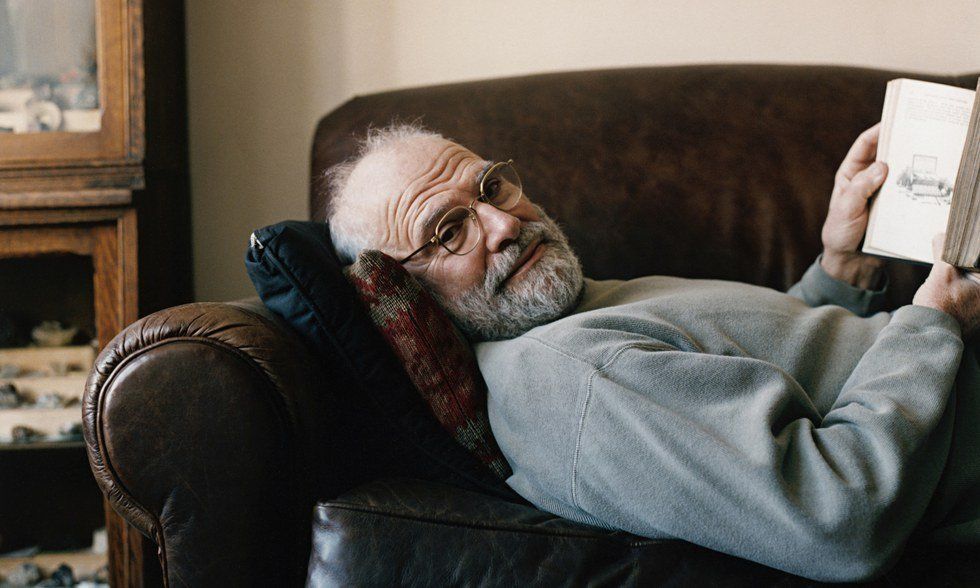
"The Man Who Mistook His Wife for a Hat," "Awakenings" and "Musicophilia" are among some of the most famous as well as some of the most intellectually stimulating books written by Oliver Sacks. Oliver Sacks died August 30 of cancer, but leaves a legacy as a neurologist and writer who contributed more than his fair share to the the world of medicine, neuroscience and the better understanding of the human experience.
As a writer, one of Sacks' main focus of discussion was how music related to the mind and how it could be used to study and possibly improve different neurological deficits. He explained why a beautiful composition like the "Butterfly Lovers" by Jon Jang might resound with one so much that it brings them to tears. In his book "Musicophila," Sacks said, "One does not need to have any formal knowledge of music -- nor, indeed, to be particularly musical -- to enjoy music and respond to it at the deepest levels." This is not only applicable to conventionally beautiful pieces of musics or to specific composers, but to every song. Whether it is Beethoven's Fifth Symphony or the Weeknd's "Can't Feel My Face," music moves us -- in both senses of the word. It's part of the shared human experience, as everyone to some extent can relate to the experience of feeling what artists try to convey through their songs. In terms of neurological improvements, Sacks used music in some of his patients who were suffering from memory deficits by asking them to remember their favorite symphony.
He also used the fact that the patients could still remember the symphonies and melodies to help them remember more mundane tasks. He also used musical therapy for helping aphasic people speak again in song form. Sacks also viewed music as a medium through which people could regain motion in their limbs as "the embedding of words, skills or sequences in melody and meter is uniquely human. The usefulness of such ability to recall large amounts of information, especially in a preliterate culture, is surely one reason why musical abilities have flourished in our species" ("Musicophilia," p. 239). He explored the intertwined nature of rhythm and most human functions and used it as a form of therapy for patients that most had deemed hopeless.
In addition to his writings and exploration of the intersection between the music and mind, Sacks is also well known for how he treated his patients. Besides providing the necessary help for his patients, Sacks often became the ray of positivity that many of his patients needed in their life. His unwavering desire to help people, his intelligence, and his diligence to his profession ultimately led to his decision to administer the then-recent drug L-DOPA, a chemical that turns into dopamine in the body, to patients suffering from encephalitis lethargica, a disease that often precedes parkinsonism. Although the drug wasn't the perfect treatment, Oliver Sacks' administration of it and remarkable recovery by his patients, as recorded in his book "Awakenings," revolutionized future treatments for this and Parkinson's disease.
Dr. Sacks brought a poetic and rhythmic approach to neuroscience that will undoubtedly benefit medicine for decades to come. On behalf of the medical community, the patients you have helped, and the students you have inspired.
Thank you Dr. Sacks, for the movements you have started.















