

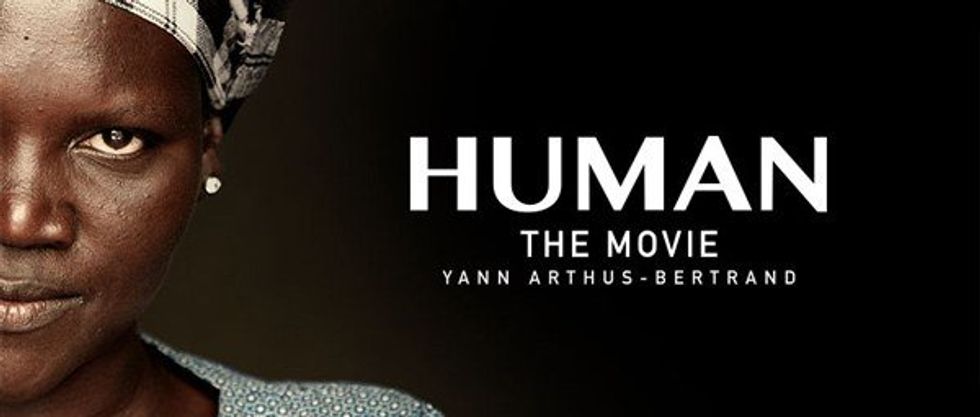
This past Thursday while surfing the internet, I happened to find a video recently posted on YouTube called HUMAN. This movie was made by Yann Arthus-Bertrand and is a look at the lives of others around the world whose lives are drastically different than ours.
The video is composed of people looking into a camera and telling their stories interspersed with shots of life from all around the world. Contained within just the first volume are discussions of love, poverty, and personal freedoms. This video is one of the most important videos I have ever seen, and I strongly recommend that everyone see it. Within the film are important messages directed not only at American Society but at all society in general. Here is a brief overview of what I learned from volume one of Human.
1. Privilege is everywhere
Toward the second half of volume one of HUMAN, the theme of the discussion changed to talking about poverty, wealth, and the implicit topic of privilege. In this section, parents conveyed their concerns for their children’s lives and futures. In this section, adults talked about how they were starving and about how there was little hope. In this section, the cyclical nature poverty was shown so that anyone could understand it. It was heartbreaking. Adults talked about how there was never enough work and how they were starving and could not get food for their children. One parent explained that she was working as a prostitute in order to support her child and how she hoped that her daughter would be able to get a proper education so that she would not have to become a prostitute as well. One older women cried out against the system and the injustice that lets the rich sit in mansions and the poor wade through trash for their meal, unheard by those who need to hear them the most. It was during these parts of the video that I relearned a lesson that I am ashamed to say I forgot: Everyone in America and in the entire Western World is more privileged than we can comprehend. I had forgotten that clothes were a blessing. I had forgotten that not everyone eats three meals a day. I had forgotten that even a bed was a blessing that many have to do without. I had taken everything in my life for granted and forgotten how precious everything in my life truly is. These are not lessons that we should ignore or forget.
2. Love is different and the same wherever you find it
In the first part of volume one of HUMAN, the main topic was a discussion of love. People detailed their experiences on love and how they thought of, and defined love. In this section there were discussions of polygamy, gender identity, divorce, abuse, and loss. In this section people described how they realized love. People also described how they lived through situations where there was no love. One of the most striking details in this section was how people's definition of acceptable love differed based on region. There were several stories describing polygamy in countries where it is legal and one story describing a similar situation but in a country where polygamy is not accepted. In every story in this beginning section I was struck by how universal and how powerful love is, but at the same time I was concerned by the fact that love can be limited based on the people you are around and the region you are in.
HUMAN was intended as a look into the life of “the Other.” It was intended to show society in other places in the world and the lives of people from all around the world. HUMAN was meant to give a view of humanity that we rarely see. It is an invaluable look at the world that I have barely even scratched the surface of explaining. No one can describe the situations better than the people depicted. That is why I urge everyone to see this film if they can. There are so many lessons within the video that I have not even begun to describe. There are discussions on education, freedom, and a hundred different things. These experiences are ones that we cannot and should not ignore. We must do what we can to help, even if the start is simply watching the video. But even if you do watch the video or have watched the video it is important to remember what might just be the most important lesson that is contained in the final minutes of the video: it is not enough to listen, something must be done.
Sources: