


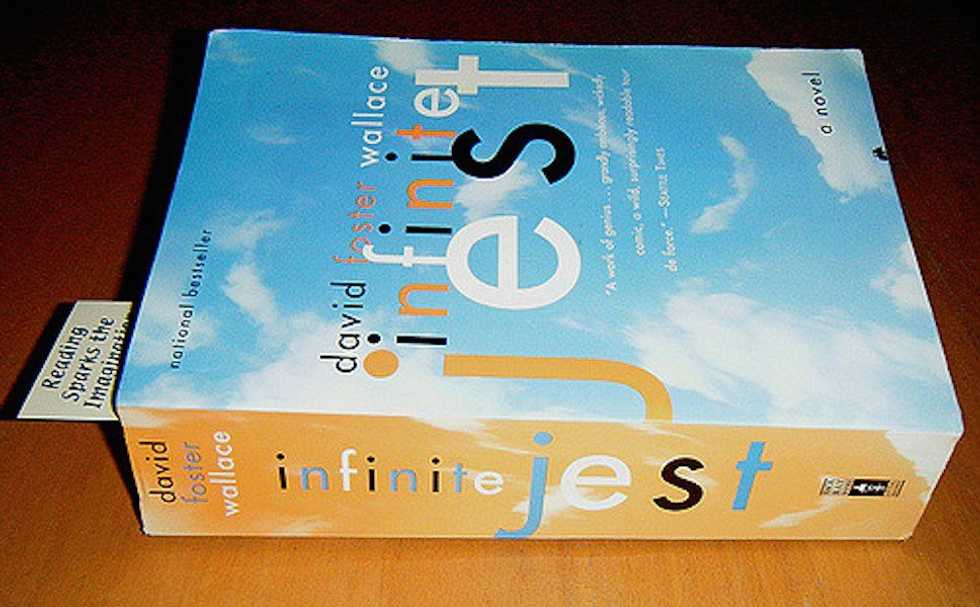
In a novel made to explore addiction and isolation, it is hard to believe that there is humor to be found within the inner workings of its pages. In it’s entirety (over one thousand pages), the book follows the storyline of a Tennis Academy and a Halfway house. We receive many marginal stories about the residents at each of these settings. Many stories of addiction are sad and stretch our capacity to understand and empathize with another person and their hardship. However, within that sadness and hardship is a delicate balance between banality and violation, humor and seriousness. In the book Infinite Jest, David Foster Wallace creates the human experience by using benign humor.
Authors of The Humor Code, Peter McGraw and Joel Warner, have created a humor theory that explores the roots of what makes humor funny. They call their research, the Benign Violation Theory. The theory suggests that, “humor occurs when and only when three conditions are satisfied: (1) a situation is a violation, (2) the situation is benign, and (3) both perceptions occur simultaneously.” (Benign Violation Theory n.d. Web.) They give the example of play fighting, or tickling. When you are tickled, there is a violation of your personal space, a violation of what you are comfortable with. The theory would suggest that tickling is funny, because it is a harmless violation, a benign attack. According to their theory, “a violation refers to anything that threatens one’s beliefs about how the world should be. That is, something seems threatening, unsettling, or wrong.” (Benign Violation Theory n.d. Web.)
This theory is applied throughout Infinite Jest. The purpose of the novel is to highlight addiction and loneliness, two themes that aren’t necessarily lighthearted. There is a need to be balanced, and that’s where McGraw’s and Warner’s theory comes into play. David Foster Wallace uses the benign violation theory in many scenes to diverge from the depressing realities of addicts.
Infinite Jest encompasses the story plot of James Incandenza who creates a lethally entertaining film. For something to be lethally entertaining, it must be a combination of the banal and the overly eccentric. There is a need for an over stimulating affect to be had, and in many respects, the novel is also accomplishing this. The book itself is addicting; not only does the reader struggle to grip an “ending, but the short fractal narratives imitate modern day T.V commercials. David Foster Wallace’s obsession/addiction to Television is well known in the literary community, so it’s not surprising that the novel reflects that addiction.
The structure of Infinite Jest relies on the constant up and down of benignity and violation. One of the most emotionally violating characters of the novel is Randy Lenz. He is a resident of Ennet House who is recovering from a cocaine addiction. Although, we find out that he has a very loose definition of the word, recovery. He takes to killing small animals like rats and mice on his walks back to Ennet House after the AA meetings. His killings eventually escalate to killing house cats and dogs. He is a violation of what a cocaine addict and an empathetic human being are. For animal lovers, his sections are the hardest to get through because of the cruelty he shows these animals; Lenz is the example of the violation portion of the balance. It is important to get his sections in contrast with the humorous.
Yet, one of the most prominently humorous scenes in the book is when we meet Mrs. Lenz, Randy Lenz’s mother. She is described in the book as being, “So unspeakably obese she had to make her own mumus out of brocade drapes and cotton tablecloths.” (Page 575) It is common knowledge that people find obesity hilarious, and maybe that is why this scene is so successful. However, this is a great example of the Benign Violation Theory;
“and the poorly marked and unflag-manned debris plus the excessive speed of the northbound bus made it jounce godawfully, the bus, and swerve violently to and forth, fighting to maintain control of what there was of the road, and passengers were hurled violently from their seats while, meanwhile, back in the closet-sized rear potty, Mrs. Lenz, right in the process of going potty, was hurled from the toilet by the first swerve and proceeded to do some high-velocity and human-waste-flinging pinballing back and forth” (Page 576)
The way that Wallace writes this scene is in a stand-up comedy fashion. The scene builds, and builds, until finally, we are told what we are expecting all along. He starts by giving us the basic essential need-to-knows; she is obese, she has to go potty, she is on a bus, she is not peeing. This combination already has you curious and formulating a situation in your head of how badly this could go, but then Wallace adds a roadblock, quite literally. He tells us there is construction on the highway, and not only is the road stripped down to the bare essentials, there are no signs for the bus diver and so he does not slow down. The scene escalates quickly. Ultimately, Mrs. Lenz’s backside gets so stuck through the window of the bus bathroom that she can’t move. At the tipping point of the scene, Mrs. Lenz can’t get rescued by her fellow passengers, either, because the lock latches from the inside (meaning she locked herself in and had to wait until the bus stopped).
The part that is such a benign violation is that we are supposed to be learning how Mrs. Lenz dies, so that the entire time she is thrashing around in the bus, we are questioning what will come next that will ultimately lead to her de-mapping. The scene ends with her death, though. We learn that Mrs. Lenz received a “morbidly obese settlement” (Page 576) from the incident that she was able to quite work, hire a 24 hour service pastry chef, and eat herself into combustion. Wallace does not mince words, and in describing this moment, it is known that the circumstances weren’t really funny at all.
Mark Twain thought, “Humor is tragedy plus time.” (Goodreads, n.d. Web.) I have to agree with that statement. If we were given Mrs. Lenz’s death first, instead of how she received her settlement, the tragedy wouldn’t have been so effective. We wouldn’t have laughed as much, because you already knew the tragedy. There would have been no time, or distance between her tragic death, and the humorous how. We see this technique is used most in the AA meetings at Ennet House.
However, Ennet House is not the only place in the book where we see the Humor Code being applied; the students at Enfield Tennis Academy rely on humor to make it through their time at the academy. I am specifically talking about Hal Incandenza, the youngest son of the late James Orin Incandenza (film maker). Much of the humor Hal gives to the novel is because he is unintentionally being funny. It is in these moments where he interacts with people and his character develops that we see his hilarity. It is dark humor; it’s by no means uplifting. He has a morbid outlook on life that parallels with his depression and possible narcissism.
A great example of this dark humor is when Hal and his older brother Orin have a phone conversation where Hal is asked about their father’s death. Hal is the one who found the father, who committed suicide by blowing his own head up in a microwave.
“ I said it wasn’t my fault that my first unconscious thought turned out to be –
…
‘That something smelled delicious!’ ” (Page 256)
Hal is a master at avoidance and will by all means go to all lengths if needed. During this entire scene, Hal is clipping his toenails and making miraculous shots into the wastebasket in his dorm room. He isn’t taking their conversation seriously at all. This plays on the tragedy (violation) of the father’s death and the son’s unwillingness to cope/process his death. Even so, the banality is that he is avoiding the whole thing all together until that moment.
Towards the end of the book, when all characters are strung out and isolated, we can find humor within their interactions with each other. This section starts when Hal can’t sleep, and so he goes down the hall to “take out the tobacco” (Page 864) and brush his teeth when he comes across Ortho Stice (fellow tennis player and friend) in a chair with his head against a hall window. Stice has gotten himself stuck to said window after he woke up in a fever and set his sweaty forehead against it. He has been there for hours.
“ ‘And that was all she wrote. Forgot the forehead was sweated up. Whammo. Kertwanged my own self. Just like remember when Rader and them got Ingersoll to touch his tongue on that net-post last New Year’s? Stuck here fucking tight as that tongue, Hal. Hell of a lot more total stuck area, too, than Ingersoll. He only did lose that smidgeon off the tip.” (Page 869)
This passage is focused more towards the use of language and character voice, but the same theory applies. The benignancy of their interaction is met with the violation of Stice’s forehead being stuck to the window, and his fear of his friends playing a prank on him if they catch him there.
“ ‘You’ve just been sitting here waiting for someone to happen along.
Chanting quietly to keep up your courage.’
‘I was just praying like hell it wouldn’t be Pemulis. God only knows what that son of a whore’d’ve thunk of to do to me here all helpless and immobilated. And Troeltsch is sawing logs just inside that door there, with his fucking mike and cable and ambitions. I’ve been praying he don’t wake up. And lets don’t even mention that son of a bitch Freer.’
I looked at the door. ‘But that’s Axhandle’s single. What would Troeltsch be doing sleeping in Axhandle’s room?” (Page 869)
The tragedy is Stice’s lack of intelligence as to not get his sweaty forehead stuck to the window. The bigger tragedy through that entire scene, however, is Hal’s incapacity to read between the lines of why Toeltsch is sleeping in Axeford’s (Axehandle’s) single room. It is never addressed verbally, though there is evidence to believe that the two are sleeping together.
The hilarity continues when Hal and Stice wake Troelch and Stice’s fear becomes real. Troelch begins laughing at him and narrating the scene with his hand in his fist like a news reporter. He makes Stice talk into his fist and the entire scene is funny because we see it as a benign violation to Stice, even though to Stice, it probably is more of a violation. It isn’t tragedy though, because we know Stice will be fine once he gets proper help.
There are also sections in the book that are straight up comical; and I mean when a character literally tells a joke, like the first conversation between Hal and Mario. Although, much of Hal’s humor is “unintentional hilarity” (Page 896) on his part, and is actually a form of avoidance.
“ ‘ Hey Hal?’
‘I’m going to propose that I tell you a joke, Boo, on the condition that afterward you shush and let me sleep.’
‘Is it a good one?’
‘Mario, what do you get when you cross an insomniac, an unwilling agnostic and a dyslexic?’
’I give.’
‘You get someone who stays up all night torturing himself mentally over the question of whether or not there's a dog.”
‘that’s a good one!’
‘Shush.’ ” (Page 41)
Here, Hal doesn’t want to talk to Mario, he wants to sleep. The two brothers room together at ETA, and Mario keeps Hal up many nights, with these types of conversations. Hal tries to avoid answering Mario’s questions by telling him a joke (it doesn’t work). Mario is asking questions about their father and mother, and their older brother Orin; and Hal is avoiding answering these questions. Hal is using humor to not only avoid talking to his brother, but to also ignore the painful truth that his relationship with his parents is practically non-existent (especially since his father killed himself and Hal found his body). This scene is very benign, because there isn’t anything threatening happening. It is strictly banality, much like knock-knock jokes.
However, not all violating moments are benign, some are very heavy. In the ETA sections, we learn about quite a few players who have killed themselves because of the stress of the sport. This quote from the book is an example of that depression and loneliness felt by the players and how not everyone can withstand it.
“after upsetting two top seeds and winning the Pacific Coast Hardcourt Boys 18’s and getting toasted wildly at the post-tourney ceremony and ball and carried off on the shoulders of his dad and Fresno teammates, came home late that night and drank a big glass of Nestle’s Quik laced with the sodium cyanide his Dad kept around for ink for drafting, drinks cyanotic Quik in his family’s home’s redecorated kitchen, and keels over dead, blue-faced and still with a ghastly mouthful of lethal Quick, and apparently his dad hears the thump of the kid keeling over and rushes into the kitchen in hi bathrobe and leather slippers and tries to five the kid mouth-to-mouth resuscitation, and but gets the odd bit of NaCN-Laced Quik in his own mouth, from the kid, and also keels over and turns bright blue, and dies, and then the mom …” (Pages 436-437)
This section is so tragic because it isn’t only the death of a single person, but the successive deaths of an entire family. It escalates so quickly, much like the Mrs. Lenz section. This example is the slight variation from the Benign Violation Theory; because this is so tragic, it’s supposed to be funny, right? It is supposed to make the reader uncomfortable and question themselves. This passage is supposed to be so absurd and heartbreaking that you crack a smile like you have just found out you were being pranked. It gets increasingly sadder when you read on to find out the family has “six more various-aged kids” (Page 437) who were all trained in CPR.
A final example of the Benign Violation Theory being used in Infinite Jest is on pages 376 to 377, when we learn about the anonymous female AA member who miscarried. Her story is that she was addicted to eight ball (base cocaine) and had a mean addiction, so much as to go to any length to get the stuff. And the entire time she was pregnant she was smoking up and selling herself for money to get the cocaine. The baby was unable to fully develop in the womb, and when she started to have contractions, she was in her hotel room smoking up cocaine. She was so focused on feeling that fix that she ended up giving birth to a still born baby right on the hotel room floor. She continued to leave the placenta attached to her as she finished her cocaine binge and passed out. It wasn’t until she woke up and realized what happened that she developed “complete and black denial.” (Page 377) she then took to carrying the deformed baby in a pink baby blanket everywhere she went, including when she would prostitute. The purpose of her story is to make the scene so unbearably sad and morbid that the reader starts to re-think his or her own life and morality. This is pure tragedy.
The importance of applying Peter McGraw’s and Joel Warner’s Benign Violation humor theory to David Foster Wallace’s novel is that humor is a big part of the human experience. Humor affects how we view the world and how we are able to empathize with another person. Through the delicate balance of benignity and violation, and also tragedy, Wallace creates the human experience in a one thousand page novel. Although the book explores addiction and loneliness, I think it is also exploring how we perceive the world and how we perceive ourselves. The purpose of the book is to get us out of our own heads and into the bigger picture, the bigger world. The take away is that we are more aware, and more opinionated; better thinkers, better readers. We are better human beings for being able to feel something in this book, from being able to sympathize and empathize. The violation is that the book tests your comfort and personal belief system; the benignity is that it is just a book. The tragedy is that it’s over.
Works Cited
Wallace, David Foster., and Dave Eggers. Infinite Jest: A Novel. New York: Back Bay, 2006. Print.
"Benign Violation Theory." Benign Violation Theory. N.p., n.d. Web. 11 Dec. 2015.
"A Quote by Mark Twain." Goodreads. N.p., n.d. Web. 11 Dec. 2015.
















