
The hit 2012 movie Pitch Perfect introduced many people to the idea of nodes. Everyone laughed at how dramatic Chloe was when she told the Bellas that she had a vocal injury but was "a survivor." They rejoiced in the fact that now they had someone to "hit the bass notes" in the all female vocal ensemble. Exciting, I know. But what the movie fails to address is that vocal injuries in real life are not a source of comedy, they're something to be taken seriously.

That's right-- here's the stuff you should really know about nodes. Vocal Nodules are callouses that form on the vocal folds. They are caused by vocal abuse: using the voice too loud, too frequently, or incorrectly. Repeated improper use of the voice and lack of vocal rest results in soft swollen spots on the vocal chords that turn into hard callous-like growths called nodules, or more commonly referred to as nodes. Polyps are a little different but they, like nodules can be caused by vocal abuse. They are sometimes larger than nodes. Polyps look like a swelling, bump, or a blister as opposed to a callous like nodes. Although small in size, both can cause serious damage to the voice.
As a performer and someone who has been training my singing voice since I was in middle school, vocal health and proper singing technique have always been of great importance to me. Whenever I would feel my voice tire out, I would automatically tell myself to rest and conserve for a later time by not singing. Instead, I would just mouth the words to whatever I was rehearsing at the time. I always knew that I couldn't expect my young and developing voice to sing as frequently and strongly as grown up professionals who perform 8 shows a week. There's just no way. Although I knew I wanted to sound like my favorite Broadway performers who could belt their faces off, I never made it my goal to achieve their type of sound unless I knew I was doing it correctly and in a way that wouldn't hurt my voice. I think that nowadays, so much of contemporary music places emphasis on a specific type of sound that young singers try their best to imitate. I've seen this in many performers who can carry their chest voice all the way from their low to high registers, but the moment they open their mouth to sing something in their head-voice, all you hear is air. Awareness of how to take care of your voice properly is something that should begin at a young age. Without this knowledge, more people will most likely end up with serious vocal damage.
After watching my friend go through vocal therapy and surgery for a vocal injury, I have been made aware of just how easily nodules can form due to vocal abuse. This is truly a more serious condition than most people realize. She suffered from her vocal injury for three years without even knowing it. Everyone just assumed her voice was weak and tired out easily-- this was not the case. If someone would have brought up the possibility that she had an injury, then the problem would have been solved earlier. There are many cases like this, and they can easily be avoided if only people would be more aware of the causes and symptoms of vocal nodules.
Common symptoms of polyps and nodes:
hoarseness
frequent vocal exhaustion
decreased pitch range
breathiness
neck pain
a rough or scratchy voice
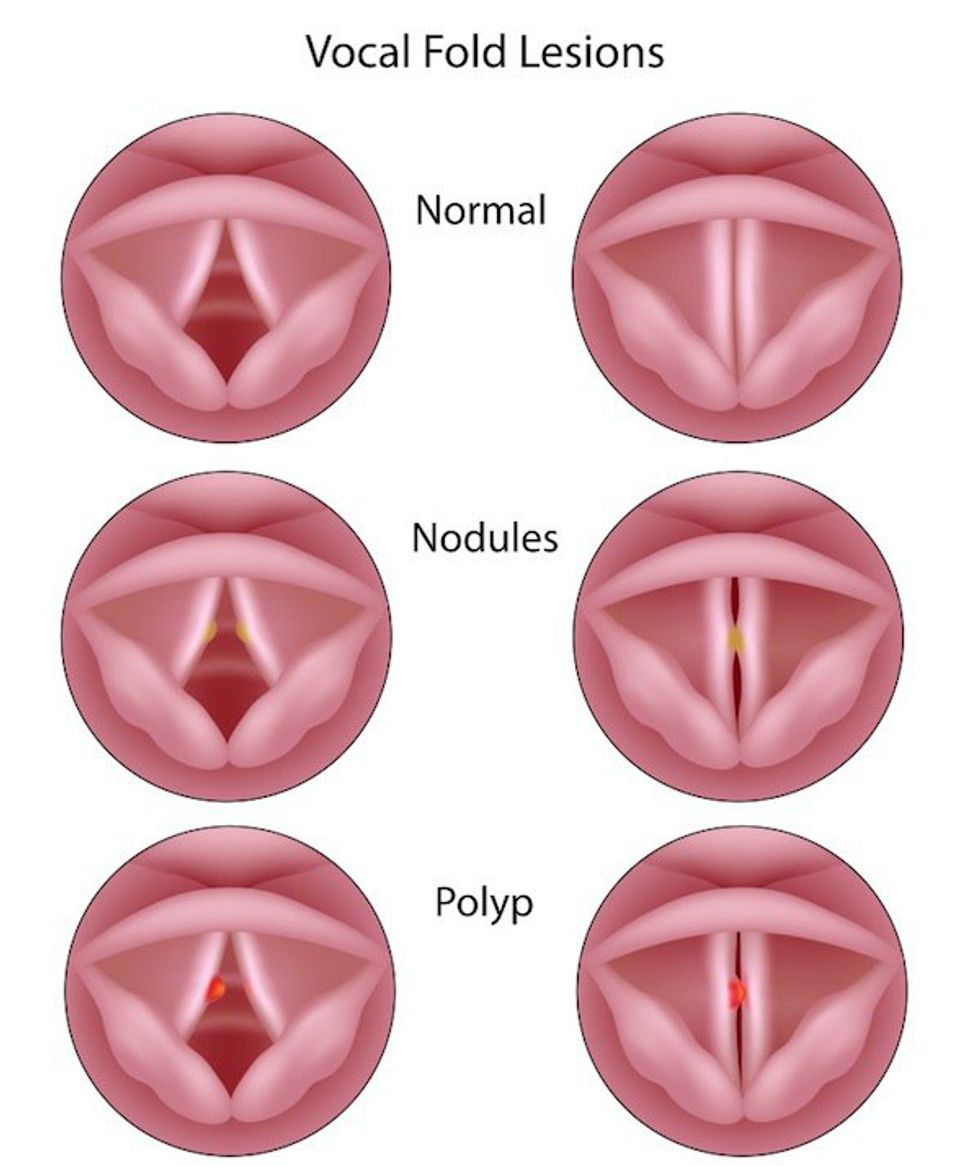
These injuries don't only happen to people who use their voice incorrectly, even if you have wonderful technique and sing beautifully, you're not out of the woods. Just look at Julie Andrews-- she lost her ability to sing due to nodules and a vocal surgery that went awfully wrong. If you feel like you might be experiencing some of the above symptoms, take a trip to an ENT. Go get your voice checked out. If you're worried about your vocal health speak up! The same goes for any injury. The longer you wait, the worse it will get and the more extreme measures you will have to take to fix it.
My friend inspired the idea for this article so I thought i'd share something that she told me-- I think it's a great piece of advice.
Know your own body, if you feel like something is wrong, tell someone and keep telling people until they listen. There is nothing more important than your own health.
Take care of yourself and help spread the word about the importance of vocal health awareness!