To that Fox-news-bred little girl just learning about the evils of homosexuality, yes Virginia, there is a gay agenda. In the world, majority rule is confused with majority rightness. Minorities are left behind. The supporters of Republican ideals of “American” values will know this looming fear, how the gays are slowly trying to take over Western culture and make the natural, up-standing straight man or woman adopt their bizarre, over-sexualized, pornographic, and unholy lifestyles. Ironically, most often it’s the prude that sees the grass ever greener, and I can’t tell you the amount of times I’ve seen the ever horny and self-destructive perfect schoolgirl/guy.
Society should move away from those heteronormative economies of possessiveness and anti-sexual mindsets. Thus, from this necessity, Queer theory and culture is born, a rejection of the hegemony pervasive in conservative worlds. In their article "Sex in Public," Lauren Berlant and Michael Warner discuss the properties and uses of a queer world. They start out their essay writing their goal is to, “describe what [they] want to promote as the radical aspirations of queer culture building: not just a safe zone for queer sex, but the changed possibilities of identity, intelligibility, publics, culture, and sex that appear when the heterosexual couple is no longer the referent or privileged example of sexual culture.” Queer theory often deals with these focuses, and this world building that they describe has likely saved millions of people who in the face of overwhelming heteronormativity had no points of reference for their own identity. As wonderful as the gay community is, it is not often that we discuss the downsides to the nature of the queer world’s language, for instance the hypocrisy and limitations of the words we use to describe the people within.
It’s important to realize that establishing these counter-publics is a natural reaction to hegemony. Reactions to an oppressive majority can happen in small or larger ways. As Nancy Welch points out in her essay "Living Room: Teaching Public Writing in a Post-Publicity Era," “Ordinary people make rhetorical space through concerted, often protracted struggle for visibility, voice, and impact against powerful interests that seek to deny visibility, voice, and impact. People take and make space in acts that are simultaneously verbal and physical.” When Welch says rhetorical space, she means a space akin to activism where effort is made to address and refute a hegemony. This happens in little ways—such as plastering posters of a political poem around campus, not shaving, wearing a dress—or in big ways like establishing protests or formations of hegemony-rejecting communities (see: Radical Faeries). A person whose personhood is largely rejected makes a purposeful effort to counter the public through text whether that’s through words, identification, or physical action. When enough people get aboard this verbal and physical action, the rhetorical space becomes self actualized and accepted and becomes an functional counter-public. In the Queer community, this has resulted in a lot of declensions and terms, all of which attempt to refute the frustrating conception that there is only one way to feel, one way to be sexual, one way to express yourself—which is dependent on the assignment given to you at birth.
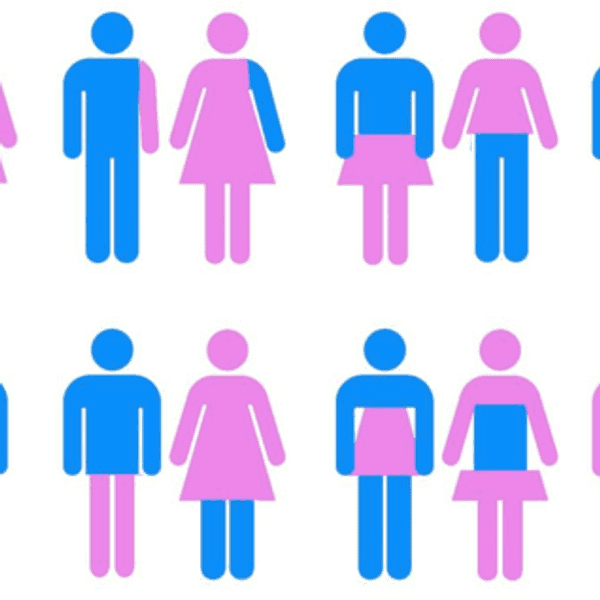
Ironically, the queer community creates its rhetorical space through terminology, definitive words like pan, demi, bi, gay, and straight to describe a person in terms of their gender, sex, sexual orientation, and gender expression. These identifying words act almost like a way of telling the world what you are interested in, what you are attracted to, whether that’s your sense of being, your way of expressing that being, or what you desire sexually. They’re a convenience. One cannot define Queer culture as an isolated group due to the fact that there is queerness everywhere you go, no matter the community, so in order to sufficiently create and serve the almost infinite spectrum of types of people, definitions are used like a diagnosis. Berlant and Warner, authors of the essay “Sex in Public” understand the nature of Queer culture and how these tribes and definitions make Queer culture unique. They write, “By queer culture we mean a world-making project, where world, like public, differs from community or group because it necessarily includes more people than can be identified, more spaces than can be mapped beyond a few reference points, modes of feeling that can be learned rather than experienced as birthright.” Although self discovery is something that happens within a person, and although these terms allow for this kind of exploration, I will argue that we do not "learn" our sexuality or gender, but we learn our terminology to define our sexuality and gender.
This learning is a kind of technology of the self. In Michael Foucault’s essay "Technologies of the Self," he describes how people use techniques of living just as they use technologies to make things easier. He describes how, “There has been an inversion between the hierarchy of the two principles of antiquity, ‘take care of yourself’ and ‘know thyself.’ in Greco Roman culture knowledge of oneself appeared as the consequence of taking care of yourself. In the modern world, knowledge of oneself constitutes the fundamental principle.” Although it is supposedly plain for straight people, the way heteronormativity in modern times has affected queer people I don’t think Foucault would have expected. As one transitions away from the straight identity, whether as a young 10 year old or 30-something closet Christian, there is always the problem of figuring out who they "really" are. Unfortunately, the heteronormative technologies of the self do not work for someone who doesn’t fit the mold. Therefore LGBT culture has adopted unique technologies of the self, some of which unfortunately limit the true pursuit and stray away from the "take care of yourself"’ and "know yourself" virtuous actions that should happen. Today, a queer person has two extreme temptations when coming out, both of which only achieve at mimicking the heteronormative way of thinking by, in fact, putting a limitation upon themself. There is a preoccupation with definitions and words within the queer world. People cannot rest until they find the perfect way of describing themselves. Words like Bi, Pan, Gay, Straight, Lesbian, Demi, Poly, etc. have arisen and become popular, acting as a form of nomenclature that specifies the type of person the individual wants to be seen as.
This is a certain technology of the self which is both liberating and limiting. While these labels do let us break away from heteronormativity, they dissuade people from exploring themselves or even take care of themselves in order to learn more about themselves. Once we find an anchor in a term, our entire political, social, and sexual capacities change. Even if someone were to identify as a completely pansexual poly-romantic genderqueer person, that would still be a definition that would specify that they are "all" even when there are times when they are not "all," almost inviting people to assume that "everything goes" with them. Words act like a cardboard sign, explaining and setting ground rules to everyone, including themselves, for their sexual limitations and preferences. Even though this is very helpful, as it makes it easier for us to know whether or not a certain situation would be appropriate or welcomed, it still plays into the heteronormative paradigm. Terminology is a divisive tool that separates the gay and the straight. Queer theory’s main goal therefore should be to break these boundaries of them vs us, gay vs. straight, heteronormative vs. queer. This would effectively remove a great deal of problems that arise out of both gender and sexual boundaries and socially perceived definitions. It would be much much easier to not assume, to act as beings of action instead of definition, to better take care of, and in doing so, learn more about each other in ways we wouldn’t otherwise see. The idea of a sexual minority therefore is a falsehood in this ideal, since nobody should be called anything.
The heteronormative has to be stopped, but we do not have to fall into the paradigm it demands. Like the Zen discovery of something beyond "yes" and "no," we must get rid of these boundaries, these groups we place ourselves in. Sex has too much importance over a society that believes itself beyond such things. It is important to think about all this before the boundaries are crossed. Even acts of sexual and emotional violence can be significantly reduced if only society can let go of their obsessions and paradigms that hold us all in place around only one way of being sexual. Of course, we could account identity for a ton of good things, as they are almost a necessity in society towards perceived consent (even though to know someone requires a good deal of communication).
I’m only imagining this as an ideal world, a philosophy to be considered truth behind our society's reality, an understanding that is both liberating and terrifying. I will not go so far as to say that this is the way that things should be, that we should forget ourselves and delete all our profile information, I am merely considering an ideal world with the most possible virtue. Therefore Fox News is right. There is a Gay Agenda. It’s agenda is to free everyone from these bonds of hypocrisy and violence. It’s an agenda of freedom. Perhaps only then can we achieve what the American dream promises and be fulfilled in any way that we see fit.