Many boxing critics and experts consider Muhammad Ali among the best and most prolific fighters to ever step foot into the ring. Through his signature smack-talk and incredibly sharp and quick wit, Ali provided genuine entertainment and some of the most memorable quotes of all-time, while bringing boxing's popularity to unprecedented heights. Through his accomplishments in the ring and activism outside of it, Ali irrevocably transformed the image of the African-American athlete in a time of overwhelming racial prejudice and tension. Through his resistance to the Vietnam War, Ali provided a voice for those who did not have the confidence or capability to publicly decry the war, famously saying that "I ain't got no quarrel with them Viet Cong — no Viet Cong ever called me nigger." Notably, this vocal and provocative opposition inspired civil rights leader Martin Luther King, Jr. to voice his own objections to the war for the first time, as well as becoming an icon of the larger counterculture movement of the time. Through these dynamics and countless others, it is my opinion that Muhammad Ali is unquestionably the greatest, most important, and most fascinating boxer in the storied history of the sport.
Born on January 17, 1942, in Louisville, Kentucky, Cassius Marcellus Clay, Jr. was first introduced to boxing at the age of 12 by local police officer and boxing coach, Joe E. Martin. Martin caught Clay fuming over the loss of his bicycle, which had been stolen by one of the kids in the neighborhood. The 12-year-old Clay promised to "whup" the thief when he caught him, but Martin told him he had better learn how to box first. Thus launched an amateur career with a record of one hundred wins and five losses, and accomplishments such as six Kentucky Golden Gloves titles, two national Golden Gloves titles, an Amateur Athletic Union National Title, and the Light Heavyweight gold medal in the 1960 Summer Olympics in Rome.
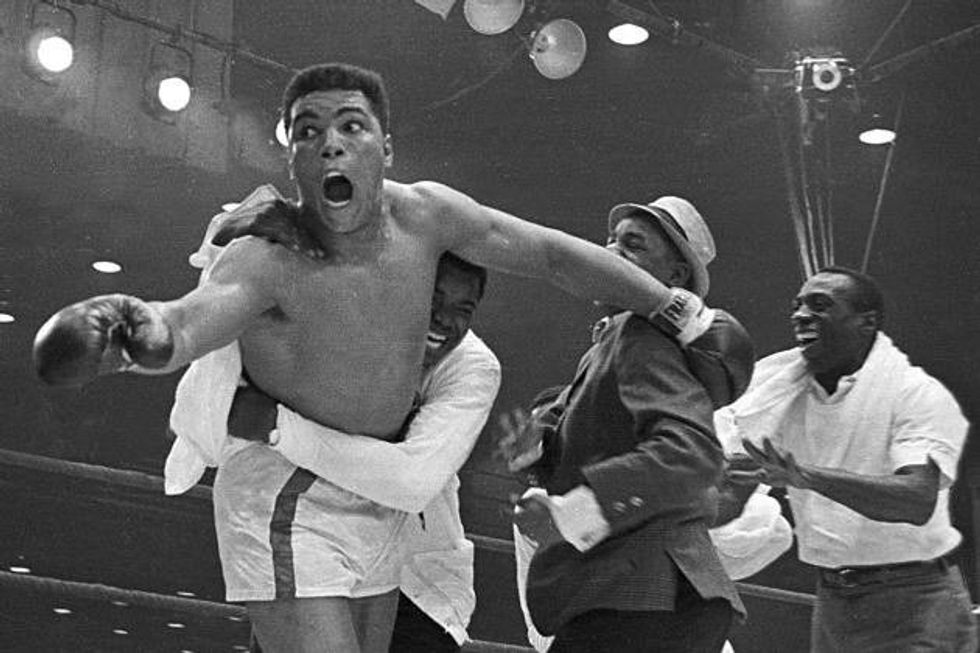
Clay made his professional debut on October 29, 1960, defeating fighter and police chief Tunney Hunsaker in a six-round decision. Clay's early fights were trademarked by his signature smack-talk and provocative behavior inside and outside the ring, which made the young fighter a controversial and generally disliked figure. None, however, could argue Clay's skill and raw talent. Clay soon became the top contender for Sonny Liston's title, a fight that would launch Clay into unprecedented stardom and fame. It was in the lead-up to this pivotal moment in both Clay's career and the sport of boxing itself that the young challenger coined signature phrases such as, "your hands can't hit what your eyes can't see," and, "float like a butterfly, sting like a bee." Clay went on to win the contest by technical knock-out when Liston failed to answer the bell to start the seventh, claiming an injured shoulder was the reason he could not continue.
After holding the title for nearly three years following the fight with Liston, Ali was stripped of his belt after refusing to be drafted into the armed services for the war effort in Vietnam. He was systematically denied a boxing license in every state and stripped of his passport. As a result, he did not fight from March 1967 to October 1970 as his case worked its way through the appeal process. During this time of inactivity, as opposition to the Vietnam War began to grow and Ali's stance gained sympathy, he spoke at colleges and universities across the nation, criticizing the Vietnam War and advocating African American pride and racial justice and equality.
Following his return to the ring in October of 1970 after his case was decided and his license was reinstated, Ali was soon to be involved in some of boxing's greatest and most memorable contests. These include his first fight with rival Joe Frazier in '71, a bout with Ken Norton in' 73, the Rumble in the Jungle with George Foreman in '74, and the Thrilla in Manila with Frazier in '75. Following his retirement from the sport after his final fight, a 10-round loss by decision to Jamaican heavyweight Trevor Berbick, Ali was inducted into the International Boxing Hall of Fame in 1990, and has received many other accolades as well. These include the Presidential Medal of Freedom, given to him by President George W. Bush in 2005, serving as a "U.N. Messenger of Peace" in Kabul, Afghanistan, as well as being a titular bearer of the Olympic Flag during the opening ceremonies of the 2012 Summer Olympics.
It is extraordinarily difficult to succinctly summarize Muhammad Ali's tremendous and lasting impact during two of the most arduous times in American history — the Civil Rights Movement and the Vietnam War. In the heat of the Civil Rights Movement, Ali was very involved with civil rights groups and activists such as Malcolm X and Martin Luther King, Jr. and provided inspiration for countless African-Americans to voice their dissent in a time when they felt disenfranchised and oppressed. While the Vietnam War was raging, Ali's provocative draft refusal made him one of the most polarizing figures at the time and, as the "People's Champion," he voiced concerns and opinions that were held by thousands but not properly admitted. Regarding boxing, Ali fundamentally transformed the quintessential sport during his tenure through both his skill and raw talent as a fighter and his provocative behavior in and out of the ring. To that end, I consider Muhammad Ali an incredibly important, arguably integral figure in American political history, and hands down the greatest boxer to ever step into the ring. Simply put, to say that the "Louisville Lip" shook up the world would be an understatement.