Borough Market is one of my favorite places in London. I went there often when I studied abroad during my junior year of college. Wandering its labyrinth of open-air stalls and permanent restaurants, treading the same steps market-goers have trod for 1,000 years, I would find produce, fresh-baked bread, meat pies, macarons, surprisingly good goats-milk ice cream, and, if I was lucky, free samples of baklava. I ate in the garden of the 900-year-old Southwark Cathedral, which Shakespeare likely attended. At the very least, he was at the church when his brother was buried there. As I left I’d cross London Bridge, which, despite being the most “famous,” is the drabbest of London’s bridges—grey and practical, like its people. (It strikes me as a very British joke: “Oh, that big fancy bridge, that must be London Bridge!” “Nope, that’s the Tower Bridge; London Bridge is the dull one just over there.”)
Partway through my time abroad, I went to Borough’s annual Apple Day celebration. In addition to about every apple-based food in existence, Apple Day featured Morris dancers (an English folk dance) twirling ribbons and batons, a man painted green and dressed head-to-toe in fruit in a nod to pagan ritual, and a prayer led by Southwark Cathedral’s minister—in other words, a standard English hodgepodge of traditions.
The prayer closed with a blessing for “everyone living in the city of London.” I smiled as I realized that I was a part of that group. I had tried hard to be a true Londoner in my time abroad, but I had the nagging fear that I was just a poser, another annoying American student intruding on the real Londoners. (This is why I never tried to blend in by speaking in a British accent; I was convinced the true Brits would see right through my charade and hate me for it.) Yet in that moment, I belonged as much as anyone else in that crowd, as much as the Morris dancers and the pie makers and the curry chefs. I was a Londoner, in spite of my American accent. There are Londoners with just about every accent imaginable.
Borough Market was crowded that day, as it always is. I had never thought of how that would make it the prime location for a terrorist attack. Hearing the news a week ago, seeing those familiar places blazoned throughout the headlines, jolted me.
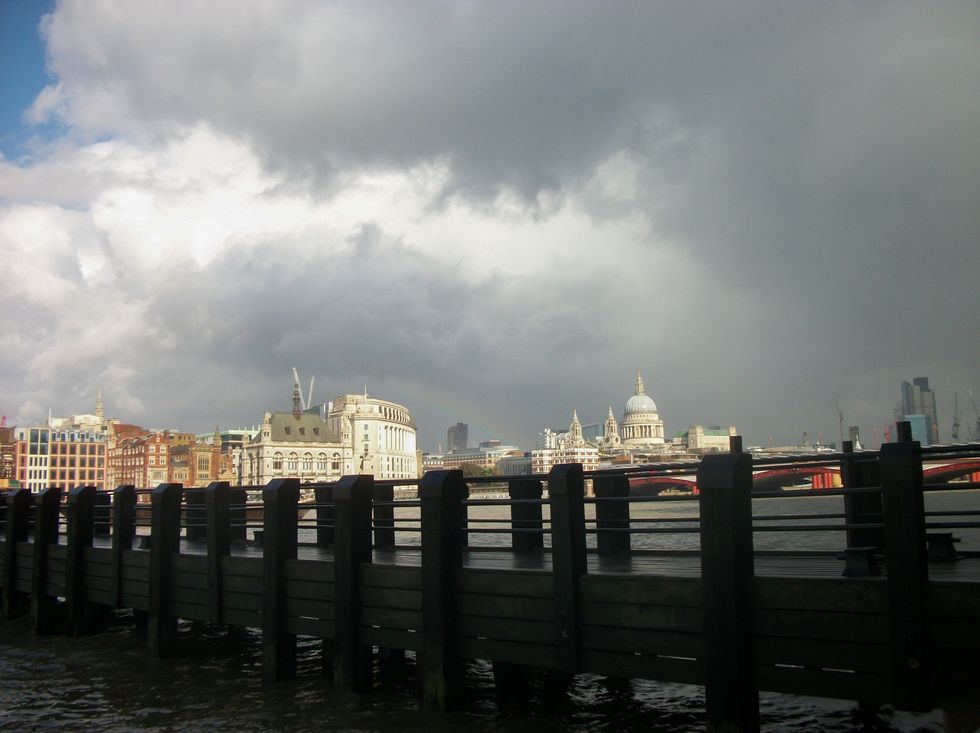
Sitting across the Thames from the City, the oldest part of London, Borough Market has witnessed its share of tragedy. Plagues that killed up to a quarter of the population. The Globe Theater, just down the street, burning down and then being rebuilt. St. Paul’s Cathedral doing the same multiple times, including in the Great Fire of 1666, which destroyed nearly all of the City. The Thames was so polluted in the 19th century that, one summer, Parliament almost moved to a different location because the stench was unbearable. London fogs, too, used to be less atmospheric and more dangerous, choked with soot and noxious gasses. In a single night of bombing during the Blitz, a third of the City burned, but St. Paul’s survived, a source of hope for Londoners that they would endure.
Because the story of London’s various destructions is also a story of rebirths. There’s a reason that, in spite of it never actually being used as a poster in wartime, “Keep Calm and Carry On” has become ubiquitous as a symbol of Britishness. Centuries ago, Christopher Wren, who designed the rebuilt St. Paul’s after the Great Fire, tried to use the fire as an opportunity to make London’s streets more planned and logical. He never got the chance; as soon as the smoke cleared, Londoners were reopening their shops on the same sites, along the same chaotic streets as before. During the Blitz, Londoners famously picked their way through rubble on their way to work the morning after a raid, going about their business as usual. After the Westminster Bridge attack this past March, Parliament re-convened the very next day.
The London Blitz, for the most part, was over by May 1941. For the rest of the war, bombed sites often sat vacant. Flowers began to spring up in their place, whether by human hand or nature reasserting itself. A popular wartime song celebrated “London pride,” a pink flower that quickly covered bombing sites: “Every Blitz your resistance toughening/From the Ritz to the Anchor and Crown/Nothing ever could override/The pride of London Town.” This legacy continues today; the ruins of two bombed-out churches in the City, Christ Church and St. Dunstan-in-the-East, are now serene public parks. The ruins still stand as a reminder of the tragedy, but something beautiful has grown from them.
And that’s my hope for today’s London. That, in the midst of grief, it continues to grow gardens.