The year is 1997. It’s Madonna and mixtapes and Backstreet Boys and Boyz II Men. People are buying CDs and albums and watching MTV for the hottest new music videos, completely content with the industries that will be rocked to their core in just a matter of years.
Napster was the iceberg to the Titanic that was the music industry of 1997 in the same way that YouTube and the rest of the internet changed MTV forever. The internet webface and computer technologies changed many industries and fields in an irreversible way, but this was the system shock that the music industry needed in order to prove its timeless qualities of adaptability, perseverance, and the unshakable nature of music itself.
The year is 2017. You’re sitting on your couch. You put on your virtual reality headset and the drum beat and intensity of Imagine Dragon’s "Believer" bursts to life. The perspective is from the stage this time and you are able to look around at the band and the audience in order to take in the entire live concert experience from the Belasco Theater in Los Angeles, CA.
This is just one of many technological advances that have been made in the music industry in the past twenty years, and it’s something that could have hardly been predicted other than in a Spielberg Sci-Fi epic. Streaming, YouTube, and other factors dominate the music field presently, but where is it heading? If it was almost impossible to imagine the impact of the internet and virtual reality, how can we predict where music will head in the next twenty years? Well, we can’t really, but we can make some pretty interesting guesses.
Artificial Intelligence and Music
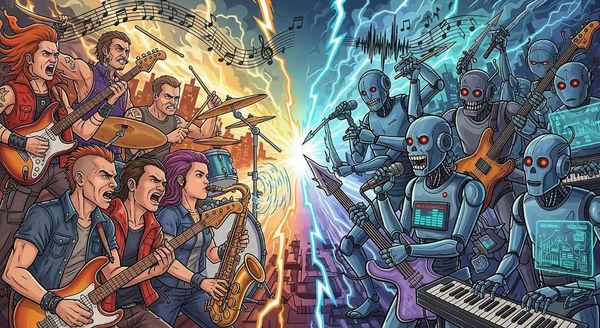
If the internet was the biggest change to art, business, and life, the next biggest change will come through the mass popularization of artificial intelligence. According to Stephen Hawking on artificial intelligence, “every aspect of our lives will be transformed. In short, success in creating AI could be the biggest event in the history of our civilization.” When it comes to music, monumental milestones are being crossed right before our very eyes. Using deep learning algorithms, artificial systems have learned to independently compose music in the same way that humans do. The systems do a scientific analysis of music theory and when you can study every composition in history at once and find patterns in successful popular music, a hit pop song or an orchestral composition is only a button press away. Don’t believe me? Have a listen for yourself.
(An artificial intelligence composer. Hans Zimmer anyone?)
Music and Accessibility
The internet’s power has put the knowledge of the world in the hands of anyone who wants to seek it out. This means information on music theory, composition, and of course, any song you could possibly want to listen to (except the new Jay-Z album because, you know, Tidal) is at your fingertips. A trend like this will only grow as music from around the world is spread to different countries instantly through the internet. The next viral kid in her bedroom will be on tour in a matter of months. Music producers will be connected to new talent like never before. All this because of the connection technologies that allow people and cultures to bridge the gap of distance and even legal bans.
But, at the end of the day, that’s all it is. Technology. It’s just the tool used as a megaphone for the already connecting power of music. Music brings people together and this is a well known, powerful, fact that’s stronger when it’s not forgotten. Even with virtual reality headsets, and artificial composers, the powerful human experience of going to a music festival and hearing the emotion in the voice of an artist is not going away anytime soon.
The year is 2037. What makes music so pure is still untouchable. There are new ways of experiencing it. There are new genres of music. There are new people listening to and making music. It will change again, and again, and again, but as long as we are still human, music will still be music.






 man running in forestPhoto by