


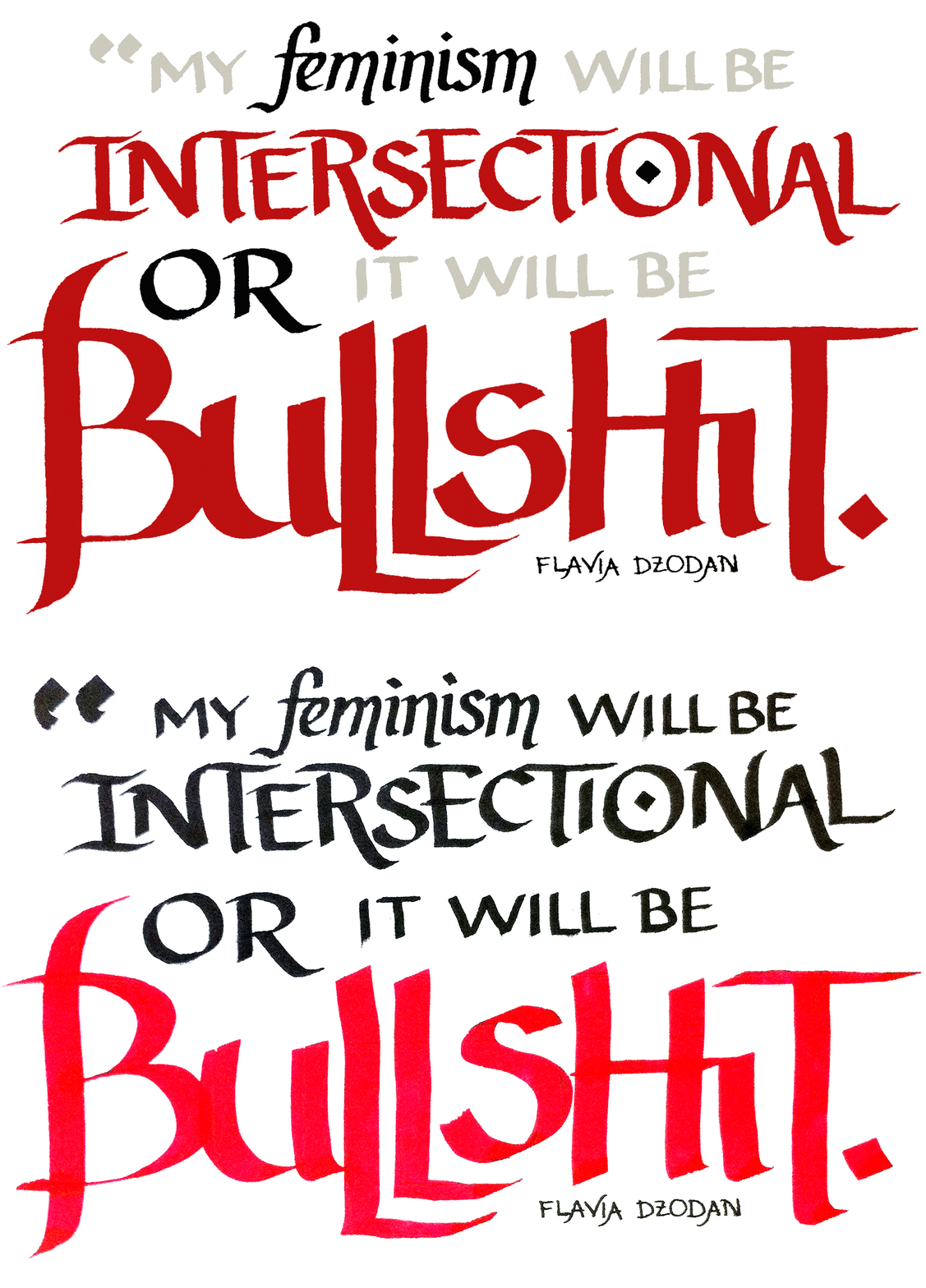
If you, like most millennials, have had any extended exposure to discussions of power, privilege, and inequality – then I can guarantee you have heard the term: intersectional(ity) or intersectional activism. This term is a bit of a fan favorite amongst proponents of progressive agendas and liberal SJWs (hell, even I use it), but let’s be honest – do we really know what intersectionality is? Do we really know what that means? And more importantly, are we capable of practicing it?
Intersectionality, as popularly defined, is the convergence of different parts of identity that results in varying degrees of power, disadvantage, and/or discrimination. As such, intersectional activism, as an ideal, would be the simultaneous and conscientious effort to consistently fight against all systems of inequality that work to oppress any part of the intersectional identity. Seems simple enough, right? Well, as with most social justice theories born out of academia, intersectionality is exceedingly difficult to actually practice – with feminism being a prime example of failed intersectional activism. Time and again, feminists have revamped themselves with quite a few waves of new age feminists with grand and bold ideas of how to fully integrate intersectionality into their platform. Yet, time and again, they fail at this task. It is this failure that has led to what I like to refer to as the “great schism” of feminism. This failure led to dichotomous existence of white feminism and (intersectional) feminism.
While we can go on and on about the problem with white feminism, I’d rather focus on the perceived key distinction between white feminism and intersectional feminism (often times just simply labeled as feminism). This distinction is that the white feminist fails to recognize the ways in which other structural inequalities matter to woman all over the world because they are merely concerned about the white feminine plight. As such, the white feminist becomes an ineffective and, I’d argue, destructive agent to the feminist movement. Conversely, the true feminist is most aptly described as a leader who does their best to pursue intersectional justice. Makes sense, in theory – but what if I were to tell you that this true form of feminism doesn’t exist? What if I were to tell you that anyone who told you they believed and strived to achieve intersectionality was fooling themselves?
Well, let me tell you now – this isn’t a what if scenario. Chances are, if you are woke, then you know that this “true” form of feminism doesn’t exist. You’d know that the people who spout intersectionality the most, are the people who practice it the least. You’d know that the most popularized form of “intersectionality” only covers the intersection of race & gender. You’d know that feminism chronically fails to serve the communities it claims to care for. You’d know that, at the end of the day, when a person says that intersectionality is the way to go – they have no idea what they are talking about.
And how would you know this?
Well, if standard American history hasn’t been clear enough for you, I’ll give you a much fresher and more recent example of this: Trump. I have to give this guy credit, for being the epitome of everything in our society, he has come through in one way. He has given POC more than ample proof that racism in the United States of America is not only clearly alive, but better than ever. (Not that we really needed more proof though.) Moreover, he has given concrete proof that intersectionality, while it may exist in theory, does not exist in practice. How do we know this? Ask white women. Namely, white women who voted for Trump and white women whose predominate concern after Trump won was the glass ceiling.
52% of white women voted for Donald Trump. The same man who spouted he would grab a woman by her pussy. The same man who has been accused by multiple women of sexual assault. Honestly, I could go on and on about everything wrong with Trump, but that’s beside the point. The point is that despite all the things Trump has done to prove that he is possibly one of the most dangerous candidates for women – 52% of white women still voted for him. We could talk about how this has to do with internalized misogyny and the normalization of toxic masculinity – but I want to talk about how these are the same white women who claim that they are intersectional advocates for justice.
Why is it that the same people who claim to be advocates/activists for intersectional justice are visibly doing everything they can to block it? The simple answer – they really don’t care about intersectionality. The more complex answer – they really no idea what intersectionality is. These women, who claim to care and advocate for people of color, don’t belong to these communities or understand the structures that oppress them. They can’t feel the hurt – and they never will – and if you can’t understand the basic systems of oppression that work to oppress a community (like the racial contract for POC) then how do you expect to achieve or believe in intersectionality? How can you understand what that entails? How can you understand the implications of intersectionality? You can’t. Period. So then why claim to be an intersectional activist? Because intersectionality is a protective blanket that shields all activists from being consistently told that they aren’t doing enough.
Feminists have been able to claim intersectionality for years without major flack or contempt from other liberal activists because they thought good intentions were enough. Feminists have always had “good intentions” and “did their best” to be intersectional and show other communities that they cared. Yet when it came down to the nitty gritty and they had the onus of protecting the communities that would effected most by a Trump presidency – they were selfish and the exact opposite of an intersectional activist. Yet what I find even more telling, are the white women who did vote for Hillary and used her loss as an opportunity to talk about a glass ceiling rather than talk about the legitimate violence and fear coursing the veins of the diverse America.
If we’re going to be honest, this election, for most POC, had less to do with gender inequality and a lot more to do with livelihood and safety. As an Afro-Latina, I would gladly live a lifetime under the stubborn inequality of that glass ceiling if it meant that I could live with a sense of safety while walking the street. I would gladly accept that glass ceiling, if it meant that I wouldn’t have to live with the fear that my family members would be denied access into the country that is their home because of racial profiling and misconceptions of immigration. I would accept that ceiling gladly, if I knew that my life, and the life of my family, was not going to be in jeopardy. Yet, instead, I now not only continue under this glass ceiling, but live in
That is what this election was about. Yet because we claimed intersectionality, we never paused to make sure that intersectionality was actually being practice. We’ve let a buzz word blind us into believing that a group that has group chronically failed to work with and serve us in the past, had no changed without any major work. We let the allure of intersectionality, seduce us into a place of comfort where we no longer questioned the validity and sincerity of the feminist or the activist – and that is the problem with term intersectionality.
As it stands today, we don’t understand intersectionality because we don’t even understand the complexity of racism, sexism, classism, and every other –ism out there. We can’t practice intersectionality because we’re too busy trying to look out for ourselves to be interested in it. Yet we never question someone when they claim it, because it makes us feel good to think we’re doing better than we actually are.

















