


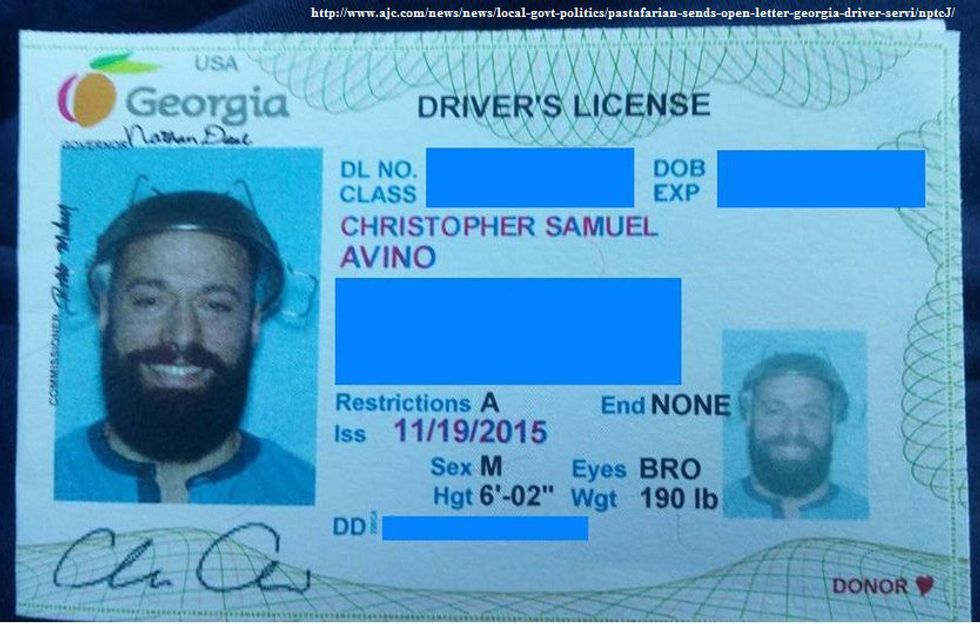
On January 13, 2016, the Main Directorate for Road Traffic Safety in Moscow granted a Russian man the right to wear a pasta strainer on his head for his driver’s license photo. Andrei Filin became the first man in Russia and the fifth person in the world to be allowed such a... privilege. Last November, a Massachusetts woman won a similar case. Lawsuits such as these have been documented as far back as 2011, when an Austrian man became the first person in the world to win the right to wear a colander on his head in his license photo. In every case, the plaintiffs cited religious reasons. They claimed to be Pastafarians – members of the Church of the Flying Spaghetti Monster – and that wearing the colander was required as part of their religious beliefs. This is a relatively new phenomenon. No, it does not involve the outright worship of pasta. The truth is considerably more tongue-in-cheek.
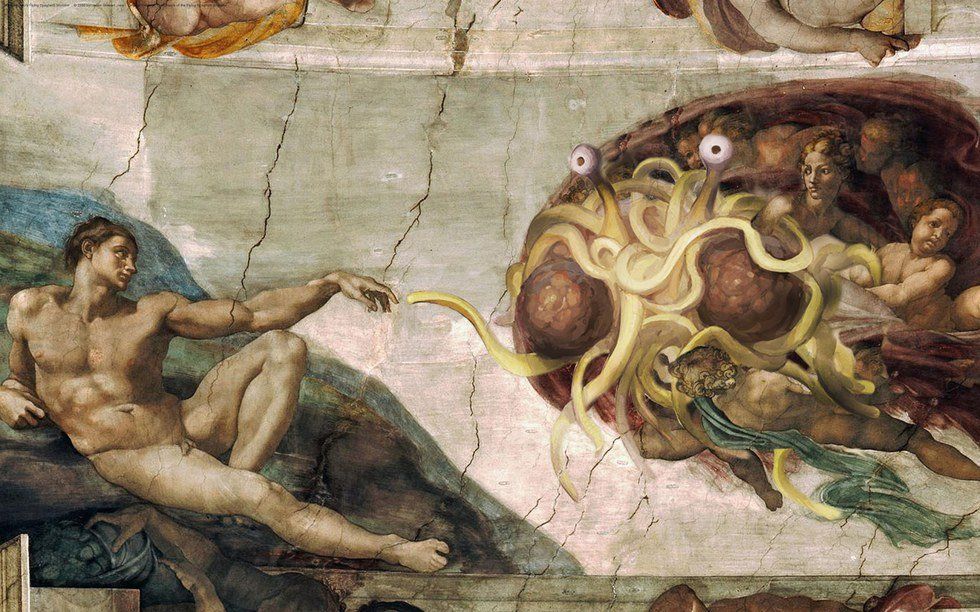
In 2005 the Kansas State Board of Education granted approval to allow the teaching of alternatives to the theory of evolution in the classroom, including Biblical creationism and intelligent design. The move was backed by both President George W. Bush and Tennessee Senator Bill Frist. Backlash from the scientific community as well as atheist organizations followed. Soon after, 25 year old Bobby Henderson wrote an open letter to the Kansas Board of Education, playing the part of a concerned citizen worried about the fact that only two alternative theories to evolution would be taught in schools. Henderson facetiously asserted that “it is important for students to hear multiple viewpoints so they can choose for themselves the theory that makes the most sense to them.” He then proposed his own theory, which he argued should be taught alongside creationism and intelligent design:
Let us remember that there are multiple theories of Intelligent Design. I and many others around the world are of the strong belief that the universe was created by a Flying Spaghetti Monster. It was He who created all that we see and all that we feel.
Henderson, flippantly claiming that this revelation of the truth came to him in a dream, threatened to file a lawsuit if his theory was not granted equal representation as a possible alternative to evolution. His sarcastic letter received an outpouring of support from all over the country from those who opposed the teaching of creationism in schools and, eventually, those who opposed the inclusion of religion in public affairs altogether. Thus, the Church of the Flying Spaghetti Monster was born. It evolved rapidly, adopting its own "doctrines", myths, and code of conduct revolving around a giant, flying hunk of spaghetti, all in a satirical attempt to mock and discredit organized religion and religious views.
 The Church has only grown in its number of followers, as well as its elaborate absurdity, since then. Its message is simple: belief that a giant ball of sentient spaghetti created and rules the universe is just as valid as the beliefs of other religions.
The question is, why go through all the trouble? On its surface, the Flying Spaghetti Monster seems to only be a device to mock religious people, used by those who want to argue but do not have anything to say that is of any substance. For many "followers," this is where its usefulness ends. However, whether it means to or not the Church of the Flying Spaghetti Monster does represent a bold philosophical concept, an understanding of which may shed some light on their end goal.
Their argument is similar to the Cosmic Teapot analogy, put forth by atheist Bertrand Russell: In his article titled “Is There a God?" (1952) Russell suggests that a china teapot, too small to be seen by telescopes, is orbiting the sun somewhere in space. Using this illustration, Russell argues that, though his claim cannot technically be disproved through observation, it is obvious, undeniable nonsense. He argues further that it would be absurd to assume that anybody would believe him based solely on the fact that his claim cannot be disproved. He would need to prove it. Pastafarians, in their own, satirical way, make a similar claim. An invisible Flying Spaghetti Monster is absurd. There is no disputing that. But since it cannot technically be disproved (since the deity is invisible, of course), then according to them Pastafarianism has every right to be included along with other recognized religions, whose own deities cannot be proved scientifically.
Thus, the burden of proof falls on the opposition. Lawmakers who want to take away the Church's ability to demonstrate and uphold their religion must first provide undeniable proof that Pastafarian "beliefs" are somehow less valid than, say, those of Christians, Muslims or Scientologists, and therefore cannot be protected by the First Amendment. Pastafarians are careful to point out that these religions do not have to prove the existence of their deities in order to legally be allowed to worship them. Often, this leads to a legal gray area and results in legal battles that leave many people shaking their heads.
Over the past several years, supporters of the Church have certainly pushed boundaries in order to get their message across. Members are erecting sculptures of the Flying Spaghetti Monster outside city government buildings around the holidays, a jab at traditional Nativity displays. Followers are encouraged to spread flyers and buttons (called “Propaganda”), which are distributed for free on the Church's website. And, of course, there are the pasta strainers, which many brave Pastafarians insist must be worn at all times, even in their driver’s license photos. One can even be ordained as a minister of the Church of the Flying Spaghetti Monster for only $25. The New Zealand branch of the Church has even gone so far as to apply for a license to perform official Pastafarian-sanctioned marriage ceremonies. The application was approved in December of last year.
With over 4 million followers representing several countries, the Church of the Flying Spaghetti Monster has become an international phenomenon, a champion of the ever-growing atheist and anti-religious movement in America and around the world. However, it does not seem that the Church will be satisfied with simply mocking religion and the religious. While much of their actions include nothing more than harmless, if not annoying and goofy "religious" demonstrations and social media campaigns, they have been known to push the limits as well. In fact, in order to make their message even clearer they seem to be taking as many measures as possible to establish themselves as a recognized religion. In many ways, they are free to do so under the law. When they are prevented from expressing their flippantly held religious views, they sue, citing religious discrimination as the reason.
The story behind the recent trend of people suing local governments for their right to bear kitchenware started with what is essentially an internet meme, which has exploded in popularity over the past 11 years and become a full blown atheist and anti-church movement in and of itself. Pushing the limits of the First Amendment, substantial time and money has been spent in court fighting over the basic human right for the Pastafarians of the world to wear bowls on their heads. The strange and, frankly, scary thing is that it is working. So when the next batch of goofballs inevitably takes to the Internet, posting pictures of their new driver's license photos complete with shiny pasta strainers on their heads, clogging up our Facebook feeds alongside Minions memes and Adele covers, perhaps it will be a reminder that Pastafarians are not going away any time soon.

















