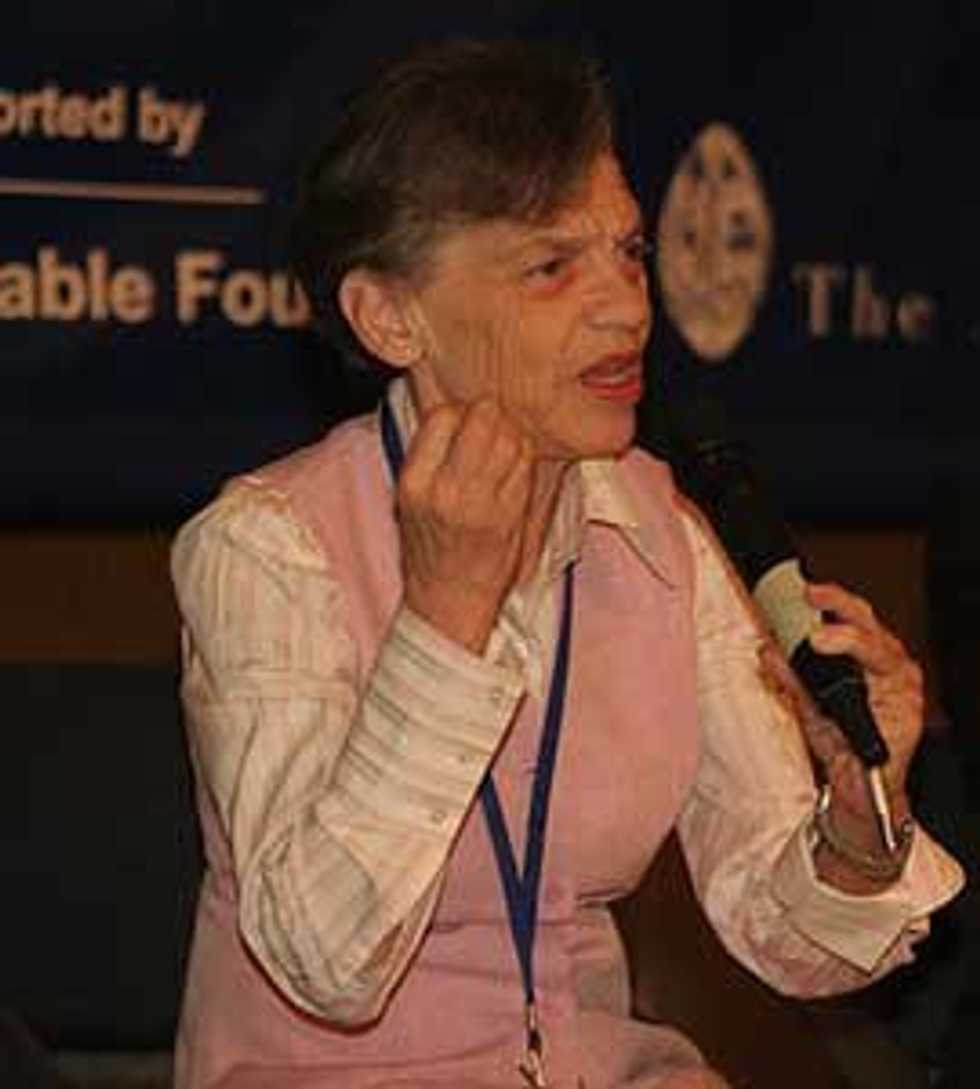
Recently, at the Holocaust Resource Center In Stockton University, Dr. Mary Johnson spoke about her experiences in college, her time spent in Nigeria and how it related to American education. When it comes to Dr. Mary Johnson, just saying she is a woman to aspire to be is not giving her the credit she deserves. She is a woman who talks the talk, she is also the one who can walk the walk. With that being said, she is a woman who has a lot to her name yet has still remained the same charismatic, humble, professor and mentor I have come to know during my Stockton University academic career as a student. She is a firm believer in the fact that human behavior does, in fact, shape the history we live in today. Those of us who plan to be history teachers, educators, or museum workers, can all learn something from Dr. Mary Johnson.
Dr. Johnson signed up to be a volunteer for a political convention. Her reasoning for this was not only inspiring but simple and to the point. “How can I teach about democracy without being a part of it? This was a very challenging statement coming from a woman so small but yet so big and intimidating in many other ways. This is all meant in good will I assure you, as I don’t feel anything bad can be said about Dr. Johnson. She is definitely a woman who inspires you to do more than what is asked of you. She brings up a true point that we as future educators should be out there empowering others young and old to vote, a power that was fought for, but is still taken for granted.
Our discussion was not only about sharing her experiences. She was trying to tell me that in our academic careers we are shaped by three things. One's the opportunities available to us in our academic experiences and outside of that, two is the people you meet who make an impact on you, and three is finding a job you love to do.
What really stood out to me about her experience within the Peace Corps in Africa. i Have long thought about doing the Peace Corps as a potential career path with my studies in International and Genocide studies. Nonetheless, I have always felt that me as a student could never accomplish. This story not only inspired me, but also showed me a person with ambitious goals such as myself could accomplish.
This part of her story started out like many other college hopefuls like myself. Her journey began when she started at Skidmore College in Saratoga Springs, New York. While At Antioch College, she dreamt of being in the Peace Corps. Fast forward a few years and she filled out the application for the Peace Corps. This was dangerous because the first batch of Peace Corps volunteers had a Skidmore girl who wrote a postcard to her family claiming there were rats in the streets of Lacoste, the capital city. This was an international incident. So anyone who applied there was a suspect. Nonetheless, she was accepted. She asked to go someplace warm. So, they sent her to the warm, dry climate of Nigeria. She was inspired to go due to President Kennedy talking about the Peace Corps.
With all the controversy that surrounded her school she still applied... that got me thinking. If she knew about this but yet still applied, what is stopping me? Many people are afraid of going to foreign countries and staying there for long periods of time. This was my same fear. But there was something about Dr. Johnson that renewed my confidence. Was it the fact that she was a small women with big aspirations who possessed the courage of a warrior to go to Africa, knowing it was not going to be the same as being here in the US? Partially. But what intrigued me the most was what she went through while being there and how this remarkable women conquered not just as a woman but as a woman who is an educator.
The bush of Nigeria in Africa is used to describe the rural areas of northern Nigeria. It is a very Muslim-populated, underdeveloped area in Nigeria where she spent some years teaching. She was dropped in a cow pasture and given an alcoholic beverage to celebrate her coming. An experience that definitely shaped her as an educator. From not having the proper technology or tools, to men turning their backs on her because she was a woman and didn’t believe that she was worthy of teaching them. It was a disgrace for women to be doing this in public. She then stood up to these men, walked alongside the room and stood in the area they gazed at to divert their attention from her. She then began to teach.These men were not only shocked, but confused. Many women had tried to teach these boys before and had been unsuccessful in their endeavors, and here this woman was, defying the male authority they inadvertently tried to place on her due to the cultural norms of how women are perceived in this area. She not only broke down this door, she broke down the whole wall. They eventually got used to her teaching but it was because she had the desire and determination that she did what she was put there to do. She even helped to build a school so that people had a place to learn and have an education.
While this part of her story had me at awe and in a loss for words her story got more dark and grim with each word that passed from her lips.
While she was there, there was a civil war. The Ibos wanted to break away from this part of Nigeria. They were very Christian and westernized in their ways and wanted nothing to do with the Muslims in this part of Nigeria. Her own Ibos Stewart was killed, which still haunts her to this day. One Sunday morning, the Ibos came and attacked the church and took her and some other women to his courtesan shop. He had saved them but told them he would kill them if they tried to do anything to him. She witnessed bodies piled up. She had no idea what genocide was to describe the atrocities that were happening. All she knew was the democracy that was in place four or five years ago was slowly disappearing. This deteriorated into one of the earlier genocides. It has taken several decades to try to stabilize this military dictatorship. When she came back from this trip, she wanted to learn more about the Holocaust and genocide.
Being a student my studies only take me as far as what the documentaries and textbooks have shown me. It's one thing to see this from an outside experience, It's totally another to be within this action, and feeling powerless to stop what is going on. This woman's experience not only opened my eyes to the world of genocide, but how one can apart of it as a mission to make this country better, but yet are not doing nearly enough to stop the atrocities that are going on around you in real time. It is no longer a textbook learning experience. Its is a battle for your life, the cause for which you were placed there to do, and if you are even going to live long enough to see your efforts come to full fruition.
This gave me a new sense of confidence to why I am studying what i am studying and none of it really matters unless we take what we have learned and put in into practice. Im nowhere near as amazing or credible as this woman I spoke to, but i can say that through her experiences, it has made me take my knowledge and explore what i can do with it. As of now i'm President of Stockton STAND, an anti-violence and genocide chapter on my university campus as well as Japanese Culture Chair for Asian Student Alliance, even though i am not Asian. I also use my writing as Assistant Editor for my University newspaper and a Staff writer for this website. All of this seems like a bunch of words at this point, But i do believe Dr.Johnson was making a really good point. What you do at school matters, but what you do outside of academia is also important as well. I'm still young and I have a long way to go in terms of creating change in a world that would rather look for faults in others instead of looking at themselves as well and wanting to create positive change.
Her story is just like many other great stories in life on how successful, dedicated people in what they do go on to keep doing amazing things. She is living proof that change can accomplish great things. Change is nature, the part that we influence, and it all starts when we decide.