“Returning violence for violence multiplies violence,
adding deeper darkness to a night already devoid of stars.
Darkness cannot drive out darkness; only light can do that.
Hate cannot drive out hate; only love can do that.”
Dr. Martin Luther King
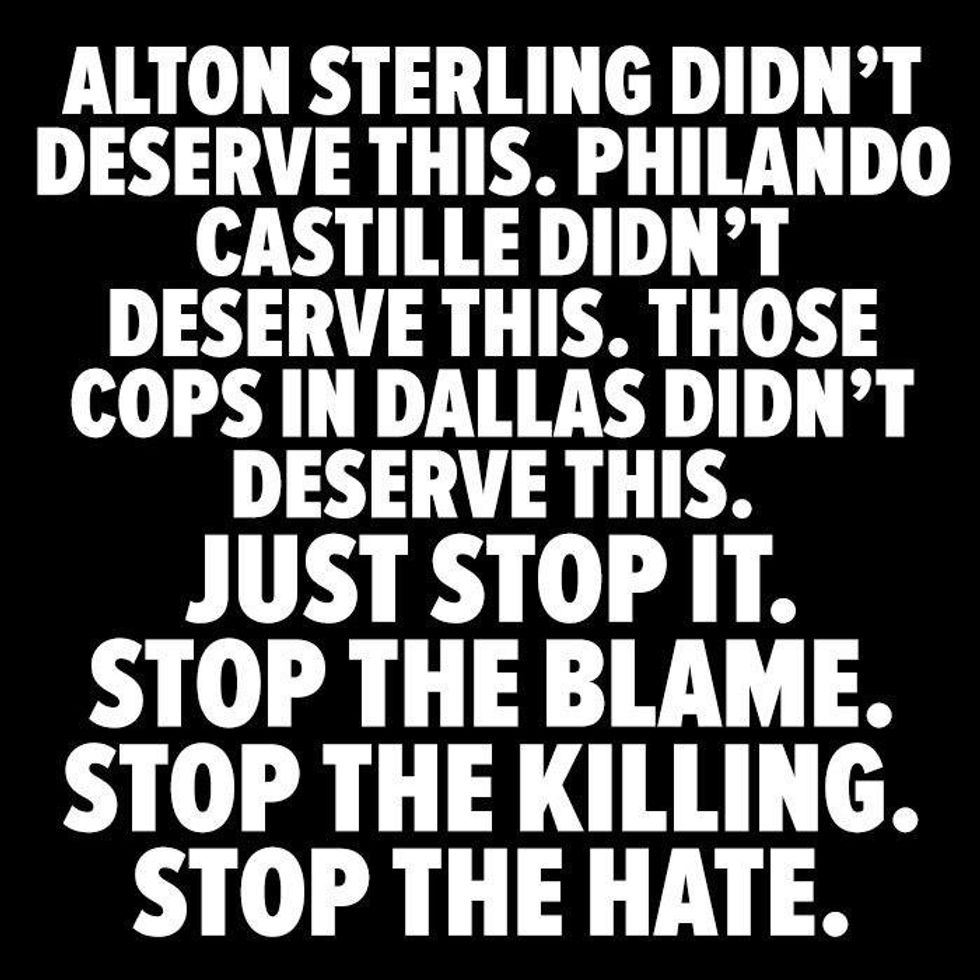
In less than two weeks, there has been a horrific string of deaths that have affected us all some way or another. There have been at least 12 deaths since June 26, including Dylan Noble, Barry Prak, Pedro Villanueva, Delrawn Small, Anthony Nunez, Alton Sterling, Philando Castile, Brent Thompson, Patrick Zamarripa, Michael Krol, Lorne Ahrens, and Michael Smith. To go in-depth with each and every case is nearly impossible, so I’ll focus on only the incidents in Baton Rouge, Missouri, and Dallas.
The shooting of Alton Sterling blew up all over the media after a video surfaced of Sterling being pinned down by police officers and shot multiple times. At the time, Sterling was selling CDs in front of the same store where he was shot down. While the African American community, especially the Black Lives Matter movement, was devastated with the events, some people began a posthumous attack on Sterling.
One of the first things that popped up as I researched the case was his past criminal record. I found it strange that it was all being brought up when the information was irrelevant to his death. The police were not after him because he’d moved and then failed to register as a sex offender but because of a call they received of a man fitting his description who had pulled a gun on someone while asking them to leave.
While this is incredibly alarming, Sterling’s gun was in his pocket and he never visibly pulled it on them when officers arrived at the scene. For those who might then argue over his possession of a gun, Louisiana has an open-carry policy which gave Sterling the same right as anyone to have a gun. Even if it were illegal for him to have it, he never visibly threatened the officers’ lives, giving the officers no possible cause to shoot him.
Then there are those who argue that he was refusing to comply with the officers’ commands. I cannot deny that; it is clear that he did not get down and that the Taser had no effect on him. However, resisting arrest is not punishable by murder. After tackling him, the officers could have taken him to jail, and he would have sat in front of a judge, who could have fined him, sentenced him to community service and/or placed him on probation.
The fact that Sterling lost his life at the hands of these officers is horrific because it shows the abuse of power some officers on the field possess and speaks volumes of implicit bias. It is impossible to know that the minute they received the call and arrived at the scene the officers had decided to kill Sterling, yet it seems quite evident that prejudice led to his death. The simple fact that Sterling owned a gun was enough for officers to assume that he would be violent and harm them.
As the case developed all over the news and media outlets, what really got to me most about this case was seeing Sterling’s oldest son (15 years old) weeping on cameras as his mother struggled to get her words out. Sterling left behind five children who will grow up without a father because implicit bias was enough to cost him his life. Tears welled up in my eyes as I watch his son looking for comfort and filled with a sorrow no child should experience.
Sterling did not deserve to die. While he fit the description of the call, from what we can tell in the video, Sterling never physically attacked the officers, and he never seems to threaten the safety of the officers or anyone else. The police officers mishandled the situation terribly, and it angered me to see people hashtagging Blue Lives Matter when an officer’s life was never at risk. Those who hastagged Black Lives Matter had a right to do so because another member of their community was attacked and killed without due process.
Then the next day yet another black life is lost over a broken light. Philando Castile was with his girlfriend and his child when an officer pulled him over. Castile made sure to follow the law by informing the officer that he was indeed in possession of a gun and that he had a permit. Implicit bias yet again reared its ugly face as Castile reached for his ID and was met with multiple bullets. When will the day come when certain officers see a Black man reaching for his waistband and don’t assume he’s pulling a gun on them?
The video of Philando Castile is horrific on many accounts. Not only do we witness his passing, but the police officer also sounds terrified and unprepared to actually be on the field. He shouts all throughout and continues to show his prejudice by telling Castile’s girlfriend to keep her hands where they are, presumably hoping she won’t reach for Castile’s gun.
Four bullets went into Castile, more or less the same amount as Sterling. These officers were not shooting off warning shots. Why not stop after one shot? Why do they need to keep going? What kind of preparation are these officers receiving that they aim for lethal areas and just don’t stop after one bullet?
Not only did they shoot Castile, but they kept a gun pointed at his girlfriend as she got out of the car with her hands up and was told to kneel on the sidewalk. The woman is then detained. Why? A gun was not out, it was the officer who was at fault, yet she’s being detained? And as this all goes down, you can hear the little girl crying. I think what gets me most about these cases (including the Dallas officers’ one) is that no one really thinks about their families, about their suffering children.
And then Dallas happened. Fingers were quickly pointed at the Black Lives Matter movement which had been peacefully protesting police brutality and mourning the deaths of Sterling and Castile when Micah Johnson opened fire. Johnson clarified that he was working alone, completely unaligned with the movement, yet fingers are still being pointed at the movement.
“Violence begets violence” was shouted by many who oppose Black Lives Matter, yet aside from Johnson, there had been no violence. Johnson was not responding to stimulus from a riot, but to his own frustration. Some claimed that it’s the movement’s violent nature that bred this, but if it was violence that begot it, it was police brutality which is up to 558 deaths this year alone.
Johnson claimed that he “wanted to kill white people, especially white officers.” While they tried to link his actions to terrorist groups and such, Johnson was simply acting out of anger. His own bias, his own prejudice led to 5 deaths. This was unsettling and deeply angered me because this “eye for an eye” policy is wrong on all counts. How can we denounce the deaths of Sterling and Castile by adding to the death count? How can we shout that Black Lives Matter yet ignore these blue lives lost?
The officers were not attacking the protesters, but protecting them. There were no guns being pulled, no threats, no tear gas, and no tanks. Thompson left behind his wife of two weeks and his admirable service. Zamarripa left two children who are suffering just as much as Sterling’s and Castile’s. Krol and Ahrens (as well as the other officers) left behind a legacy of hard work and devotion to the law that showed the wonderful work real and good officers do. We cannot turn from these deaths because they’re equally as tragic. They threatened no one, they were doing their job, and they left their families behind and lost their lives due to a deeply rooted prejudice.
Dallas was a huge setback that promoted the idea that black anger is black violence. There really must be another way and that thought circles back to the MLK quotation. King was advocating for change through nonviolence. If we seek to bring light and love into this world, we must protest all injustice but never stooping, never become that which we stand against. We must stand together in love, unity, and the pursuit of justice and only then will we see a better day.