
As some of my readers know, I have, for the past several weeks, been studying in and traveling throughout England. This past week, my class read some of the works of William Wordsworth. A Romantic poet, and somewhat pompous, I found that I enjoyed reading the poetry and prose, but disliked studying him. I was glad to finish with him as I turned in this week's response. However, I felt it would be appropriate to share a modified version of that paper here, as it pertained to the best part of my entire stay in England and my hopes for the future.
This week, as we walked among the fells, struggling up steep inclines, through bogs and in pain, I decided I would not take any pictures. When I consider my personal relationship with “nature” and the kinds of friends (waddup Sienna, Danee!) who usually accompany me into it, this does not feel like a radical decision. The one is rather notoriously averse to social media and the other has, as I see it, a comfortable relationship with nature, pictures and social media that doesn't demand a record of every moment in life.
It does feel like an indirect result of some of this class’s "cultural minutes," wherein one of our professors relays a bit of information about British culture where it relates to the subject of the day/week. Particularly, I think of the one featuring landscape mirrors (or Claude Glasses) and the resultant discussion of “selfie culture.” These are concave little mirrors which would allow people in the part 18th and 19th centuries to turn away from the landscape and see the breadth of it held in their hands. The parallel to contemporary life seems obvious, as many of us are constantly turning around and splitting our focus between our own image and the landscape in order to create a socially relevant signpost of authenticity and interest for others to judge. I also confess that I had seen a shocking article titled “140 Best Selfie Deaths of 2015,” and that may have had something to do with it.
I could not say
for certain whether the noticing happened, because my mind went back to those discussions, or more
squarely rested in the hands of my old and awful phone (or even the anticipation of that pain), but either
way, the end result was the same: I refused to take pictures on our hike in the Lake District. So, I reduced
my phone to its most basic functions: communication and timekeeping. This turned out to be one of the
best decisions I have made throughout this past month of travel.
Slowly, over the past few weeks, everywhere I went, I felt a creeping dissatisfaction with my smartphone, serving as my camera. Apart from the fact that the ancient thing has a battery life of about four hours, I experienced a growing dislike for the thought process which accompanied anything beautiful which moved me: Wonderful! Fantastic! Wait, before this feeling is gone, take a picture, then the feeling will last forever! I think. OK, frame it just so, you want to present it in its best light and from the best angle. OK, we’ll settle for that; and take it!
In the end, after I had exhausted myself on the image, I turned, walked away and forgot whatever feeling the sight had instilled in me. As soon as my heart felt something with regards to the landscape, my brain burst in, like an unexpected and unwanted family relation turning up and telling you in loud and no uncertain terms how to properly organize your home. Completely exhausting, utterly bewildering and it’s over too fast for you to have time to properly react.
Back when I was in high school, I took various trips through the Grand Canyon. It never occurred to me then to take photographs as I went along. Several years out of nature, though, and I had forgotten how it feels to just experience it. I knew then what Wordsworth reminds us of in this passage from "Lines Written a Few Miles Above Tintern Abbey":
“Though absent long, these forms of beauty have not been to me, as is a landscape to a blind man’s eye: but oft, in lonely rooms, and mid the din of towns and cities, I have owed to them, in hours of weariness, sensations sweet, felt in the blood, and felt along the heart, and passing even into my purer mind with tranquil restoration” (203).
I have long desired to get back into nature: to be surrounded by tranquility and effortless, careless beauty; to feel something not demanded of me by society and circumstance; and to feel connected to something that holds the best of the fleeting and the enduring. Thoughts of such wonders often carried me through some of the worst moments of high school and university. Somewhere along the way, though, I forgot the “sensations sweet” in the “din of towns and cities” and the endless, everyday drudging steps of civilization. I had been absent too long.
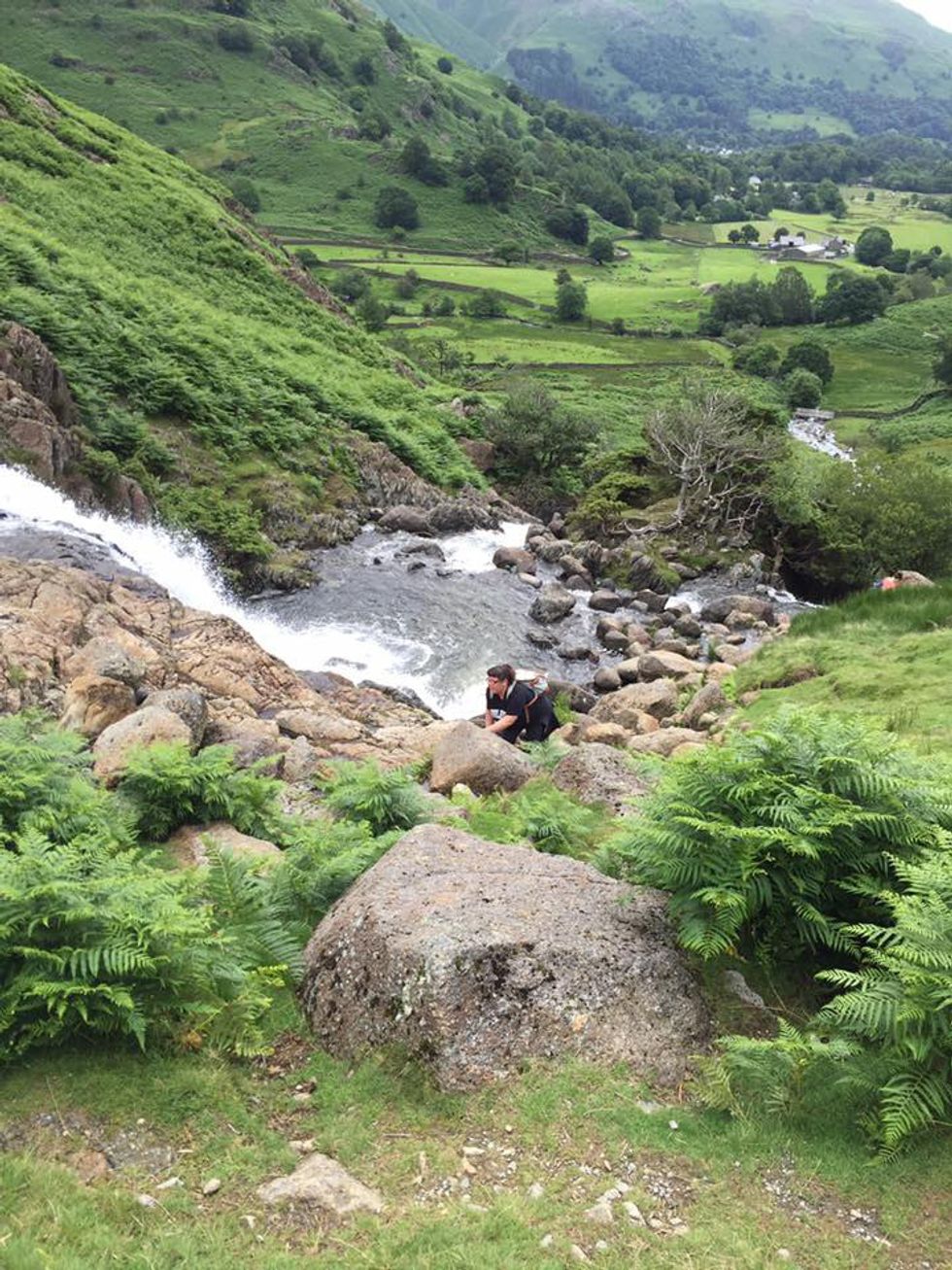
However, with Wordsworth’s reminder and our brief discussions rattling around in my head, I was able to fully immerse myself in the beauty of the fells. Our hike took us along a small river rushing down the side of a little mountain; past waterfalls and miniature lakes called tarns; accidentally through bogs and over gently rolling hills; and finally right up to a pub, which only served local beer and strange, hard ciders (along with food).
The beauty we saw that day spoke to me as no environment outside of my hometown and the Grand Canyon have. I have been living too long in suburbs and cities. I have, hopefully, formed memories of that wonderful place which will carry me through the next set of obstacles I meet. My goal, though, is that it shouldn't have to. When I return home, I will make it a point to try to see more nature and less man as much as I can. The possibilities for healing are endless, and I know that more than anything else, that is exactly what I need.