

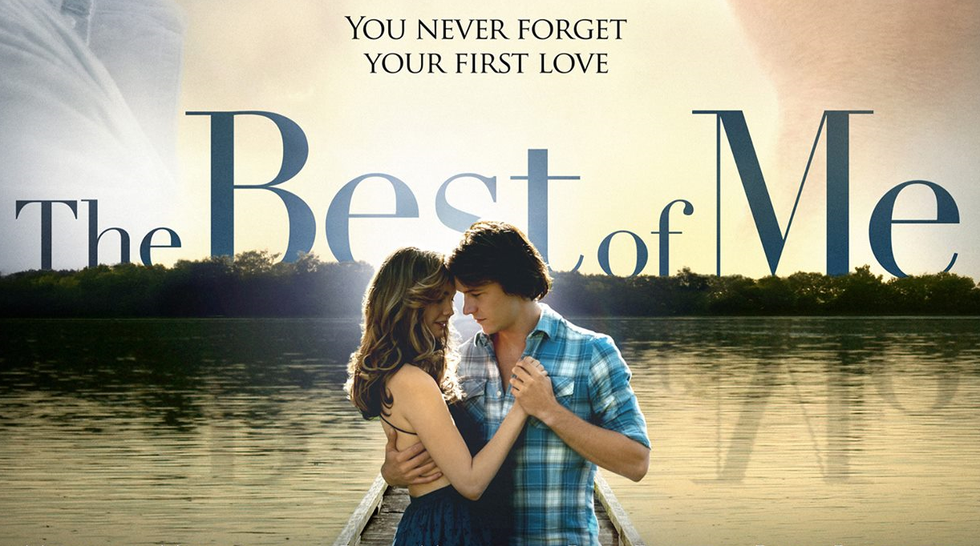
If you're a die-hard Nicholas Sparks fan like me, you've probably read all his best-selling books and seen all movie adaptions produced. Sparks' memorable love stories and well-developed characters appeal to audiences of all generations and it's no surprise many of his novels became films. One of these movies, "The Best of Me," is currently available on Netflix.
"The Best of Me" follows the lives of Amanda Collier and Dawson Cole who fell in love as high schoolers in Oriental, North Carolina. Despite his respectful nature and good character, Dawson comes from a family of criminals and Amanda's parents do not approve of her relationship with him. However, Dawson and Amanda believe they were meant to be together and do not let anything stand between their strong bond.
Both characters return to their hometown after the death of Tuck Hostetler, an old man who greatly impacted their young lives, per Tuck's request. There is a catch, however—neither of them knows the other one will be there, and love's dying embers reignite despite many years passing by.
The film leaves much to be desired since it is loosely based on the novel and should not be classified as true book adaptation. It focuses heavily on Amanda and Dawson's past lives when they first met through various flashbacks while the book centers on their current lives and unrequited love, only hinting at past events.
Luke Bracey and Liana Liberato star as young Dawson and Amanda while Michelle Monaghan and James Marsden play them as adults. The younger versions of the main characters are well-developed but the adult versions lack the level of depth present in the novel, especially with Amanda, whose character is thoroughly detailed in the novel. Without these important character aspects, the film's characters do not generate the same impact as the book. Nonetheless, the actors still did a great job portraying their characters.
The movie hardly mentions certain key characters, such as Amanda's mom, that are more essential to the overall story. Amanda's husband, Frank, also plays an important part in the story but only appears at the beginning and end of the film. However, the lack of these characters does not become detrimental due to the film's different perspective. For example, Amanda's encounters conflict with her mother as an adult, but since the film looks at flashbacks, her mother only appears in one scene. The movie even has an additional character, Bobby Cole, who does not appear in the novel.
The movie also does not look at Tuck as in-depth as the book does, which hurts the film in a way since Tuck influences the majority of events occurring in both the film and book. In addition, the film hardly mentions his relationship with his wife, Clara, whose ghost appears often in the novel.
Many major events were changed to suit the film. The film does not include the novel's opening scene where a mystery man saves him from an explosion that occurred when he worked on an oil rig. The way Dawson dies is also changed as well as the entire rest of the book's ending. Even simple details like the way the lovers meet did not carry into the film script. Although the way these events occur in the movies makes sense and happen in a similar way, they amend the original story Sparks wrote. However, these changes may have been necessary since the film does not focus much on their present lives.
"The Best of Me" remains one of my favorite Nicholas Sparks stories, but the film left much to be desired and was not produced with the same quality seen in adaptations of his other novels. Even though the overall story endured major changes in the film adaptation, the actors accurately conveyed the unbreakable bond between Dawson and Amanda and all characters were well-played. The film also provided insight to the events that occurred during their high school years through various flashbacks
As someone who desires strict book-to-movie adaptations, this film did not live up to my standards. Seeing the film as a book adaptation yields disappointment due to major storyline changes, but viewing the film as a supplementary element to the novel makes it worthwhile due to the different perspective presented.

















