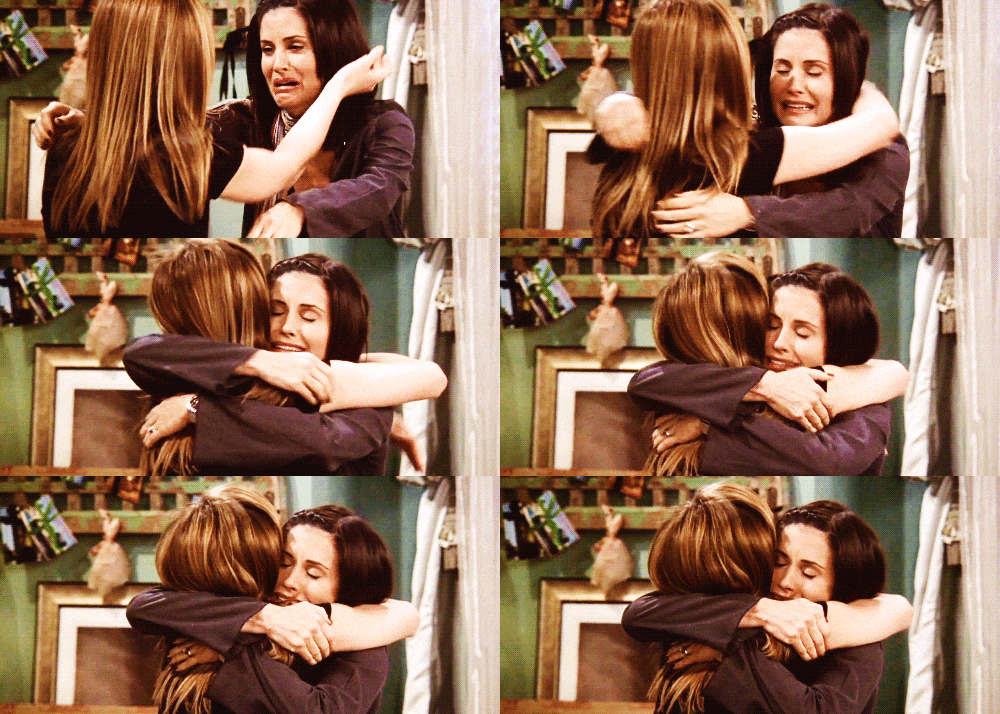


Nails press into your palms. Your jaw tightens. Heat flushes your neck. Your legs feel lighter than usual, weak. Your eyes well up before you have a chance to realize you are crying. You retort with words you’ve saved from past fights. You leave to find the closest bathroom and let the hurt do the rest of the work.
Humans are innately fragile creatures. We spend our whole lives creating a persona that we deem not only livable but acceptable to others. We forge friendships in hopes that they will validate these ideas of self. We date others who will reveal to us areas worth praise we did not yet recognize. We look towards our parents for the roots of our identities and similarly, away when the two don’t align.
More often than not, individuals are aware of their flaws, their inconsistencies. I am selfish. I expect those I hold close to being capable of understanding what I want without having to say it. Many dinners out have been ruined by my unwillingness to admit that no, I don’t want Chinese, while simultaneously feeling dismayed that my partner could not recognize this through my passive-aggressive sulking that I’d hoped he’d take me for Indian instead.
With 7.125 billion people living on the planet with different backgrounds, upbringings, and molecular makeup, the number of ways one could hurt a person’s feelings is incomputable. Joking How much can you eat?, laughing at someone’s baseball cap, asking You’re looking for other jobs, right? The deepest bruises seem to emerge from the subtlest jabs.
When recently attending a writing workshop, the issue of insensitivity arose in a peer’s essay. Among others, he used the word “helicopter parent” to describe a childrearing style he personally disagreed with. The director responded to his use of the term by saying “If someone were to call me a helicopter parent, I would look up from circling my daughter and say, ‘Well yes, but now you’ve hurt my feelings.’” The writer seemed unaware of his caustic language, scribbling notes in the margins silently. Show more depth. Multiple sides to story?
The issue with hurt feelings is while the offended cowers beneath their blankets, replaying the painful scene over and over in their head, the offender is probably bowling, tossing down their ball with happy ignorance to their mistake. How do we bridge this disconnect? I used to believe through direct communication, anything was possible. After relying on this mechanism, however, I’m not sure communication earns the title of problem panacea. Maybe communication fails because pride is too prevalent on both sides. The offended feels their own already cut down, making them bitter. The offender feels they are being harangued, leaving them irritated. Both are unrelenting in their opinion, their feelings, their interpretation of what happened. Who can claim their side is the right one when viewing it from behind different eyes? In a world where words so often undercut others, when did the childhood lesson of saying sorry leave our lexicon?
I am visiting home and lying in bed with my sister, listening to her tell me stories about ex-boyfriends, lost friends, our parents. She tells me she “holds grudges,” that she “doesn’t forget the moments when she’s been insulted.” Instinctively, I respond “I forgive easily,” knowing as I say this that I am lying. I think of the human brain and how it begins as a lump of pinkish flesh—smooth and void of experience. How as individuals age and encounter moments of happiness, fear, hurt, the brain tissue folds, physically ingraining those events in people’s minds. How can we blame humans for resisting forgiveness when seeing or hearing about the person who hurt them sends electrons firing across those raw pinkish ridges, replaying that memory with the same intensity felt the day it happened?
Maybe we expect too much from other people. Maybe emotionality trumps reason when dealing with loved ones. Maybe the best we can strive for is actually wanting to forgive, hoping that forgiveness itself heals like most things do, with time.