
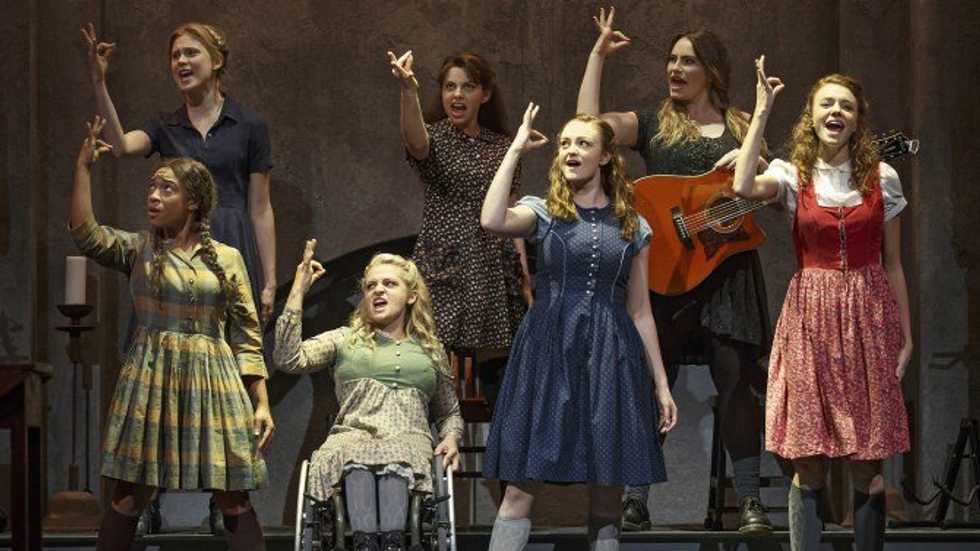
“We love the idea of diversity, but do we really know what it means to authentically represent it?” Ali Stroker, the first actress on a wheelchair to be on Broadway, speaks to the audience.
Her presence is fundamental since it represents a community that is often neglected: the disabled community. According to the United States Census Bureau, one out of five people in the United States is disabled. Yet, disabled artists very seldom have the possibility to express themselves on the stage or in movies. The theater, since its origin, aims to portray the largest variety of human experience; yet, how can it present universal stories if the actors who tell those stories are not universal at all? Perhaps what Stroker is implying is true; we all theoretically support the concept of inclusion, but we still don’t have a clear idea of what it means.
Because of the enormous absence of disabled actors on stage, the Deaf West’s Theatre’s project stunned the public. In New York in fall 2015, a cast formed by half deaf actors and Ali Stroker performed a revival of Spring Awakening. This provocative and progressive musical, set in 19th-century Germany, deals with the struggles of young teenagers that try to intimately and honestly communicate with adults. The last named are locked up in their world of conservative forms and close-mindedness, and educate their children through taboos –sex, sexuality– and secrets.
The 2015 Broadway revival is incredibly compelling to our present situation; we claim that we are an open-minded society, that everyone has equal opportunities, but that’s a lie. We did not progress that much from 19th-century Germany.
According to the New York Times, “between the 2006-07 and 2012-13 theater seasons, Asian-Americans filled about 3 percent of the roles on Broadway and Off Broadway theaters […] Hispanics had roughly the same numbers of roles, while black actors had 14 percent and white actors had 79.” The numbers presented by the New York Times are shocking, yet even more shocking is the fact that the article doesn’t even mention disabled actors. Perhaps able-bodied people are, somehow, afraid of disability.
The majority of able-bodied people consider disability as a flaw, as something terrible, and, at the same time, as a taboo –just as sex in Spring Awakening. They see disability as the impossibility of doing what able-bodied people do. Yet, is disability really a catastrophe? Or is this just the perspective of able-bodied people?
Stroker never referred to disability as an impossibility; she called it a “different ability." If you are deaf, it doesn’t mean you are not able to communicate, it means you communicate in a different way; if you are on a wheelchair, it doesn’t mean you cannot dance: You simply dance in a different way. Being disabled does not mean that you are not able to act; it means you act in a different way. So, if disabled actors are just as capable as able-bodied actors to act, what prevents casting directors from hiring disabled actors?
Many directors have become interested in portraying disability in films (some examples are Lasse Hallstrom’s What’s Eating Gilbert Grape or Olivier Nakache and Eric Toledano’s Intouchables). All of these movies are beautifully written, incredibly acted, and critically acclaimed. However, every disabled character is performed by an able-bodied actor and disability is portrayed in a negative and heartbreaking way.
This happens because our perception of what is normal or not depends on the society we are part of. If this society decides that disability does not "fit" in the "normality category," we start seeing disability as something alien from us, something we don’t know about and that we should not talk about. The reason why we fear disability is that the only knowledge we have of it comes from our society’s stereotyped conception of it –disability is a catastrophe, something that has to be pitied.
Chimamanda Ngozi Adichieonce gave a TED Talk entitled “The Danger of a Single Story." She explains how having a single idea of someone, of their backgrounds, of their culture can lead to the creation of stereotypes that impede the possibility of connection. This is why, in my opinion, there will be no possibility of connection, of communication, of inclusion with the disabled community until the stereotype is torn apart.
We can start destroying this stereotype by including disabled actors in the world of performing arts. In this way the audience is exposed to an often unexplored side of the human life: the ability within disability. Disabled artists should be seen as a 'doorway', rather than as a hindrance or as a taboo. They shouldn't only represent the struggles they go through and how they overcome them; they also can use their disability as a doorway that leads to a different universe of artistic and human possibility; they can tell a whole new range of stories. Deaf West's Spring Awakening was a huge success because its diverse cast added an entirely new significance to the play. The more universal display of bodies added a universal connotation to the story. By doing so Spring Awakening The Revival enriched the world of performing arts. Disabled artists can contribute to make the theater be that universal and educational place that shows every side of the human life.
In this way, by communicating with one another, listening to and understanding one another, inclusion can be achieved, stereotypes can be destroyed, fear is eliminated, and universal art is possible.