

Until you turn 12, birthdays are supposed to be joyous, a celebration of growing older marked by getting gifts from Brookstone that you will use for two days, and then put in your closet for the rest of eternity. Eating birthday cake is one of the main one ways to celebrate such an occasion, but recently, birthday cakes have left me with a bit of a sour taste in my mouth. Let me explain why.
Much of the trouble with birthday cakes involves ordering them. If you are one of the few who still bakes birthday cakes, stop reading this article and go back to watching Ellen's show. The rest of you -- take notes.
Cake ordering at a store or bakery begins with just that: someone requests a cake to celebrate their dying third aunt's birthday, and immediately, things go wrong. If the circumference of the cake is off by even one millimeter, you will hear it from the customer. If the icing was the milano red instead of apple red, you will hear from them (apparently, most customers come from memorizing paint samples at Home Depot.) As someone who has taken plenty of cake orders, I am well acquainted with this struggle.
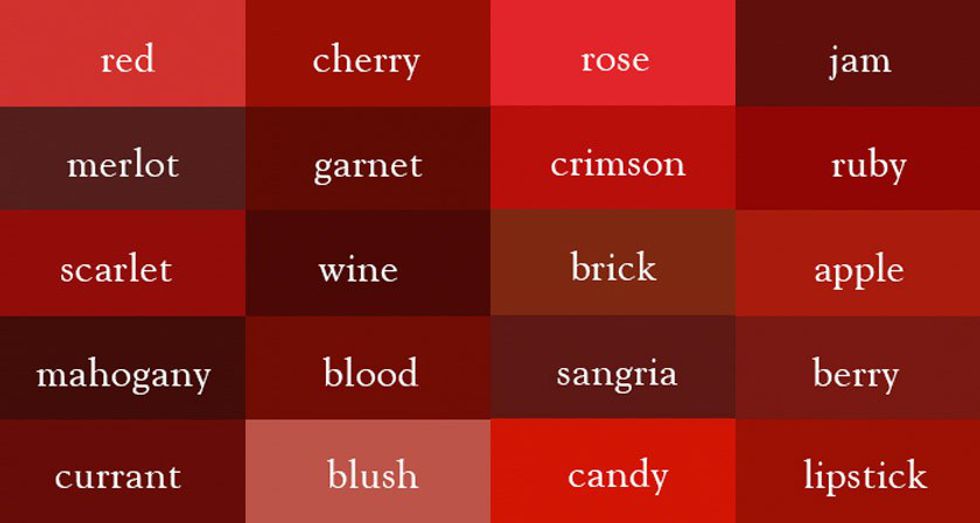
(Red: thecolor of death, the death of your sanity).
All cake-related issues go back to 1954, when William Golding released "Lord of the Flies," which is not a commentary on our bakery's sanitation habits, but rather human nature as a whole. One of the themes of the book, according to Sparknotes, is the realization that human nature can lead us toward savagery, but you don't need to go to a deserted island during the height of World War II to recognize that: just go to a bakery.
This trouble begins when you take the order for the cake, a task which involves affirming that you know how to spell, “Congratulations,” as if the customer was asking, “Congratulations, did you pass third grade?"
All the trouble surrounding cake ordering is amplified when two people order the cake, particularly two parents. Watching parents argue about designing a cake to celebrate their child's first birthday (which the child will clearly remember) might help one understand the ineffectiveness of the United Nations. Reagan and Gorbachev could have solved the Cold War before a couple decides on what type of icing they want on their child’s cake.
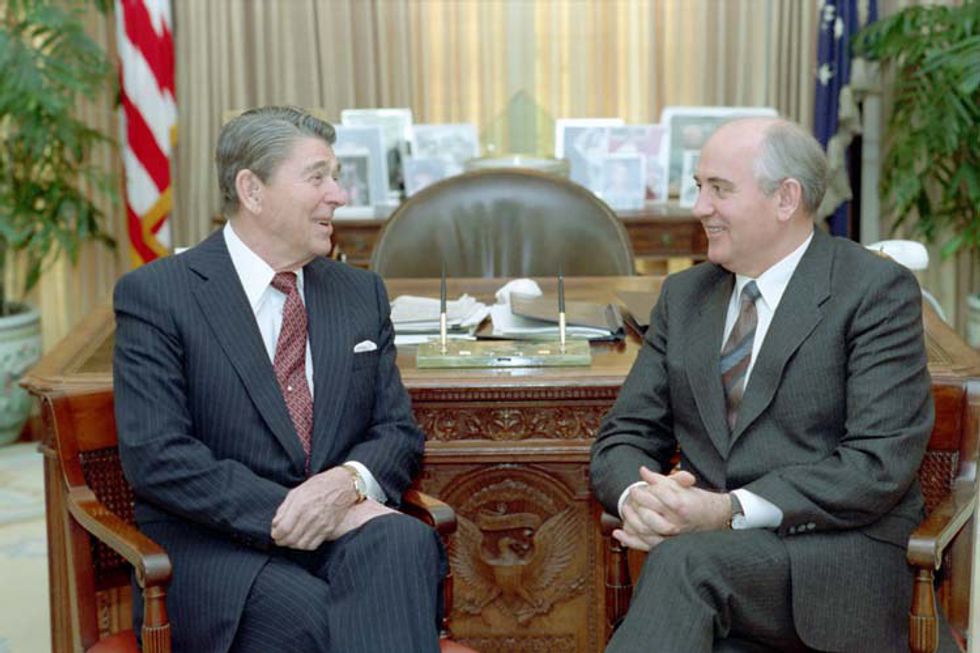
(Two world leaders discuss yellow cake, the sort with Uranium-238).
Appropriately, giving a customer a cake after the cake is made is as dangerous as handling radioactive material. See, if by some miraculous alignment of the cosmos you created a cake that 100 percent met the customer's expectations, it somehow will not be good enough, and you will be forced to whitewash the cake like an AP U.S. history textbook.
Often, a customer knows that there will be an issue picking up the cake, so they send their spouse to retrieve it for them. Unfortunately, the lack of communication between parents only makes the process more difficult. In fact, spousal confusion surrounding cake ordering is one of the leading causes of divorce in America, which are as follows:
1. Cake ordering.
2. DVR arguments.
3. I really loved his brother, instead.
The likelihood of this all going well is around 10 percent -- a number that can only be rivaled by the approval rating of one thing: Congress, whose help I need to ban birthday cakes. Like the couples ordering birthday cakes, Congress can't seem to agree on much, but I think I could sneak by an amendment banning birthday cakes under the facade of health.
My proposition is win-win. On the one hand, if they ban birthday cakes I will regain my sanity, but on the other hand, things that get banned by Congress tend to become more popular as a result. So this amendment would lead to an increase in birthday cakes -- I just wouldn't be the one making them. Wouldn't that be icing on the cake?