
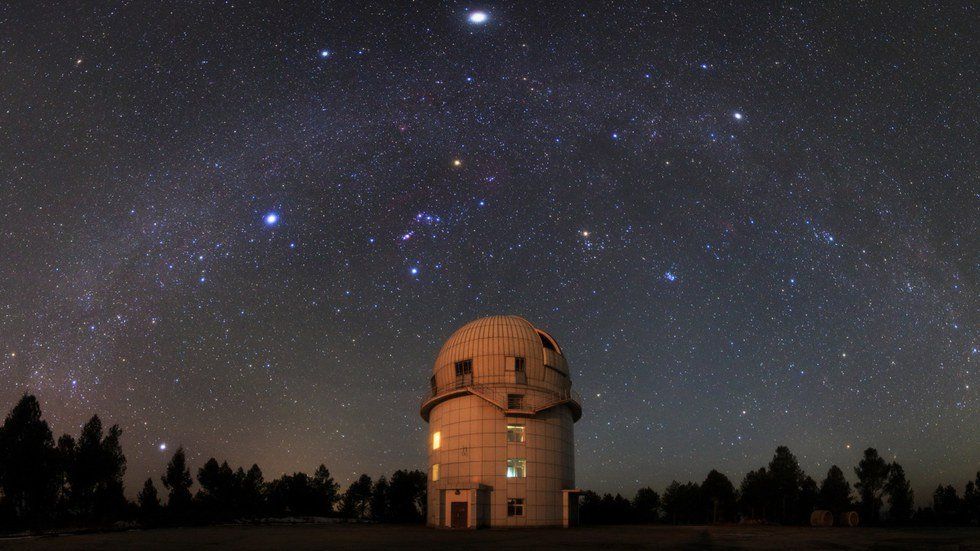
History is capable of telling us that humans have been fascinated by ourselves for quite some time. Honestly, we have always been full of ourselves. It is where our overwhelming pride as a species comes from, but it is also where a lot of our curiosity takes root. As long as we have had conscious thought, we have been curious about our origin. Why are we the way that we are? What does it mean to be human? Where did the very universe come from? As a kid who grew up in youth group and going to church, I had the opportunity to get to know that these questions have answers that are bigger than anything any of us can imagine, but hold on… I’m getting ahead of myself.
Let’s talk about 19th century Germany. Germany at this time is a hotbed of Protestant Christians in a world that still felt the might and rule of Catholicism as the overarching superpower in Christianity. Under Catholic rule, scientific inquiry had had many ups and downs. We need only look at the way that Copernicus was excommunicated from the church for suggesting that the earth is not the center of the universe to see that Christianity and science were in serious tension. Fast-forward to Germany in the 1800s, and we see a lot going on. This is a place where Protestantism is in full swing. It is also a place where science is moving forward in leaps and bounds. Protestant men are training in the universities of Europe and in Germany, progress is happening fast. One example of this progress is a German man named Wilhelm Wundt. Wundt’s big accomplishment was using his knowledge of medicine as well as philosophy to bring about an entirely new science: psychology. In 10th century Germany, we have a boom of both Protestant Christianity and scientific progress working together.
Does this still exist? One of the most prevalent arguments against Christianity is when people say, “I don’t believe in God. I believe in science.” At what point did this become a logical thing to say? When did the term “Christian scientist” become an oxymoron? This is one of the biggest issues that Christians face today: as scientific understanding continues to grow, do we have to mistrust science to continue believing in God? In the work I’ve had the honor of doing with young people, I’ve been able to see that this is a big question in the heart of your everyday youth group kid.
Imagine, a young teen named Howie. Howie grew up in a “Christian home”, meaning that he was brought to church from time to time with his family and knows the Fruits of the Spirit song from Vacation Bible School. Howie does not know much about the Bible, but he does know that Jesus came to die for him so that he could be free from sin. What he does know a lot about is science. Howie is a self-proclaimed science nerd. He loves studying the stars and the laws of motion and the way the water cycle works and everything in between. When he goes to youth group, he hears the pastor say something about how public schools have been teaching evolution and how this is a bad situation. They open up the Bible and discuss Genesis 1 and how God formed the heavens and the earth. Now, Howie is thoroughly confused because, say what you will about the pros and cons of evolution, the evidence he’s been presented definitely does not support a claim that the earth is 6,000 years old.
The issue that I want to raise is not the debate between Creationism and Evolutionism. In fact, straying away from that debate is exactly what I would like to suggest. When I was growing up, I was fascinated by science, especially astronomy. When I went to college, I got the opportunity to take an astronomy class with a professor who is both a Christian and a notable astronomer. In that class, we were taught about the intricacies of the observable universe. We learned the process by which stars form and how to measure distances between them. In everything we discussed, my professor was able to link the content back to the certainty of a designer God forming and sustaining the cosmos. I learned just as much about God in my astronomy class as I did about elliptical orbits and atmospheric compositions.
I wish I could direct every youth group’s science nerd to a class and a professor like the one I had. Too often, kids like Howie are led to believe that science and Christianity are incompatible. Though it is never stated as such, many kids eventually come to a time when they feel they are being told they have to choose between rational, scientific inquiry and faith. Now, this is not the message the majority of youth pastors are preaching, so where is this idea coming from? Why has it become so hard for the science nerd to be a Christian these days?
I would like to advocate for those kids (and adults) who feel as though becoming or staying a follower of Christ is impossible because of their belief in science. God’s glory is revealed in so many ways that we often overlook. We have seen that glory in His Scripture and in the work of His Church, but what about the heavens declaring the glory of God? The skies proclaim the work of his hands. (Psalm 19:1). Seeking out scientific answers for things like the origin of our planet and universe is not an attempt to disprove God. This scientific inquiry can lead us to a deeper understanding of the ways that God has lovingly and incredibly intelligently formed the world that He has allowed us to live in. This is my encouragement for the science nerd in youth group. Do not fear science, for it is just another way of bringing glory to God. This is a reality that Protestant Christians in 19th century Germany knew. It is a reality too many people ignore today. Let’s teach this to our younger generation so that we can make “Christian scientist” less of a scandalous term.