


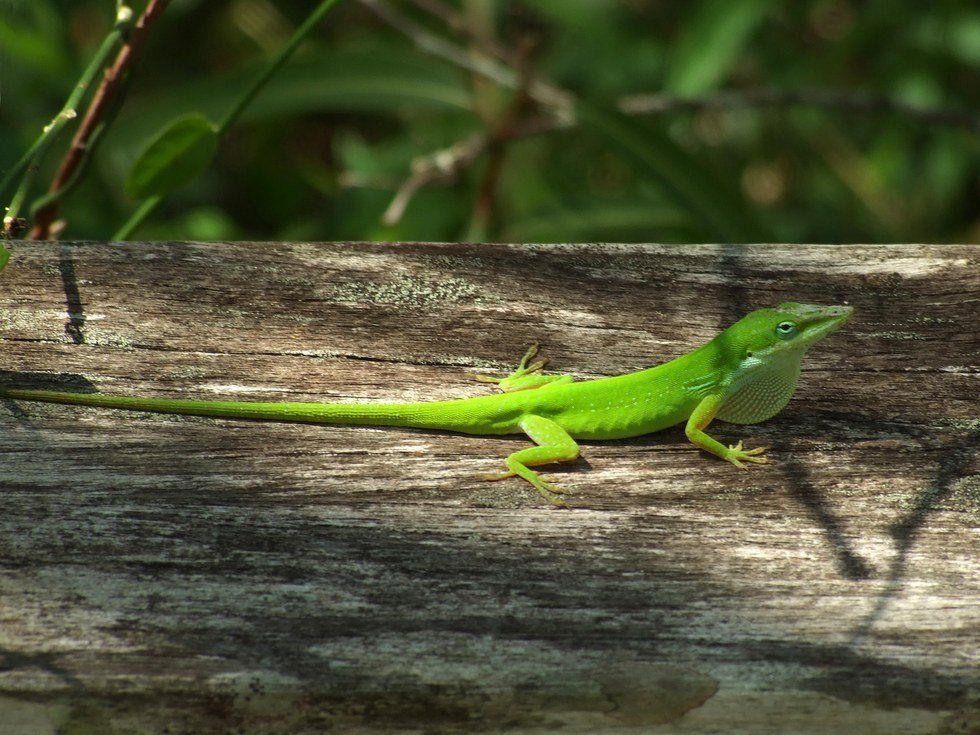
Animals live in a variety of environments and face different challenges. Novel adaptations enhance their survival. The tail is one characteristic prevalent in vertebrates which are important and vary in usage. This can include aiding in movement, balance, and mate attraction. Mammals have been greatly studied in how they use their limbs for balance and stabilization. Mid-air reorientation of animals was debated until 1894 when research confirmed falling cats achieve righting by body twisting. Theropod dinosaur agility has even been hypothesized to be possible because of tail stabilization during maneuvering. Lizards can utilize their tails alone to right themselves mid-air, but mammals must use body rotation in association with tail movement. Tail rotation as a stabilizer in lizards establishes a framework for understanding the impact of changes in tail morphology, and has been enhanced by technological advances.
Tail swinging in lizards is a mechanism for counteracting aerial body rotations. Falling and slippage in the wild can occur because of predator evasion, species interactions, or complex environmental features. Proper landing would therefore reduce risk of injury and aid movement to favorable regions. A system promoting greater mid-air control would be highly beneficial to an organism. Because evolution in response to substantial environmental pressures produces adaptations, longer tails may have been selected because of their usefulness. This may have facilitated tail development in arboreal environments. Aerial righting is achieved by the body’s momentum being transferred to the tail and thereby decreases unwanted rotation. Tail revolutions occur in the opposite direction of the desired body movement. Such rotation is positively correlated with misalignment size, meaning more tail revolutions are needed for larger deviations to reach the desired body orientation. Rotation by posterior appendage swinging has been found to enhance precision and agility of maneuvers. No body twisting appears to be involved in lizards, therefore, tail rotation alone is sufficient to reorient their bodies. Because mammals rely more on torso twisting than appendage use, this phenomenon appears somewhat unique to lizards. Longer tails are more effective because they require less swinging to stabilize the body after an undesired rotation. Perpendicular tail swings to the body have been found to be more effective. This means tail orientation impacts the effectiveness of mid-air righting along with tail size. Selection for longer tails in certain environments may have aided its evolution because of its stabilizing capabilities. Using proper technique, tail rotation provides lizards with a tool that may give them an advantage in navigating difficult terrain.
Substantial modifications of lizard tails can change righting effectivity and even impact fitness. Adjusting aerial position can be important to survival. Death is a possibility should successful adaptation not be achieved. Whether it be jumping to avoid hostile situations or recovering from an accidental fall, mid-air adjustments expand an organism’s range of options in unpredictable environments. Lizards exhibit differences in tail size and length. And about 100 species of lizards can deliberately remove their tails (called autotomy) to evade predators, adding another dimension to tail variation. This strategy gives an immediate advantage but may reduce locomotion and speed, reproductive success, and/or group acceptance. Such an approach has evolved separately in various lineages, demonstrating its adaptive potential. However, a passive tailed or tailless lizard is less efficient at decreasing unwanted body rotation. Adding a stationary or active tail to a tailless lizard significantly increases stability. This shows the importance of tail morphology. In the model organism for jumping, Anolis carolinensis, the preparatory phase and velocity/speed were not different in tailless lizards. A significant backwards rotation, tumbling, and swinging of the tail stump was seen in these modified green anoles, compared to nearly obsolete rotation in wild type lizards. Gillis et al. (2009) hypothesized this backwards spin may have been caused by tails not hitting the surface during jump initiation, as seen in normal anoles. Jusufi et al. (2010) proposed A. carolinensis may be restricted in tail movement by their large posterior limbs, thus reducing their effectivity. Adjustments to lizard tails and associated structures can produce a variety of fitness related effects. Understanding these changes provides insight to evolution and usage of these structures.
See the difference between how a lizard lands after a jump: With a tail, the landing proceeds without a problem. Without a tail, the lizard cannot offset the unwanted rotation and lands at a bad angle.
Mathematical models and robots have been used to verify and test stabilizing tail function. Many researchers have used existing data to come up with innovations in predicting events or in creating automated machines. Mather and Yim designed a robot with reorientation capabilities similar to a cat’s bending torso and stated a tail would not be helpful in rotating large bodies. Though previous investigations have attempted to construct stabilizing robots, Libby et al. (2012) were the first to use a tail for this purpose. They found robots with a tail could withstand undesired rotation better than without, and efficiency was increased by adding mass to the tip of the tail rather than the base as in lizards. Using their model, Libby’s research team evaluated velociraptor agility and found it may indeed have had superior maneuverability as hypothesized. Jusufi et al. (2010) based their model on Hemidactylus platyurus, a well studied gecko, to test and simulate the capacity of other lizards. Using their model and the prototype robot based on it, they verified tail inertia is enough to right a body without twisting. Jusufi’s team modified a four legged climbing robot, Stickybot, by adding a tail. The model accurately predicted the robot’s functionality. Tails indeed control movement better in shorter time spans and have been seen to stabilize climbing. Incorporation of tails onto recreational, medical, industrial, and/or research robots may enhance maneuverability in topographically complex areas. The accuracy of each model may be used in understanding lesser studied lizards or upgrade existing prototype robots.
The tail is a fairly conserved trait among mammals. Though in some it may serve as a means to communicate, lizards can also use it to reorient themselves mid-jump or during a freefall. A rigid tail confers an advantage over no tail in mid-air movement. Following the establishment of tailed lizards, autotomy developed by providing an immediate benefit to fleeing organisms. Though this entails a cost, it must not be detrimental to the lizard. With advances in modelling, tail-like appendages may aid unmanned transports completing complex tasks in unpredictable situations, especially when no other form of modification is appropriate. Dense areas that may not allow for aerial propulsion or conventional means of transportation may be perfect for such novel machines. It seems tails grant greater agility to lizards and even robots!

















