


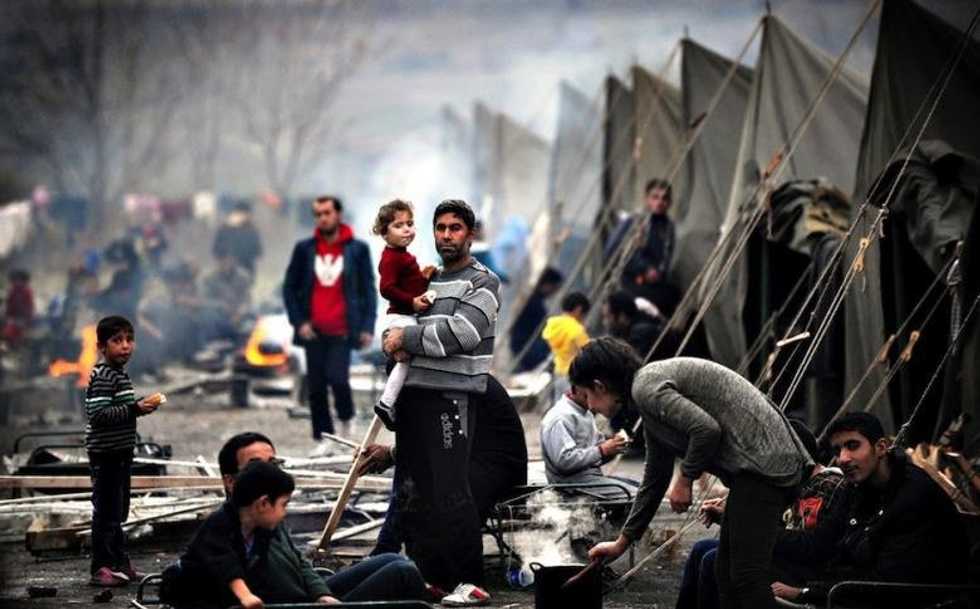
According to a report by the United Nations, the amount of people "forcibly displaced" in 2015 "far surpassed" a record 60 million, mainly driven by the Syrian war and other protracted conflicts. This number does not include migrants that voluntarily left due to home (economic, political, religious, etc.) conditions. Many refugees will live in exile for years to come, the Times said, adding that "if you become a refugee today, your chances of going home are lower than at any time in more than 30 years."
So far the United States accepts only 10,000 refugees. Those applying for refugee status and resettlement to the United States from outside the country are required to stay in the country from which they applied while going through several rounds of interviews with U.S. federal agencies. Security concerns and strict rules regarding who can be admitted to the United States mean the application process can take up to two years.
Asylum seekers, those who apply for refugee status after they reach the Unites States, are in a slightly different situation. The asylum application review process can take even longer than those applying for resettlement, as the current backlog of asylum cases that have yet to be reviewed approaches 100,000. The immigration courts have been delayed and backlogged for years because of a persistent underfunding and understaffing of the immigration courts. As far as federal benefits are concerned, until a person is granted asylum they are not eligible for anything, and for the first 150 days the application is pending, they are not allowed to work either. After 150 days the applicant can apply for a work permit, which takes 30 days to process. This means that while being displaced in a country they do not know, filled with a language that they do not know and with unfamiliar faces, those who were forced to leave also have no way in which they can provide for themselves legally. This can often push them into horrible conditions, working for wages that cannot support them, in jobs that are deplorable.
Especially after recent terrorist attacks, like that in Brussels, Islamophobia grows. This makes it harder for refugees to enter the country and to eventually attempt to assimilate. There are also more serious ramifications regarding this. “If someone assists an armed group in a combat situation, then they could be barred as a terrorist [and be not let in] even though they may have done it under duress,” said Kevin Appleby, Director of the Office of Migration Policy and Public Affairs at the United States Conference of Catholic Bishops. “So someone could get a knock on the door. There’s armed soldiers there. ‘Feed us, or we’ll kill you.’ You feed someone lunch to spare your life, and [you’re] barred from resettlement.” This leaves a person with very little option of where to go.
These are only conditions which refer to immigration into the United States. A majority of refugees seek entrance into European countries due to the closer proximity. Many counties have sought out to close their borders to refugees, or have an acceptance limit lower than that of the United States. So with the over 60 million displaced bodies, options are elusive and dangerous.
The problem only continues to grow, and it is clear that this is a topic that we must focus on. The democratic party presidential candidates, Clinton and Sanders, both favor allowing Syrian refugees into the country. Clinton claims “I said we should go to 65” — meaning 65,000 refugees — “but only if we have as careful a screening and vetting process as we can imagine.” While Sanders says “What the magic number is, I don't know. Because we don’t know the extent of the problem. But I certainly think that the United States should take its full responsibility in helping” refugees. The remaining republican candidates have expressed the opinion that the United States should not allow refugees in. They generally emphasize the difficulty of vetting the refugees and the possibility that terrorists could slip into the country. Trump stated "If Obama, through his weakness, lets them come in, I’m sending them out if I win.” Kasich merely said “There is no way that we can put any of our people at risk by bringing people in at this point." While not completely against the influx of refugees, Cruz has stated that only Christian refugees should be allowed into the country: “Those who are fleeing persecution should be resettled in the Middle East in majority Muslim countries. Now on the other hand, Christians who are being targeted for genocide” should be provided safe haven in the United States. It does not seem clear how he would ensure that only Christians make it into our country, or how Syrian refugees could be resettled into these other countries he speaks of. It is also unclear as to how Christian refugees are guaranteed to be safer and less of a risk than Muslim ones.
What is clear is that there is still a huge displacement problem for millions, and most countries are reluctant to take on the problem. A reality for millions is that there is no home, no place to go, and no way to provide for themselves. It is clear that a solution must come soon, and that we should all be aware of the problem.

















