

I’ve had a fascination with superheroes ever since I was little. The costumes, the powers, the secret hideouts; what was there not to love? These were people with exceptional qualities put into extraordinary situations. I grew up with superhero stories, whether in the form of Teen Titans comics my dad periodically brought me, or cartoons like Teen Titans and Static Shock. The latter is really where I found my love of superheroes. I could go on listing all of the cartoons I watched that built my canon; ranging from The Powerpuff Girls to the short-lived Wolverine and the X-Men. All of these cartoons had a special place in my childhood, and built parts of it.
And yet, I remember so distinctly frantically trying to change the channel when any family member walked in on me watching X-Men: Evolution or Wolverine and the X-Men. Somewhere deep down, I was ashamed to like, love really, all of this. I was trying to hide this, despite the fact that I’d tuned in every week to watch Teen Titans with my parents and sibling by my side. But by the time I was watching the former two shows, I must have been in fifth or sixth grade; by then, I had some conception of “what was meant for me” and superheroes apparently weren’t.
Now, anyone who knows me knows that I exhibit few typically feminine qualities, and even at that age I had already begun refusing to wear dresses. I was in no way ashamed that I was female, nor was I ashamed that I didn’t fit into the typical concept of femininity. What I feared here was being judged.
Eventually, I got so fed up with changing the channel, you miss some important parts of episodes that way, that I just stopped trying and proudly proclaimed my geekiness to my family. But there was still the knowledge that I was an outsider in an outsider’s hobby.
This wasn’t a deterrent to me; I quickly stopped caring what others thought. With that said, as I got older and started reading the comics not designed for kids it was clear that I was often not the intended audience, perhaps more so that I was the forgotten audience. So many comics were built around a masculine fantasy that rarely treated women as they treated men, as three-dimensional characters, capable of leading a story.
There have been a number of changes since then, and mostly in a positive way. There’s still a lot of room to grow, but there has been a slow progression towards more inclusion, not just in terms of gender, but in race, ethnicity, and sexuality as well. For while superhero comics have always appealed to outsiders, they've always been targeted to the very specific demographic, rather than to a diverse array of people who are interested.
I’ll be honest; I’m more of a Marvel fan when it comes to the big two, so I can only really speak to major changes in their lineup. However, it is how many of those changes have been done that can be a great stepping-stone for diversity, and great storytelling, in all superhero comics in the future.
In addition to pulling some underutilized characters out of the woodwork, Squirrel Girl and Luke Cage come to mind, Marvel has utilized the concept of a title as a mantle to put female and minority characters into more prominent positions. The concept of new characters taking on previously held positions isn’t new to comics, just ask any of the Robins, but what’s been happening at Marvel has been happening at a far higher concentration than ever before, and has changed the landscape of their comics far more than ever before.
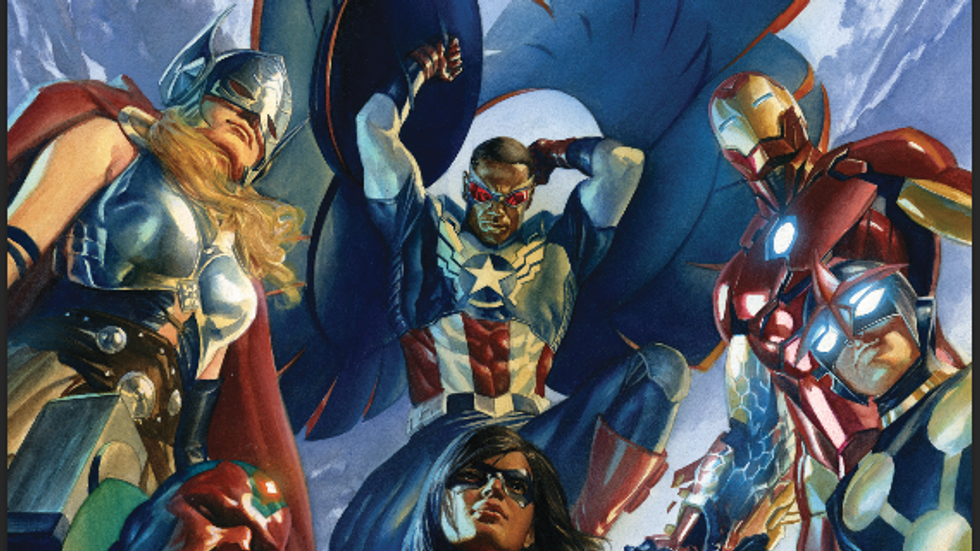
The current Avengers team flies under the banner “All-New, All-Different” and in many ways that couldn’t be more accurate. The team appears relatively similar to teams of the past, but not when considering who’s under the mask. Spider-Man is a familiar name to comic readers and non-readers alike, but Peter Parker won’t be found on this Avengers roster.
Instead, Miles Morales can be found in his signature red and black outfit. Miles first appeared in 2011, when the Ultimate Universe’s Peter Parker died and Miles took on the mantle of Spider-Man. This event even made mainstream news, largely because Miles is black and Hispanic, and news sources took every opportunity to use the headline “Spider-Man is Now Black.” Some fans claimed this was only a publicity stunt, but time and time again Miles proved to be a complex character with interesting stories, so even if it was it didn’t matter in the end. If there is a poster child for superhero mantles being a way to increase diversity and pump energy into a tired story, then it’s Miles Morales. He became the only part of the Ultimate Universe to really work, as the rest of the universe never really gelled with readers, to say the least. Miles was one of the few aspects of said universe to make it into the new post-Secret Wars Marvel continuity.
Characters are rarely retired in superhero comics and their deaths are rarely permanent; as such, characters might have fifty or more years of history and story behind them. Eventually, they become stagnant and clichéd; there’s nothing else to add to them. The reason behind the immortality of these characters is popular demand and easy marketing. But it’s sometimes at the cost of storytelling.
Peter Parker remains a prime example for this. After more than fifty years, his story lines are becoming repetitious and his character has been written in so many different directions that character development rarely exists in the long term, and writers are running out of new ideas to play with.
By creating new characters and having them assume the mantles of old favorites, there can be a rebirth of story, while the company gets to use a title that consumers are already familiar with. Comics need reinvention; too much of the time they rely on the status quo.
But superhero comics have the potential to go to nearly anywhere the imagination can take us, so why limit that? Why not, push writers, artists, and readers out of their comfort zones? By retiring characters and creating mantles, there can be consistent growth from characters, but there is also the ability for comics to change with the times and diversify their line-ups.
That’s what Marvel has been doing lately. Jane Foster currently holds the position of Thor. We can argue about the fact that Thor is actually a name, not a title, but it’s obvious she has the title for marketing purposes. Here we get a new perspective of Asgard and of superpowers, through the eyes of a woman fighting breast cancer. Kamala Khan is Ms. Marvel, and with her comes one of the least depicted perspectives in comics, that of a Muslim girl. Both have opened up an infinite number of storytelling possibilities that just weren’t there before. In terms of being new characters, or underutilized as is the case with Jane Foster, who haven’t been bogged down with decades of canon, but in also being voices that superhero comics have often ignored.
Mantles are already a way to change the landscape of comics, but they’re also an opportunity to put more diverse characters in important positions, and thus create more storytelling opportunities. Mantles and diversity go hand-in-hand as they add more and more dimensions to the existing landscape. They both contain a sense of pushing forwards and creating opportunity. It is with the use of both that we can keep superhero comics growing, rather than riding the past and becoming stagnant and uninteresting.

















