On April 29, the UC Riverside College Republicans, with the help of Young America’s Foundation, put on an event titled "The Victims of Socialism. "As a member of the CR executive board, I had the privilege of planning the event and inviting speakers Dr. Lawrence Reed and George Harbison to come and speak. For a couple of hours, students were transported out of the safe sunny streets of Southern California, into a horror-filled nightmare, a reality forgotten by the privileged in the world. In George Harbison’s presentation, slide after slide, the bodies of the dead filled the screen. Students bore witness in silence, accompanied only by the eerie musical score, to the images of nameless victims who suffered at the hand of the Marx-inspired, brutally collective regimes. It was a foreign experience, surreal, but to one member in attendance it was all too familiar. Sitting quietly in the back of the room, eyes glazing beyond the pictures, beyond the words being spoken, was an eyewitness, a survivor—my mother.
My mother was 11-years-old when Cambodia fell to the socialist regime of Pol Pot. Prior to the revolution, my mother spoke of a happy time with her family. They lived in the capital, Phnom Penh, but they were by no means rich people. My grandfather was a farmer, but he moved to the city for opportunity, so he found work as a tuk tuk driver, which is basically a cab driver. My mother described my grandfather as a hardworking man. He always put food on the table, and he always provided for his children. Because toys were too expensive, my grandfather use to make them himself. He would carve wooden figures and dolls for his children, and he always saved money aside to buy the children sweets from the market, although money was tight every month. He was no member of the bourgeoisie, he did not belong to the elite or the one percent. What he was was a man, a man with dreams and aspirations, a man who deeply loved his wife and children, and a man with a long life ahead of him. This all changed on April 17, 1975—the people’s revolution had reached the city, and the so-called 99 percent were ready to take whatever they believed they were entitled to.
When the Khmer Rouge came in, they forced the families to march from Phnom Penh to the countryside for a temporary evacuation. Sadly, no one who left the city would ever return back to their homes. My mother remembers the day vividly. She was crying because she did not want to leave home. My grandmother and my grandfather were scrambling, packing what they could, and burying any money they had in the backyard so that they may come back for it later. They knew that if they kept any valuables or money on them, the Khmer Rouge soldiers would take it from them or accuse them of being rich. When my mother and her family began their march, they had to move in silence. Under the threat of a pointed gun, the soldiers screamed at my grandfather to shut his children up or they all would be shot. My mother held back tears and cries, marching in silence. Behind them, those who could not make the march, the elderly and the sick, were left behind to die. The Khmer Rouge would not allow any unable bodies to march. Families were separated that day, many died. The march seemed to last forever. It was my mother’s hope that there would be relief once they reached their destination, however, it was not relief or comfort that awaited them. It was death.
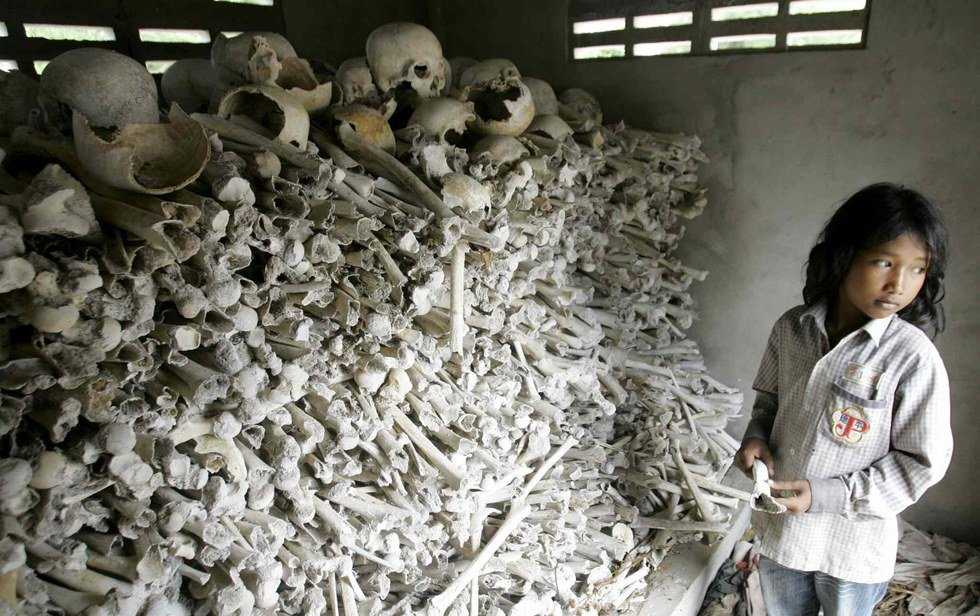
The people were led to work camps in the countryside, or what is more famously known now as the Killing Fields. Pol Pot, following in the example of Mao Zedong, wanted to initiate his own version of Mao’s great leap forward, forcing the people to engage in hard labor to produce agriculture. My mother remembers that upon arrival at the camp they separated the children from the adults. The Khmer Rouge understood that the family unit was dangerous to their socialist utopia, thus they separated families so that they might brainwash the children. My mother at the age of 11 worked from first light until the sun went down. They were fed practically nothing. Private property was abolished, as well as private ownership, so each individual was only entitled to their own spoon. Over time, my mother’s health would deteriorate. She was slowly starving to death. My grandfather, seeing his children starving, would secretly save whatever rations he had to give to my mother and her other siblings. In the dark of night, he would go out and steal from the so-called collectively owned crops, so that he might feed his children. He himself was starving and would often go days without food just to keep his family alive. Eventually he would be caught.
The night my grandfather was led away was a night my mother would never forget. The people in the village gathered around as the soldiers came to round up the enemies of Angka (the government). My mother watched as my grandfather was rounded up, blindfolded, and led away with all the other helpless victims. As he walked away, she sobbed quietly, for if the soldiers heard her express remorse for an enemy of the people, they would either beat her or kill her, too. As she watched her father being led away, she could say nothing—no goodbye, no last embrace. The Khmer Rouge had robbed her of everything: They robbed her of her home, they robbed her of her personhood, they robbed her dignity, and they robbed her of her father. Starving, helpless, and weak, she watched her father walk out her life forever.
My mother sat in that room on April 29 in silence. I do not know if that lecture would have made a lasting impact on the students in that room, but I knew that this event meant something much more for my mother. It served not as a reminder of the horrors she went through, but it served as a memorial and respect for the survivors and the dead. All the socialists and leftists in this country may choose to turn away from the atrocities perpetuated by their communist heroes, but in my family, we will never forget, we will never forgive, and we will always stand firmly against socialism.