
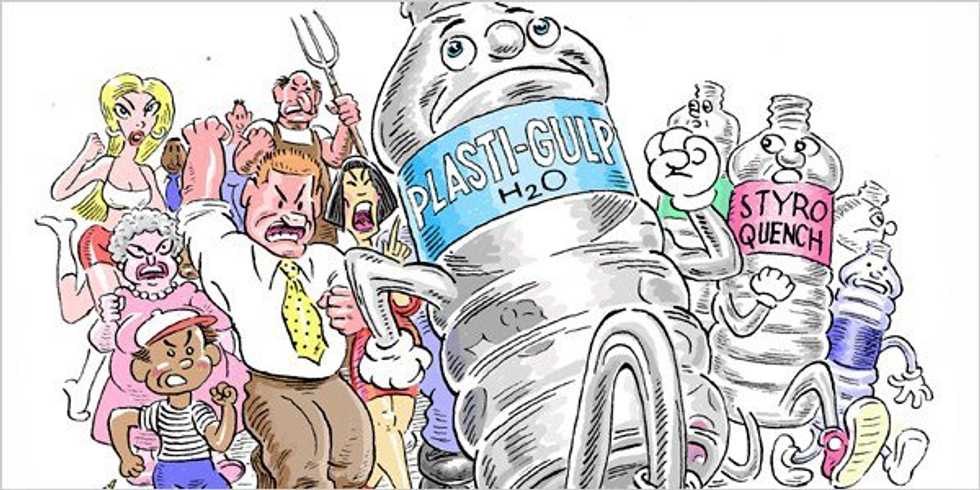
Would you spent 600 dollars on a chocolate bar? How about 3,000 dollars on a movie ticket? Unless this movie is going to spill all of life's secrets, you are probably not going to drop more that fifteen dollars on a movie ticket. So why do we consistently throw money at the inflated prices of plastic water bottles? Normally, I would take little interest in where individual's money goes. However, the purchase of water bottles is detrimental to not only our wallets, but our ecosystems. It is no secret that bottled water is over priced but the price we are paying is much more than any dollar amount.
The very creation of the water bottle is costly to our environment before it even hits the shelves. According to Banthebottle.net, the United States alone consumes around 17 million barrels of oil a year to meet our plastic bottle demands of about 50 billion plastic water bottles a year.
Now that the plastic bottle is out of production, it is time for it to make its way to the consumer. Not before charging them nearly 2000x the price of the production cost. As consumers, we love to save money where we can and often times we try. For some reason, that concept ends in the water bottle aisle. Perhaps it is the convenience or maybe a lack of knowledge. Regardless, the annual spending costs in America sits around 11.8 billion dollars, according to Statisticbrain.com.
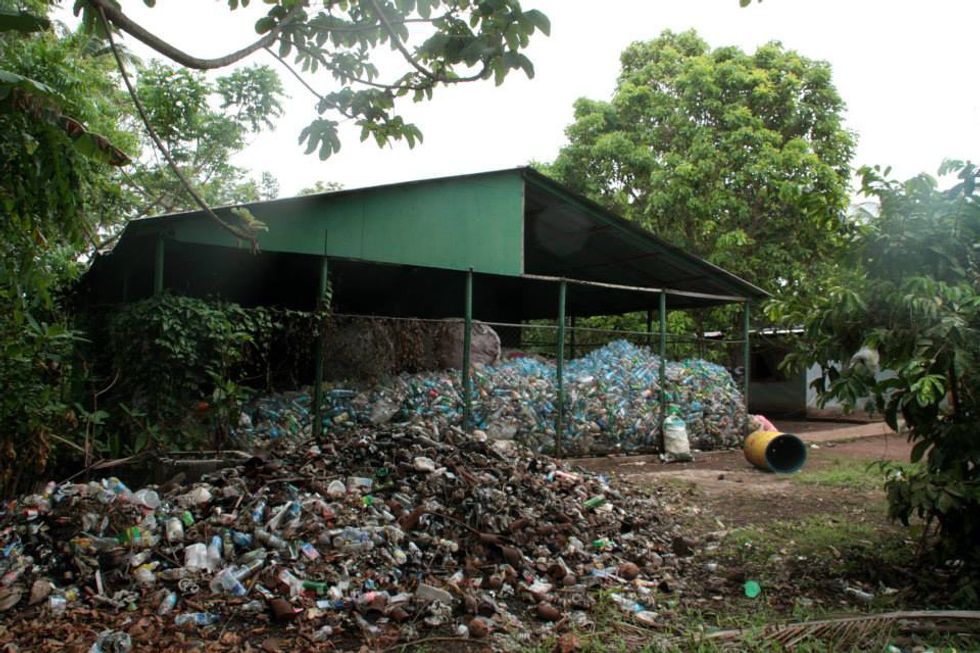
The fleeting convenience of the plastic water bottle has now ended and it must be discarded. Close to 40% of plastic water bottles are recycled (Plasticsnews.com) and many companies use large amounts of recycled plastic. This is a drastic improvement from years past. This shift in ideology offers hope but we are not out of the woods. The "Three R's" we were taught in elementary school are "Reduce, Reuse, and Recycle." Reducing and reusing are crucial but recycling seems to have taken most of the limelight. In May, I spent two weeks volunteering in Nicaragua with a group that seeks sustainability amongst many other great values. While passing an overwhelmingly large cage of water bottles for the small island of Little Corn (featured below), our guide said, "It's not a matter of recycling, it's a matter of using less." He is right. Not all of the water bottle gets recycled, if it makes it to the plant. In addition, the process of producing a water bottle, recycled or not, is not at all good or sustainable for the environment.
What, then, is the alternative? Reusable water bottles and using less. Simple and just as convenient once you get used to it. I have heard it said that it takes 21 days to break a habit. Take the challenge and try not to use water bottles for 21 days. If you break, try to use significantly less water bottles for during that time. The reusable water bottle I use is the one I received in Nicaragua to remind me of why I am using it. There are plenty of possible small incentives that don't require going to a third world country. Maybe your reusable water bottle of choice is really stylish or perhaps it is much more convenient than the plastic water bottle.
Ultimately, plastic water bottles are not only bad for the environment, but they are bad for us as well. Then again, are we not apart of the environment? The list of reasons why these water bottles are bad is endless, but the message remains the same. Challenge yourself to reduce, reuse, and recycle, while it is still a choice and not because we are environmentally cornered.