The history of the graphic novel is not necessarily an easy one to tell; there is no real origin or creator. In his book "Comic Book Nation: The Transformation of Youth Culture in America," Bradford W. Wright asserts that while, “the juxtaposition of words and images is as old as language itself” the modern comic book as it is known today is the progeny of two different literary mediums (Wright 2). According to Wright, the first forebear in the genealogy of the comic book was the pulp magazine. These were magazines designed to deliver “cheap thrills” while making “few intellectual demands” on their readership. The pulp narratives tended to exploit young Americans’ fascination with the “lurid, sadistic, and grotesque.” The other entity whose lineage Wright believes to be the structural antecedent for the graphic novel was the newspaper comic strip. These entities became “familiar daily distractions” for Americans, and would often satirize “the foibles of domestic life, social relations, and ethnicity.”(Wright 2) This, however, is a gross oversimplification of the graphic medium.
The graphic novel is not an American invention; its origins transcend nations and even the written form itself. Arguably, the first example of the use of graphic imagery is found in the Lascaux caves of southwestern France. There isn’t an accompanying transcription, but the pictorial representations of people and animals surpass the written medium. The images are, in and of themselves, universalizing in their ability to tell a story. Regardless of religious, national, or geographical boundaries, it is the essence of the graphic image that allows audiences to understand and appreciate the story. It was famed graphic novelist Will Eisner who claimed that, “an image once drawn becomes the precise statement that brooks little or no further interpretation.” (Darda 32) Eisner’s supposition is that the graphic image is indicative of the power of the graphic medium.
In her seminal work "Persepolis," French Iranian author Marjane Satrapi uses the power of the graphic image to her authorial advantage. In her piece “Perceiving 'Persepolis': personal narrative, sense memories, and visual simplicity in Marjane Satrapi’s animated autobiography”, Meghan Gilbride explores the use of “intercultural media” in Satrapi’s "Persepolis." The term “intercultural media” (as coined by Laura Marks) refers to the use of memory by “diasporic people” to connect with their “cultural and social histories.” Satrapi is an individual bound to both Iran and the West. By the time she was 24, she had lived between Tehran and Vienna before ending up in France. During her tenure in Vienna, she became acquainted with the detrimental depictions of her people and country. It was these negative depictions of Iran and the misrepresentation of its denizens that became the impetus behind Satrapi’s creation of "Persepolis" 1&2. The Graphic medium as explored by Gilbride acts to create a literary piece that “loosens” the cultural, geographical, historical, and socio-political tensions fostered between Iran and the West. The graphic novel allows creators to portray situations and images that would otherwise be engendered with negativity brought about by adverse western imagery. Using the graphic medium to its fullest extent, Marjane Satrapi’s "Persepolis" criticizes negative depictions of Iran, the patriarchy adherent in Iranian government, and the male-dominated graphic medium itself. Her use of the medium not only allows for the redaction of deleterious stereotyping, it also allows her to create a literary world not bound to anyone place. "Persepolis" may take place in 20th-century Iran, but the difficulties and experiences of Satrapi and her contemporaries are applicable to any global region.
In a film documenting the creation of "Persepolis’" animated adaptation Satrapi concedes, “'Persepolis' could not be presented in any medium outside of animation.” If the film had been adapted to any other medium, it would have come to represent the antithesis of the original work. The power of "Persepolis" comes not just from its subject matter, but its art style. Western depictions of Iranian culture tend to be more than a little unflattering. Following the abdication of the Shah, the Iranian hostage crisis, and 9/11, the region in its entirety came to represent terrorism and religious fanaticism in the eyes of the western world. “I had to try in explain to people what Iran was really like”, Satrapi stated in a 2005 New York Times article, “not every woman in Iran looked like a black bird…[and] the axis of evil included people like myself.” (Darda 31). The first panel of "Persepolis" addresses this generalization in its depiction of Iranian children. The frame as it is presented focuses first on young Marji and expands to encompass her entire class. The children are presented as a duotone image; any semblance of identity becomes lost in the uniformity of their veiled visages. The image addresses two major aspects of the novel’s construction. It acts as both a representation of female subjection under domineering patriarchy and as a means of exemplifying Western stereotyping. The veil is used by Western culture to “other” the denizens of the Middle East. It acts as a proponent of negative typecasting and removes all individuality from the people and the region.
Satrapi uses these pre-existing misconceptions as a means of juxtaposition. The characters in "Persepolis" benefit from the duotone; the exclusion of colors other than black and white excises the racial bias of a western audience. The story takes place geographically in Iran, but the lack of identifying racial characteristics acts as the universalizing agent. Marji’s story of adolescence is not inherently different from Western depictions of childhood. She idolizes action heroes, imitates the adult world she inhabits, and grapples with her burgeoning religious and philosophical identity. Duotone allows Satrapi to represent childhood in a fashion that is emblematic of the human experience. Iran is a geographic set piece, it may represent patriarchal society, but it is far from the only place in the novel impacted by sexism. The contradictory nature of Western society is its ability to address flaws inherent in other nations without addressing its own problems. Satrapi’s simplistic art style acts to address the commonalities between Western society and Iranian society. The lack of any physical ethnic characteristics paints subjugation of femininity as a global issue not just limited to Iran.
That being said, the use of the graphic medium does aid Satrapi in representing the detrimental effects of religious fundamentalism on a post-revolutionary Iran. The pictorial depictions of Iran allow for literal and symbolic representations of systematic oppression that would otherwise be lost in a written medium. The use of black increases as the influence of religious extremism ravages Iran. Black is the color of both the veil and the beards of Iranian men. Both act as agents of oppression, and remove the identities of their wearers. As previously stated, the image of Marji’s class is representative of Western stereotyping but it is also representative of the sterilizing of female individuality as brought about by Iranian patriarchy. The girls in the image look almost identical; the veil minimizes their personalities. Their angry faces come to symbolize feminine dissatisfaction and subjugation. This scene and its color pallet lay the groundwork for the oppressive imagery found throughout "Persepolis."
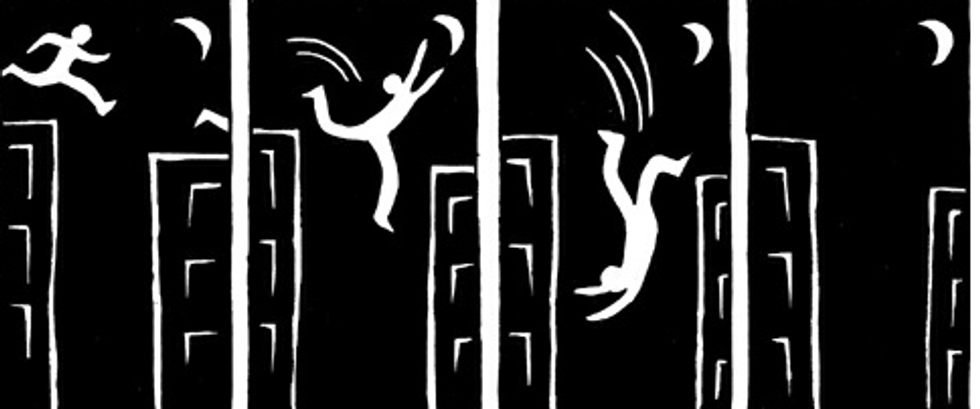
In "Persepolis 2," there is a scene in which Iranian officials storm a party thrown by one of Marji’s friends. The men present at the party are chased across the rooftops of Tehran. The chase inevitably leads to the death of one of these “revolutionaries” when one of the men doesn’t stick his landing. Throughout the entirety of this segment, there is no dialogue. There is no authorial intrusion via thought bubbles. The power of this scene comes from Satrapi’s use and understanding of mise en scene. This term is cinematic in its origins and refers to the director’s use of stage design, cinematography, and lighting. Satrapi manipulates the color pallet to represent the philosophical and religious juxtaposition between characters. Black encroaches on the scene, representing the omnipresence of the Iranian regime. The only white objects in the frame are the absconding men and the moon. While this appears to be done for superficial reasons, the implication of this choice of coloration has a number of different purposes. The moon is present and does not move from its position in the upper right corner of the frame. The crescent moon depicted implies the influence of religious extremism in Iran. The crescent is symbolic of Islamic iconography, and its unwavering placement throughout the frame represents Islam’s habitation of the region. The men are colored white to represent their rebellious insurgency.
Coloring is not the only structure manipulated by Satrapi for symbolic effect. The first three frames depict the officials in pursuit of their targets. Satrapi deliberately structures the scene to represent the discord and chaos of their organization. None of the officials are depicted at the top of the stairs, and the stairs themselves are drawn in a pyramidal fashion. The officials’ inability to reach the top of the stairs represents two things. Firstly, it is emblematic of the government’s inability to gain total control of their countrymen. Yes, the government is all encompassing but the parties held by Satrapi and her friends represent social rebellion. The pictographic representation of failed ascension is optimistic in its presentation of Iranian discord. It is also symbolic of the deceitful nature of Iran’s religious oligarchy. The stairs come to represent the religious hierarchy imposed by the Iranian government. In an attempt to impose their spiritual ideologies and raise their placement in this hierarchy these officials have betrayed their humanity and their countrymen. Their figures do not reach the top of the stairs because they are not acting out of religious duty but self-interest. This applies not just to the officials themselves but all Iranian governmental bodies. Religion is represented by Satrapi as simply another entity to control women and the Iranian populace.
Patriarchal domination is innate in every facet of global society. The graphic novel, a medium that supposedly detracts negative labeling, is inherently patriarchal in its construction. The graphic novel largely ignores the feminine sphere. When one thinks of the great graphic novelists, the names Moore, Speigelman, and McCloud come to mind. The medium is, in essence, a product of male domination. The inclusion of Satrapi in this literary canon is in and of itself a subversion of the medium. Despite not wanting to tell a feminist story, Satrapi’s "Persepolis" presents readers with a feminine representation of childhood not seen before in the medium. The structuring of "Persepolis" as a universalizing story is not just limited to its content, but to its basic framework. Satrapi is using a male-dominated art form to tell a story of repression. It is this appropriation of what has been a largely male-oriented medium that benefits Satrapi’s narrative.
Through her use of the graphic medium, Marjane Satrapi tells a story that attempts to appeal to a Western audience, criticizes Iranian patriarchy, and restructures a male-dominated medium. Satrapi has succeeded in doing what Melvin Van Peebles did for the American film industry: she’s taken an oppressive medium and made it universalizing.