
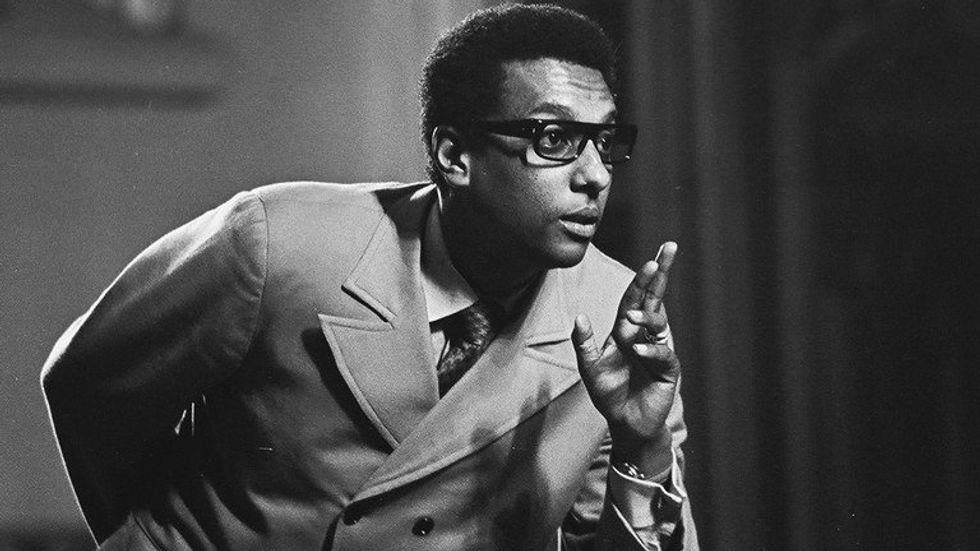
Kwame Toure, better known as Stokely Carmichael, said in his first “Black Power” speech after his release from jail for participating in the “March Against fear” March in 1966 that “It is a call for black people in this country to unite, to recognize their heritage, to build a sense of community. It is a call for black people to define their own goals.”
While Carmichael is a well-known activist from the 1960s Civil Rights Movement, with political affiliations to that of Dr. Martin Luther King Jr and Malcolm X, I only came to know of this powerful individual only two years ago. It was at one of the National Black Writers Conference and the John Oliver Killen’s Reading series events at Medgar Evers College. What started off as a mandatory event I had to attend for a class blossomed into an eventful night I would never forget. The speaker that night was Peniel Joseph, who was presenting excerpts of his book, "Stokley: A Life." As a native of Trinidad and Tobago, I had no idea who Stokley Carmichael was until that night. I sat there and was fascinated by the content of who this man was and his accomplishments, and was infuriated at myself at times because Carmichael was of Trinbagonian descent and I ashamedly did not know who he was. I left there that night with a lot of questions floating around in my mind and with a desire to know more.
Stokely Carmichael was born on June 29, 1941 in Port of Spain, Trinidad. He attended Tranquility before migrating to the United States at age 11, where he lived with his parents in Harlem. There, he attended the elite Bronx High School of Science in New York, and later enrolled at Howard University after graduation. At Howard, he was educated by professors such as Toni Morrison and Sterling Brown. During his term at Howard, he joined the Nonviolent Action Group, from which he emerged the leader of the Student Nonviolent Coordinating Committee (SNCC). He also participated in the Freedom Rides, which resulted in his many arrests. Peniel Joseph writes that Carmichael helped form The Black Panther Party, where his support of black power “instantly transformed the aesthetics of the black freedom struggle and forever altered the course of the modern civil rights movement. For Stokely, the power of ideas mattered only if they were applicable in the real world. He now defined Black Power, or political, economic, and cultural self-determination, as the vehicle for achieving radical democracy” (115). Stokley Carmichael was very vocal in his criticism of the Vietnam War, even popularizing the anti-draft slogan, "Hell no, we won't go!", during that time. Seen as a revolutionary, Carmichael became a target for the FBI. Carmichael moved to Guinea under the protection of President Séhou Touré. On November 15, 1998, Kwame Ture died from cancer in Guinea.
This is just a brief introduction on the life of Stokely Carmichael. Although Carmichael is somewhat forgotten in our history books, as we celebrate Black History Month, I encourage people to get to know the large persona that was Stokely Carmichael. To get you started, I leave you with a few of his quotes from his various speeches.
“The first need of a free people is to define their own terms.”
“The secret of life is to have no fear; it’s the only way to function.”
“There is a higher law than the law of government. That’s the law of conscience.”
“Our noses are broad, our lips are thick, our hair is nappy-we are black and beautiful!”
“We are revolutionaries.”