


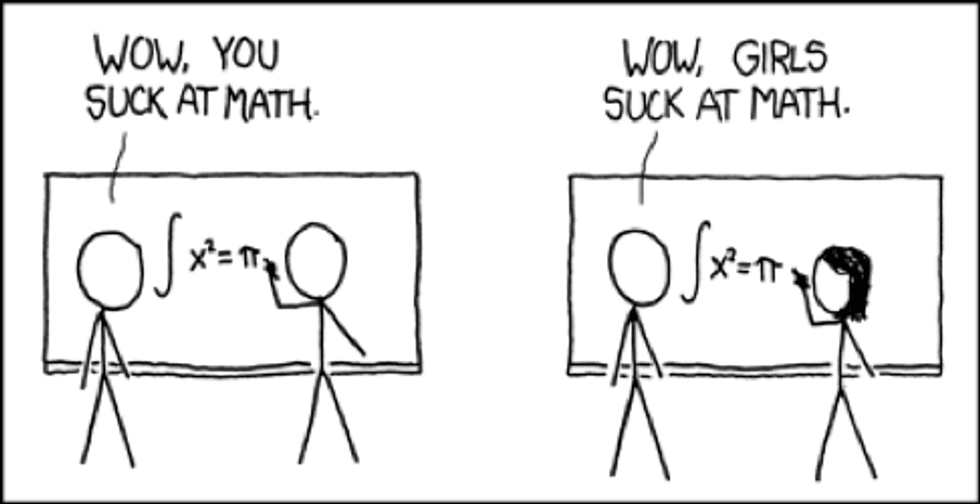
As an African-American female pursuing a major in biology and a minor in chemistry, I always feel obligated to make sure others like me have the same chances I do. Recently, there's been a call for more women to work in STEM (science, technology, engineering, mathematics/medical) fields. The problem isn't that women are less interested in these fields; it's that men are usually prioritized when it comes to them. I'm sure you can't remember how many times you've heard a girl say that they're bad at math. In truth, society has been telling them their whole lives that they should be bad at math. It's things like this that drive the gender wage cap and enforce stereotypical gender roles.
The division in interest for STEM fields for women usually begins in college. Statistically, up until college, females take the same math and science classes as their male classmates, and perform well, but males are more likely to take engineering and physics classes. However, these gaps persist in low income and minority students, who may not have access to schools that offer these classes. In undergraduate courses, more women pursue degrees in biological studies, with race disparities becoming more apparent. In 2012, only 11.2 percent of bachelor's degrees were given to minority women. Despite this, half of STEM degrees were awarded to women.
In the workforce, women are definitely underrepresented, though the greatest disparities occur in fields like engineering, computer science, and the physical sciences. Women make up 47 percent of the workforce, and are very disproportionately represented in particular science and engineering occupations. Usually less than 50 percent of women make up each field. For example, 39 percent of chemists are women, and currently, one in 10 workers in science occupations are minorities.
So, how do we get more women into STEM fields?
Better resources! Obviously, this is up to the government. But all students, especially low income students, need better resources. I was lucky enough to go to a high school that offered AP science classes, but I know for a lot of other people, they don't have these opportunities until they go to college. Even then, my high school didn't offer any specific medical classes other than the typical physical science classes. And honestly, if it wasn't for a really good biology teacher, I would've never considered being a science major, despite wanting to go into medicine.
One study said that most women don't feel welcome in STEM classrooms because they are male dominated. There's also a lack of role models for women. Women need a comfortable environment in which to pursue their interests without feeling pressure or intimidation. Yes, there are some female scientists, but women like Rosalind Franklin are usually overshadowed by male counterparts "male-washing" the sciences. Women who are pursuing careers in STEM fields should encourage younger girls (especially minorities) to start taking all of the science classes they can!
Sources:
https://ngcproject.org/statistics
http://www.aauw.org/2015/03/26/add-women-engineeri...
http://time.com/3835310/girls-stem-school/