

This week, the world has seen many terror attacks, most of which are not being covered by major news sources. ISIS has claimed responsibility for many of these attacks, which has fueled the debate surrounding how to best protect our country.
Though a wave of terror attacks is typically a sign of a growing terror group, in this case it might indicate some weakness in ISIS. This is not to say that the attacks over the past week are any less tragic; in fact, they are incredibly lethal, leaving 300 dead. Weakness is peaking through in that these attacks show that ISIS is failing to achieve one fundamental goal to their organization: become a state.
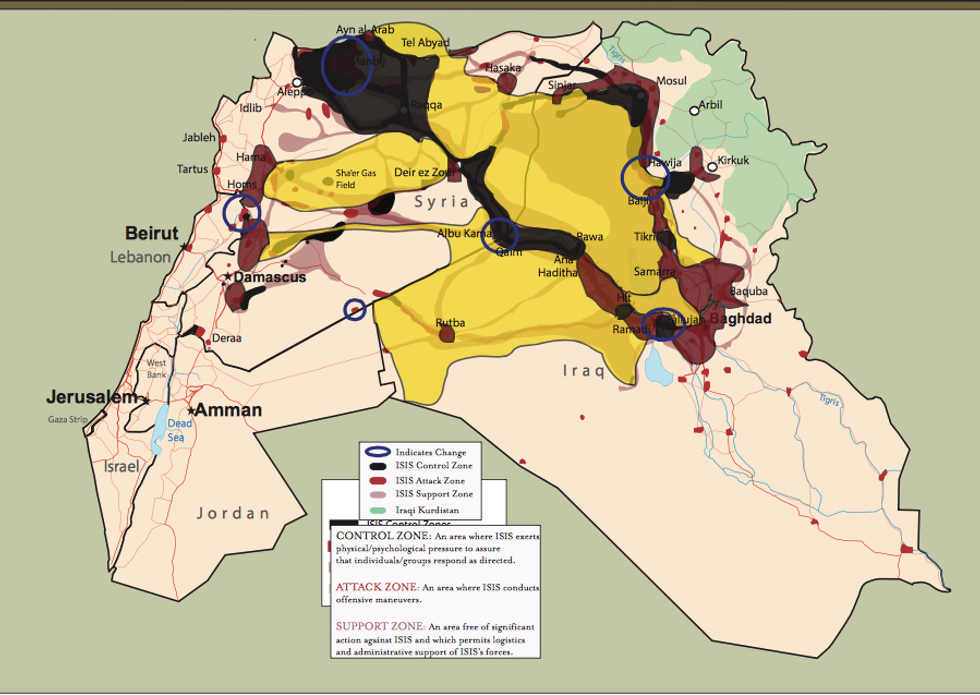
ISIS has been losing territory, and lots of it. ISIS was present at 126 points across the Middle East at the height of its momentum. Now, ISIS has lost power, or has been forced out of nearly half of these strategic locations. A big win for the forces fighting ISIS include Iraq reclaiming Ramadi in January of this year. Many countries, including Syria, are fighting to reclaim many cities that have been infiltrated by ISIS. Currently, ISIS is focusing on maintaining territory on the Turkish border, as this land serves as a point of international transfer for ISIS forces. ISIS is referred to as the Islamic State, though the attacks that violate Islamic holidays and values prove that they are not loyal to Islam, and their lack of territory shows that they are no state.
In addition, losing territory means that the terror group makes less money, limiting their ability to grow. When ISIS takes over a city, they take all the taxes paid to that city or local government. This is a major source of income for the terror group which is taken away as countries reclaim their territory.
It is encouraging to think that ISIS may be falling to weakness, though less obvious ISIS-lead actions are creating great strife for young women. A startling development in funding ISIS, is the use of smartphone apps to facilitate selling sex slaves. Currently, about 3,000 Yazidi women and girls are being held as sex slaves by ISIS or groups in support of ISIS. Even children have been sold, for example, in one case a child was sold over WhatsApp for $3,700. Until recently, aid groups have been able to consistently free about 134 women per week, though escape and rescue has become more difficult.
Mirza Danai, the founder of the German-Iraqi aid organization, says, “They register every slave, every person under their owner, and therefore if she escapes, every Daesh control or checkpoint, or security force - they know that this girl ... has escaped from this owner.” Yazidi women and girls are targeted specifically because of their faith. Yazidi faith is a mix of several religions including Christianity, Islam, and an ancient Persian religion called Zoroastrianism. Though the application WhatsApp has been confirmed as being used in this process, privacy policies are stalling any action to stop this sex trade.