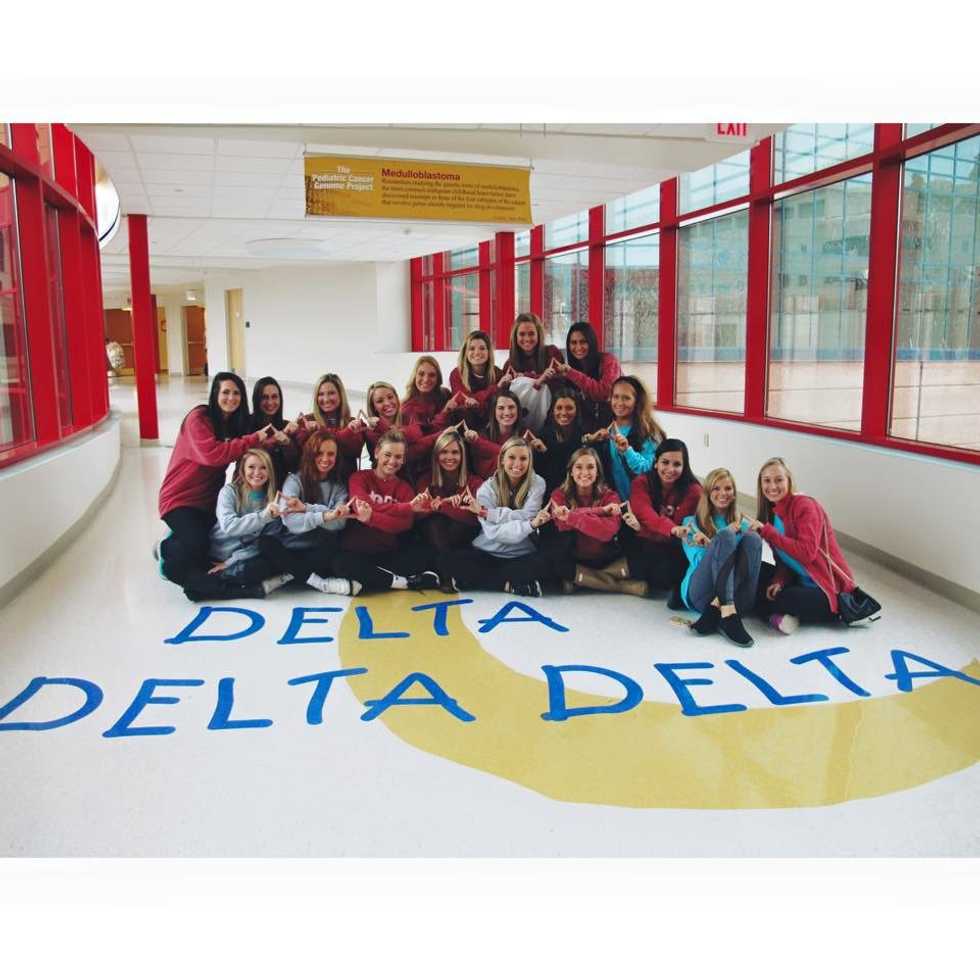
On Feb. 20, 110 women of the Delta Xi chapter of Delta Delta Delta spent 6 hours on a bus to Memphis, Tenn. to visit the St. Jude Children's Research Hospital, their philanthropy. The group of girls began their trip at the Danny Thomas-ALSAC Pavilion where they got to read the history of St. Jude and Danny Thomas and look at pictures from throughout the years. They also had the opportunity to make cards welcoming families to Tri Delta Place. Tri Delta Place serves as the primary short-term stay (1-7 days) facility and has the capacity to hold up to 100 families per night. When families arrive at St. Jude Children's Research Hospital for treatment, Tri Delta Place is the first place they will stay and is just steps from the hospital's front door. Absolutely everything from housing, to food, to deodorant is paid for by St. Jude, which requires $2 million a day to run. Many of the details of the decor have to do with the symbols and traditions of Tri Delta such as the use of pansies, pearls and deltas.

Freshman Molly Rothhaas said, "It was really amazing to see how much Tri Delta truly impacts St. Jude. I mean I had no idea that when we would walk in, there would be representations of Tri Delta everywhere. The walls, the floors, furnishings, [etc.] all had a touch of Delta Delta Delta and it was really humbling to see that our hard work goes to something so important, and we are representing something so amazing. It was also really cool to see all the little kids enjoying themselves, even in a rough time, in something we helped create."


After the tour of Tri Delta Place, the women were able to shop in the Gift Shop where, at checkout, they could round up their total to donate to St. Jude.
Then it was time for the four-hour hospital tour to begin. The girls were split up into groups and got to tour the hospital with a guide who explained different stories about clinics, blood donation centers, different donors and stories of their experiences within the hallways of the hospital. There were murals all over the walls giving the hospital an extremely positive vibe, very full of hope and happiness. The patients we saw pass through the halls were all smiling, as if they didn't care about the battle they were fighting and just knew they were in the right place.


Junior Lexi Beussink said, "It was a humbling experience actually seeing and visiting St. Jude. It made me realize and understand where all our fundraising is going to. It makes me happy knowing how big of an impact our philanthropy has and that it helps so many families."

We learned about many things that go on in the hospital, such as the art contest that the teenage patients get to participate in every year, the arcade in the clinic area and the teen room that is only available to patients between the ages of 13-19 and no one else. It was really amazing to see how the hospital caters to every need of their patient such as mental health, normal illnesses, and even their happiness and well being in general, not just their disease.


Out of the five executive chefs in Memphis, three of them are employed at St. Jude. It is extremely important that the patients are getting all of their nutrients during treatment so these chefs are trained to make the food healthy but tasteful so the patients will want to eat, because sometimes it is hard to keep down the food. Our tour guide even told us that some of the younger patients had issues getting all of their nutrients in, so the chefs came up with the idea to put vitamins in their gummy worms and to use them as a gelato topping. (But, shh don't tell the kids that!)
The tour guide said you have to be aware of the little moments that happen within those walls. She told us a story of a young patient who was sitting with another patient who looked sad and he asked, "How have you been feeling?" and the other patient replied, "Not good, I haven't been feeling well today," and the other patient replied, "It's okay we'll get through this." Our tour guide said it was hard for her to not tear up at the little small talk she overheard between two young kids who were wise beyond their years because of what they were going through.
We were also guided to the bust of Danny Thomas. His nose is gold, different from the rest of his body, because so many people rub his nose for good luck much like the nose of David R. Francis's bust that is placed on the quad on Mizzou's campus. When we looked above his bust, there were flags from many different countries. Each flag represents a country that a St. Jude employee came from. The flags have to be rearranged regularly because of rules that different countries have about whose flag can be next to who, whose flag can be hung above a certain country or when 2 countries are in conflict.


All of this came as such an incredible experience to us college women. It made us so much more motivated to raise money for the children of St. Jude and it was awesome to actually get to experience in real life where our money is going to. The amount of time we spend each year fundraising is so worth it considering we couldn't walk through the hospital without seeing a smiling patient or a doctor or nurse throwing up the delta as we walked by. Mizzou Tri Delta's goal of raising $111,000 this year will get the world one step closer to putting and end to pediatric cancer for good. I know I'm not just speaking for myself when I say that this trip has given a whole new meaning to the word philanthropy and St. Jude.
Junior Nursing major Ciera McNabb said, "Visiting St. Jude gave me motivation for my future as a nurse. Seeing how much the hospital and staff impact the lives of every child makes me hopeful that I can do the same one day for many patients. St. Jude is not just a home for these children but a journey of faith and strength and I was so honored to witness some of that."
Overview of St. Jude Children's Research Hospital
Then: St. Jude Children's Research Hospital was developed because of a prayer that Danny Thomas, a struggling entertainer, asked to St. Jude Thaddeus, the patron saint of hopeless causes. He said, "Show me my place in life and I will build you a shrine." His promise to St. Jude became St. Jude Children's Research Hospital and the answer to the prayers of so many families from around the world whose children are battling deadly diseases.
Now: More than 50 years after opening, St. Jude has helped improve the survival rate of childhood cancer from 20 percent to 80 percent. Acute lymphoblastic leukemia which used to be basically a death sentence back in 1962 now has a survival rate of 94 percent. The work here is not even close to being done.
Future: The future of this amazing hospital is so bright and they continue to cure children and give them a second chance at life. Individualized therapies and mapping the pediatric cancer genome are two projects being developed to help put an end to pediatric cancer in the future because no child should die in the dawn of life.

To donate to St. Jude Children's Research Hospital, you may go to this link.