


Trust is one of the most important and prominent cornerstones of human interaction. Scottish author and Christian minister, Chris MacDonald, once said “To be trusted is a greater compliment than being loved.” Without it, there are no friendships or relationships. No shoulders to lean on or shoulders to cry on. And when it is broken, or abused, people fall apart, leaving a piece of themselves behind never to be picked up again.
I can only imagine this is how victims of child molestation feel.
On January 6, 2002, the Boston Globe released a newspaper that would forever change not only the city of Boston, but the entire religious world - its headline: “Church Allowed Abuse by Priests for Years.” The story’s author, Michael Rezendes, a reporter for the Globe’s investigative “Spotlight” team, sparked such a powering turmoil that by the end of the year, the Archbishop of Boston, Cardinal Bernard Law, stepped down from his position.
Tom McCarthy’s Spotlight (which he co-wrote the screenplay for with Josh Singer) tells the story of that investigation. Spotlight is an excellent newspaper movie. The film follows an already established format used by some of its predecessors, like Robert Redford’s Academy Award winning All The President’s Men, which is about the Washington Post’s investigation of the Watergate scandal. The problem in using this form is that filmmakers can run themselves into cliches. Towards the end of the film, there’s a tired out sequence that shows the newspapers with the “Spotlight” articles being printed. Through the machines, they move up and down and side to side, until finally ending up in their own cubicles, ready to be shipped away. But the unoriginal scene can be forgiven as it is also an emotionally powerful moment for the characters and the audience - the “Spotlight” team’s work is finally going to be released, and with it, the truths and evils that had remained hidden for years.
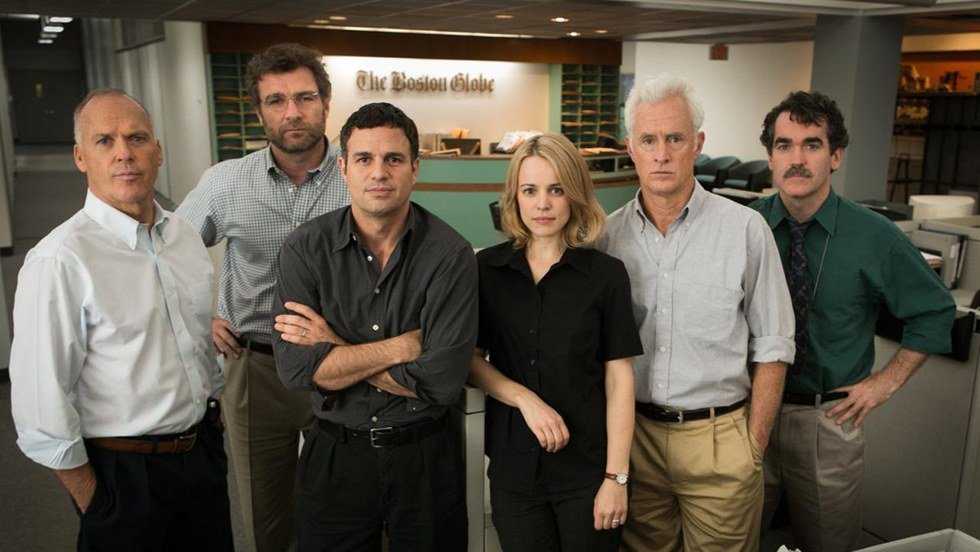
The “Spotlight” team consists of editor Walter ‘Robby’ Robinson (Michael Keaton), and writers Mike Rezendes (Mark Ruffalo, Oscar-nominated performance), Sacha Pfeiffer (Rachel McAdams, Oscar-nominated performance), and Matt Carroll (Brian d’Arcy James). John Slattery plays Ben Bradlee Jr., another editor for the Globe, but not a member of “Spotlight.” All of them are Boston locals, each with some kind of personal connection to the Catholic Church. The only character without that connection is the Globe’s newest editor, Marty Baron (Liev Schreiber). Baron is a Jewish man who has worked all around the country, and for that, he is considered an outsider. After reading a column by one of the Globe’s staff writers about an abuse case, Baron tells Robby to set aside his team’s current assignment and begin working on the other case. Aside from Rezendes, or even perhaps more than Rezendes, Baron is the most important person to the success of the investigation. His unbiased stance on the Catholic Church not only initiated the newspaper’s inquiry, but kept it going.
After spending their time focusing on one former priest, John Geoghan, who had allegedly molested several children years ago, the “Spotlight” team is reminded by Baron that this is a much bigger issue than just one case. He tells them they’ll make a lot of noise, but won’t change things one bit. “We need to focus on the institution, not the individual priests.” He says go after the system.
From that moment on, “Spotlight” scatters across Boston, interrogating lawyers, raiding archive files, and finding “survivors” (titled this because many people who were abused turned to drugs, alcohol, and in some circumstances, suicide as they got older). Rezendez and the McAdam’s character, Sacha, are the ones that actually go out to the streets to interview victims. Some are welcoming. And others are not. One person, an openly gay man named Joe Crowley, described to Sacha his experiences with a priest as a young boy. He tells her the reason why he did all these things “to some creepy guy whose thirty years older than [him]” is that the priest was the first man to tell him that it was ok to be gay, and he was a priest, a likeness to God. When Sacha asks Joe if he ever told anybody about this, he sarcastically replies “Like who? A priest?”
Another man, Paul Saviano, explains to “Spotlight” that to poor kids and poor families, religion is a big deal. And when an underprivileged kid is given special attention by a priest, it’s something special. The priests then use that power to groom the children into sex slaves. They use the collar to rape children. “How do you say no to God?”
As their research continued, the “Spotlight” team discovered almost 100 priests in the Boston area had molested children.
Two worlds were changed in 2002 - the journalism world, and the Catholic world. The film and its screenplay do an excellent job in their depiction of the deception brought upon not only the victims, but the unsuspecting Catholics all across the world. The film does take faith, and loss of it, very seriously. At one point, Rezendez has a conversation with Sacha about how the story has affected them. She tells him that she stopped going to church with her grandmother because she couldn’t restrain herself from anger. “It really pisses me off.” He replies. “I actually really liked going to church when I was a little kid...I figured that maybe one day, I would actually go back. I was holding onto that. And I read those letters, and something just cracked.”
Spotlight will be remembered as an important film, not for its acting, and not for its script, but for how persistent it is in displaying and attacking its central problem. At the end of the film, before the final credits, there is a list of places around the world where major abuse scandals had been discovered. As the names continues to unwind (it feels like it will never end), the audience is torn apart as they see places they’ve been to, or maybe even places they’ve lived up on the screen alongside the horror they’ve witnessed for the past two hours.