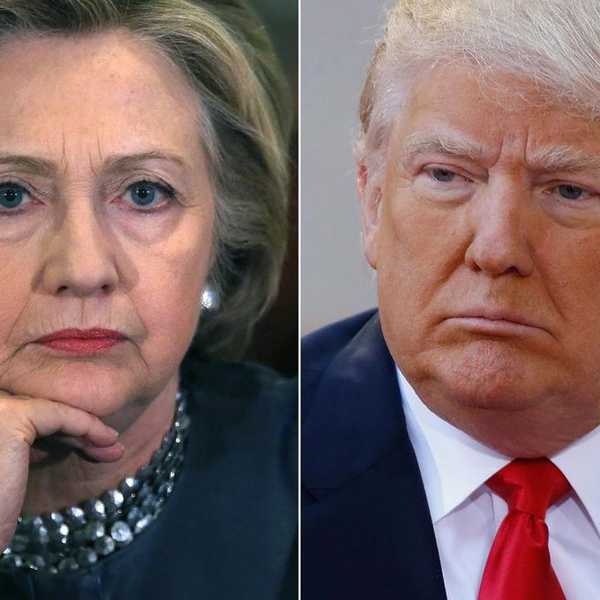
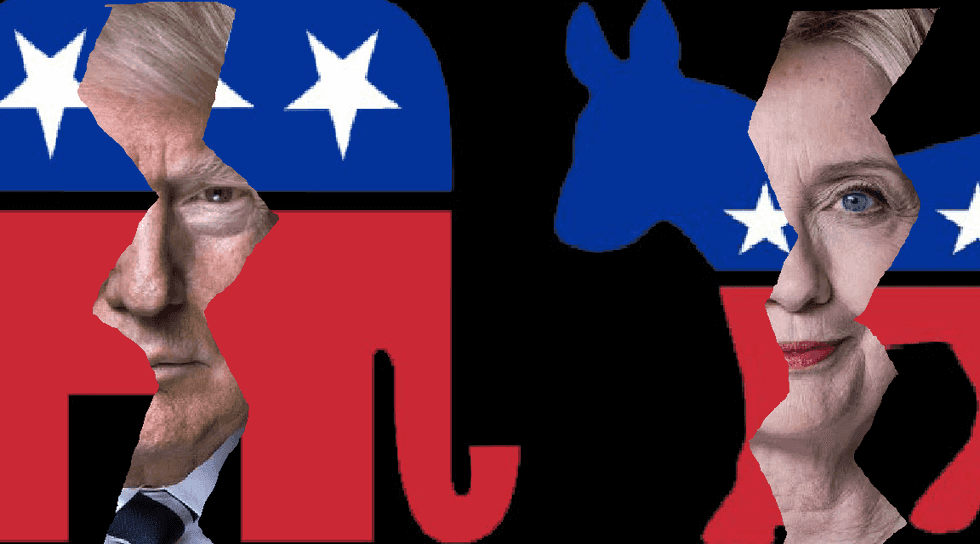
As the 2016 election approaches, the divides within the two major American political parties is hard to miss. Senator Ted Cruz, the runner-up for the Republican presidential nomination, refused to endorse Republican Candidate Donald Trump upon the latter’s nomination; while at the Democratic National Convention, Hillary Clinton’s nomination was protested by liberal supporters of the Democratic runner-up, Bernie Sanders. According to Gallup, the conventions themselves did not change how the country views its political parties: they did, however, reveal a lot about where each party faces division.
At the Republican National Convention, on the day of Trump’s nomination, challenges arose from within the party: besides Cruz’s refusal to back Trump, the GOP appeared to face issues in gathering speakers and persons of political prominence to speak at the convention. Speakers did include several of Trump's former rivals in gaining the nomination, as well some current and former Republican leaders: however, compared to past Republican National Conventions, the political representative numbers were small. Perhaps most notably, the Convention’s speakers did not include any past Republican presidents or presidential nominees. Of the former, none even attended the convention. Lacking political support, the convention turned to celebrities and Trump family members for speakers.
As the party itself stands divided and donors grow wary of Donald Trump, the man they pledged to back, the voting Republican public still leans in his favor. While at first glance, Trump’s 69 percent favorable rating among Republican voters may seem less than ideal, his favorable rating is 6 points higher than voter approval of the Republican party overall (63 percent favorable). Also important to note is that the entire country’s approval of the GOP has not seen notable change in light of Donald Trump’s recent rise to political visibility: the Republican party is currently viewed as favorable among 36 percent of American voters (before convention: 37 percent), compared to 35 percent in July of 2015. While this does not mean that the Republican Party is not experiencing divisions among its voting population (in fact, its fairly low favorable ratings prove the opposite), it implies that its candidate might not be entirely to blame.
The Democratic National Convention, and its nomination of Hillary Clinton, tells a different story. Unlike at the RNC, the DNC’s speakers included the current Democratic President, Vice President, and First Lady, as well as rival Bernie Sanders. Unlike that of the Republican Party, the Democratic Party’s runner-up in the race for the nomination declared his support for the official nominee. Clinton apparently has the unmitigated support of the Democratic Party itself, a fact bolstered by the convention.
Clinton’s convention struggles came from the Democratic voting population. Her nomination saw protests ranging from boos to marches, both within the convention and in Philadelphia as a whole. Notably, these were not conservative-led protests, but were instead demonstrations led by “Bernie-or-Bust” liberals who strongly oppose Clinton and refuse to shift those views in the aftermath of Sanders’ loss.
The Democratic public reflects that atmosphere in the polling: while 80 percent view the party favorably, only 74 percent view Clinton favorably. While these numbers are still higher than those seen by the Republicans, it highlights a major issue faced by Clinton’s campaign, especially as her unfavorable rating among the entire American public remains high at 51 percent.
Trump is more popular among people who view the GOP favorably than Clinton is among people who view the Democratic Party favorably, while Clinton is more popular within her respective party itself. This means that the GOP is internally divided over its candidate, while Democrats mostly face candidate-fueled strife externally, in the blue-leaning public.
Further, a Gallup poll released on Friday evening reveals that regardless of Trump’s and Clinton’s favorable or unfavorable ratings, many voters wish their respective parties had nominated someone else. Just over half (56 percent) of Democrats are content with Clinton’s place as nominee, while less than half (46 percent) of Republicans arehappy with Trump. These figures differ from those for favorable ratings, as they take into account preference and not simply approval in the absence of another choice.
What all of this information means is that the third-party candidates in this election are likely to play a huge role in its outcome: most notably, Libertarian candidate Gary Johnson. While a Libertarian or other third-party victory (i.e., for Jill Stein of the Green Party) remains extremely unlikely, the Libertarian Party, which runs on a socially liberal and fiscally conservative platform, is on track to be on the ballot in every state, which is unusual for a non-major party and which will allow its nominee to receive more votes that would otherwise have gone to Clinton or Trump.
This leaves many dissatisfied potential voters with four options: vote along party lines regardless of the nominee; abstain from voting; vote for the candidate of the opposite major party; or vote for a third party candidate. According to historical voting trends, most will likely choose one of the first two choices. However, some (and likely more than usual) will choose to vote third party.
Polls have shown that, when Libertarian Gary Johnson is introduced (as opposed to a poll offering only Trump and Clinton as choices), Clinton loses more supporters than Trump. Some reasons for that may be:
- Republicans who strongly oppose Trump would choose Clinton when the two are head-to-head, but prefer the more conservative (if mostly fiscally) Libertarian platform to the Democratic platform.
- Given the discrepancy between Democrat voter approval of the party and of its candidate, more Democrats likely felt the initial need to vote along party lines in order to stop Trump. With another option presented, they may have felt drawn to it do to their disapproval of Clinton.
- The many Republicans who view both the GOP and Trump unfavorably may not have supported Trump even in the absence of a third party, and so they were not present for Trump support to begin with.
If these trends continue to November and beyond, the American political system may find itself at the precipice of a major change. Although the third-party numbers are not yet strong enough for any one of them to become a major party in this election cycle, the present strife within the two major parties may pave the way for that rise as a possibility in the future. Contemporary American politics are standing on shaky and publicly unfavorable ground and change, regardless of its manifestation, appears to be coming.